

Every good marketing strategy incorporates some form of content — and thoughtful marketers always back up their content marketing strategy with targeted content marketing KPIs.
A key performance indicator functions as a compass for your content efforts. They are detailed and specific objectives that keep you focused and on track as you work toward your larger content marketing goals.
The question is, what are good KPIs in the context of content? What metrics and benchmarks should you track to see if your content is performing? Let’s consider some of the tools that you can use to measure content effectiveness and what KPIs you can set within those tools to better direct your content marketing.
What our client team is seeing today – March, 2026
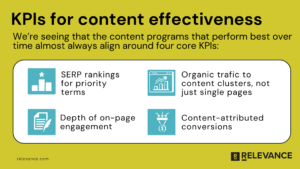
From our own client work right now, we’re seeing that the content programs that perform best over time almost always align around four core KPIs:
-
SERP rankings for priority terms – Tracking rankings and search impressions for a tightly defined set of keywords still gives the clearest signal of whether your content is gaining or losing organic visibility.
-
Organic traffic to content clusters, not just single pages – Looking at organic sessions into topic clusters (and not only “hero” posts) is much more predictive of durable growth than chasing one-off spikes from single articles.
-
Depth of on-page engagement – Time on page, scroll depth, and internal click-throughs to related content are proving more useful than raw pageviews as search and social algorithms shift what a “view” really means.
-
Content-attributed conversions – Whether you’re using last-click, assisted conversions, or multi-touch models, tracking the specific forms, demos, trials, signups, or sales that content helps drive is where we see the strongest correlation with revenue.
From our experience running growth, SEO, and PR campaigns, the clearest pattern is this: when SERP rankings, organic content traffic, deep engagement, and content-attributed conversions are all trending up together, content is almost always driving meaningful business impact; when even one of those four lags, overall performance plateaus or declines.
We’re also seeing a shift away from vanity metrics. Metrics like total pageviews or social impressions still have a place, but they’re increasingly used as context around these four anchor KPIs rather than success metrics on their own. Teams that re-center reporting on this smaller, outcome-oriented KPI set make faster decisions, pivot content more confidently, and can defend their budgets much more easily.
What top content experts are saying today
Current industry leaders are largely aligned on two themes: you should track a focused set of KPIs, and those KPIs must map directly to business goals rather than vanity numbers.
Content Marketing Institute stresses that measurement is both essential and difficult, noting that many marketers still struggle to integrate data across platforms and that “just because you can measure just about anything these days, doesn’t mean that you should.” Their guidance is to understand what each metric really tells you, then narrow in on the few that best represent business impact.
Recent frameworks from WordStream and Planable echo this, urging marketers to pick KPIs based on specific campaign goals (brand awareness, lead generation, conversions, or engagement) and treat them as a “compass” for the content strategy rather than tracking every available number. In practice, they highlight metrics like:
-
Brand visibility KPIs – impressions, organic traffic, pageviews by content type, backlinks, referral traffic, and subscriber/follower growth.
-
Engagement KPIs – average session duration, time on page, scroll depth, social likes/comments/shares, and meaningful onsite interactions such as comments or content saves.
-
Conversion & ROI KPIs – lead volume, conversion rate from content, revenue generated or influenced by content, and overall content marketing ROI. Several experts frame ROI as the “ultimate” proof that content is working because it connects content directly to business growth.
Experts also consistently argue that high-quality content should change behavior, not just generate views. Joe Pulizzi, often called the “godfather of content marketing,” has famously said that “good content marketing makes a person stop, read, think, and behave differently,” underscoring why conversions and actions matter more than surface-level reach.
Taken together, today’s leading voices are pointing in the same direction: align your KPIs with specific business objectives, emphasize organic visibility, engagement depth, and conversion/ROI metrics, and resist the temptation to chase every possible number just because your tools can report it.
Our favorite tools to measure content marketing performance
There are many tools that can help measure the impact of content. The most well-known of these is Google Analytics. This is a content tool that can track various content on your website. You can see how users interact with your content, from the number of visitors to how many pages they visit and even how long they spend on those pages.
Google Search Console is another Google product that is a powerful tool in the hands of a marketer. It provides further insights into website traffic and can help with optimizing things like SERP rankings and other technical SEO decisions.
Of course, there are more tools besides Google’s admittedly impressive content-tracking software options. For instance, third-party tools like SEMrush, Ahrefs, and Moz all provide their own flavor of content insights.
In addition, many marketing content platforms provide their own in-house analytics. Email platforms like MailChimp and Constant Contact provide reporting analytics dashboards. These show things like open rates and click-throughs. Most social media sites have similar native analytics options, such as Facebook Pixel and Twitter Analytics.
Each of these tools helps you track and observe data. But if you want that data to be effective, you need to know what metrics are worth tracking. Let’s consider a few KPI examples that are particularly worth keeping an eye on if you want to gauge the effectiveness of your content.
KPIs that we use to measure content effectiveness
There are many different content marketing metrics that you can watch when it comes to content. Each one provides a different value. For instance, tracking the amount of time a person spends on a page can help you decide if your content is answering the searcher intent of those who are finding it through the SERPs.
With that said, there are a few statistics that are particularly relevant to optimizing content performance. Here are four of the best KPIs to track content marketing success.
SERP rankings for content visibility
Your ranking in the SERPs is one of the most obvious KPIs that indicate your content is doing well. Search engine results pages are the digital equivalent of physical foot traffic. If your valuable content is tucked way down on the SERPs, it isn’t likely the consumers you created it for are going to find it.
To boost your SERP rankings and build brand awareness, you want to consider the utility and purpose of your content marketing strategy. Who is it for? How does it help them? The better you can address these factors, the more likely your content will resonate with its intended audience and the more likely they’ll be able to find it in the SERPS.
It’s a good idea to keep Google’s E-E-A-T content standards in mind when considering SERP rankings. E-E-A-T stands for Experience, Expertise, Authority, and Trustworthiness. If your content satisfies the E-E-A-T standards, it’s more likely to perform well.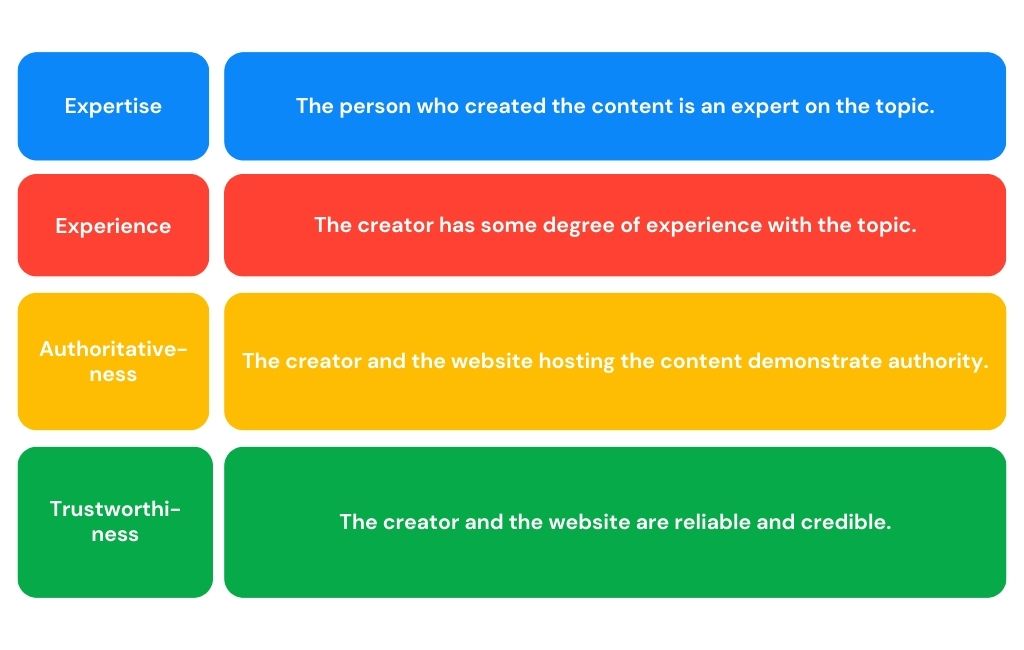
Site traffic for organic synergy
Showing up in the SERPs is a good start. But, as a content marketer, you also want people to click through to your website.
This generates traffic, which builds synergy across your website. The more people click through to your site, the more likely Google is to move it higher in the search rankings. This makes it more likely to generate traffic, creating a repeating cycle of benefits.
It’s important to note that we’re talking about organic traffic here. You can pay for traffic through things like pay-per-click ads, but paid campaigns are limited in scope and can be very expensive.
Quality content that answers customer pain points should generate organic website traffic all on its own. Tracking that metric ensures it is actually doing so.
User engagement for content impact
It’s great for your content to show up in a search engine and even for consumers to click through. But to truly be effective, it should spark action, as well.
When consumers engage with your content, you know it’s performing. Members of your target audience are finding what they need, and it’s prompting them to interact with you and, ideally, proceed further down your sales funnel.
Engagement metrics can take many different forms and can occur both on and off of your website. Onsite engagement could be signing up for an email form or requesting a demo. Offsite engagement could be clicking through an email or commenting on a social media post.
Whatever form it takes, it’s worth tracking to see if your engaging content is resonating with its intended audience.
Conversions for true performance
The most powerful KPI of all is conversion. This is when a consumer takes a specific action that you’ve defined as important.
Conversions often overlap with user engagement. However, they are also more detailed and important to your specific marketing goals.
For instance, a customer clicking through a link in an email may be engaged. But if they request a demo or sign up for a newsletter, that may be an action that you’ve identified as particularly important.
You can create conversions that are unique to your marketing needs in Google Analytics. Tracking these is a great way to gauge if your content is not just performing but doing so in the specific areas you need it to.
How to find the right KPIs for your content
As you identify your target audience, create timelines, and otherwise map out your content strategy, remember to keep content metrics in mind. Partnering with the right content marketing agency can help ensure these metrics are being tracked correctly and consistently. Setting the right content KPIs gives your content marketing efforts a greater impact by ensuring that they are delivering the results that you’re looking for.
Even if they aren’t performing well, good KPIs help you identify shortcomings quickly so that you can pivot and make adjustments where necessary. They are a powerful and necessary tool for any content marketing campaign.
How we wrote this article
For this article, our growth marketing, SEO, and PR team pulled directly from the dashboards we live in every day — GA4, Google Search Console, CRM and marketing automation reports — to isolate the KPIs that actually get discussed in real client reviews, not just listed in strategy decks. We pressure-tested the usual suspects (traffic, rankings, engagement, conversions, ROI) against what we see move pipeline, revenue, and brand lift in ongoing campaigns.
From there, we cross-checked our short list against fresh guidance from leading industry sources on content measurement and KPIs, including recent frameworks and research from Content Marketing Institute, WordStream, Planable, Entail AI, and others. That combination of in-the-weeds client work plus outside expert perspective is what shaped the four “anchor” KPIs we highlight in this piece: SERP visibility, organic site traffic, meaningful engagement, and conversions tied back to content.
Throughout, we focused on practical benchmarks and examples you can realistically pull from common tools (GA4, GSC, email platforms, and social analytics) so that any KPI we recommend is something your team can actually measure and optimize week to week.
