

If you are wondering why your brand ranks well in Google but barely shows up in ChatGPT, Gemini or Claude, you are not alone. We hear this weekly from CMOs who did everything right by classic SEO standards. Solid backlinks. Clean technical foundation. Content that converts. Then they ask an AI tool a question squarely in their category and a competitor gets named instead.
Here is the uncomfortable truth. AI visibility is not just about what you publish. It is about how clearly you explain your own site to machines. And internal linking is one of the strongest signals you control.
This is not theory. We have watched internal linking changes shift brand mentions inside large language models in under ninety days for B2B and ecommerce clients. No new backlinks. No viral content. Just clearer structure.

- Screenshot
Why AI models care about internal linking
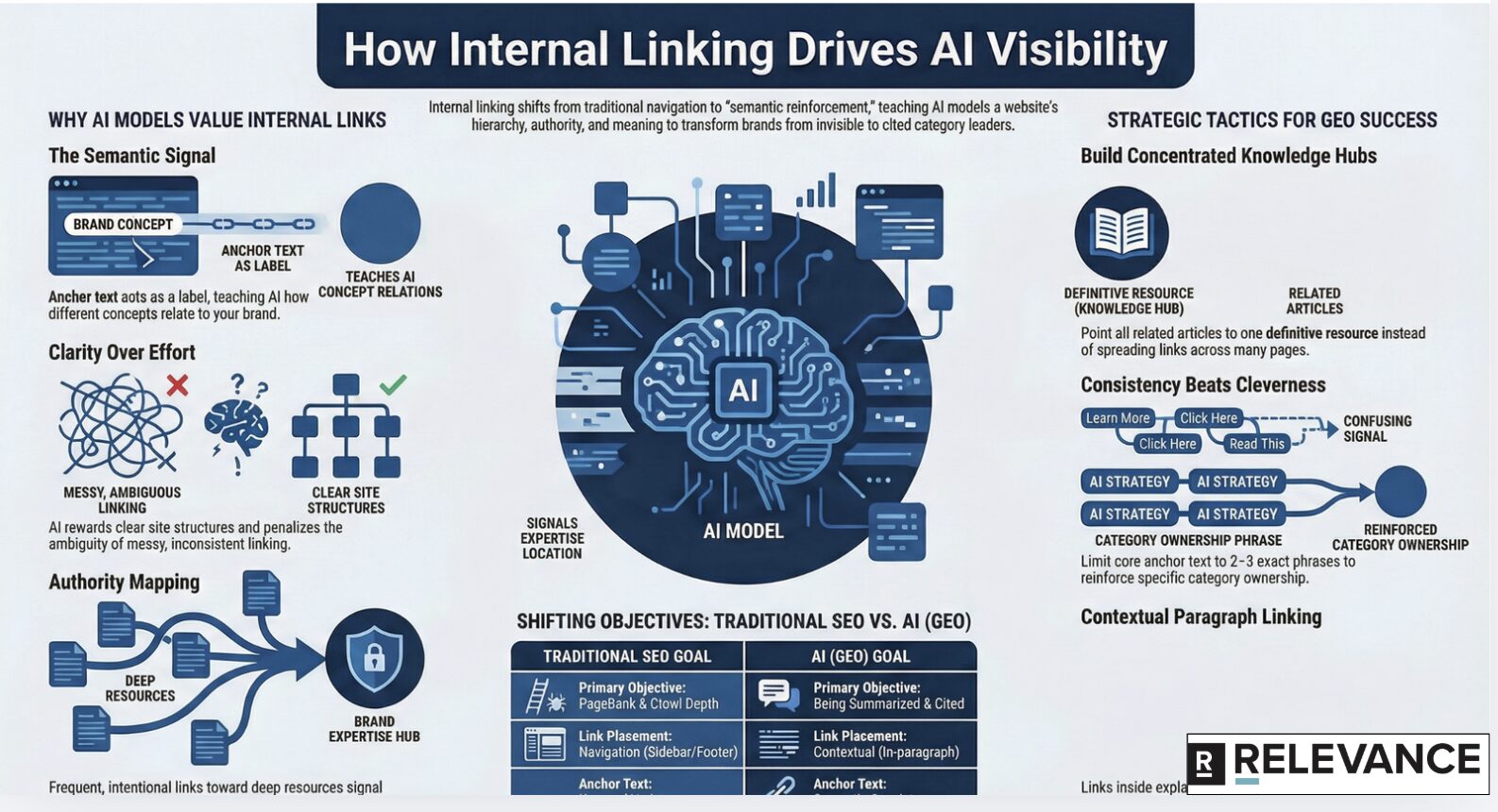
Search engines use internal links to crawl and rank pages. That part you already know. What is less obvious is that AI systems use internal links to understand meaning, hierarchy and authority inside your domain.
Large language models do not browse your site like a human. They ingest massive snapshots of the web, parse relationships between pages and learn patterns. When your internal links are messy, inconsistent or purely navigational, you create ambiguity. Ambiguity is poison for AI understanding.
Here is the thing. AI does not reward effort. It rewards clarity.
Internal links tell models three critical things.
First, what pages matter most. If every page links to everything else, nothing stands out.
Second, how concepts relate. Anchor text is not decoration. It is a semantic label.
Third, where expertise lives. Repeated, intentional linking toward deep resources signals authority far more clearly than volume alone.
When those signals are weak, AI tools default to competitors who explain themselves better.
GEO shifts the goal of internal linking
Traditional SEO internal linking often chased crawl depth or PageRank flow. GEO changes the objective.
For AI visibility, the goal is not just ranking. The goal is being understood well enough to be cited, summarized or recommended.
That means your internal links need to do more than move users around. They need to teach.
We frame this internally as semantic reinforcement. Every important concept on your site should be reinforced by multiple pages pointing to a single, authoritative explanation using consistent language.
When that happens, models learn that your brand owns that idea.
What this looks like in practice
Let me make this concrete.
One SaaS client came to us frustrated that ChatGPT would describe their category but never name them. They had thirty plus blog posts touching the same core concept. Each used different phrasing. Each linked randomly to product pages or recent posts.
We consolidated.
We created one definitive resource page that clearly defined the concept in plain language. Then we updated internal links so that every related article pointed to that page using nearly identical anchor text.
Within two model refresh cycles, their brand started appearing in AI generated explanations of the category. Not every time. But often enough that sales noticed.
Nothing else changed.
Anchor text matters more than you think
Most internal links are wasted.
“Learn more,” “read here” and “this guide” tell humans nothing and tell machines even less.
For AI, anchor text is one of the clearest labels you provide. It teaches the model what the destination page is about.
If you want to be associated with a concept, your anchor text needs to repeat that concept consistently. Not creatively. Consistency beats cleverness here.
We typically limit core anchors to two or three exact phrases per concept. That repetition feels boring to writers but it is incredibly effective for machines.
Depth beats breadth for AI visibility
Another trap we see is overlinking shallow content.
AI systems are much more likely to surface brands that demonstrate depth on a topic. Internal linking helps signal where that depth lives.
Instead of spreading links evenly across dozens of posts, concentrate them toward fewer, stronger pages.
Think of these as knowledge hubs. They should be longer, clearer and more updated than anything else you have. Every related article should point inward.
This mirrors how high-performing Wikipedia pages are structured. That is not a coincidence.
Internal links as context, not just navigation
Here is where most teams miss the opportunity.
Internal links placed in sidebars or footers help crawlability but do very little for understanding. Contextual links inside paragraphs are far more powerful.
When you link within a sentence that explains why the linked page matters, you are giving the model extra context. You are effectively annotating your own content.
For example, a sentence that defines a concept and links to your definitive guide is far stronger than a generic “related resources” section.
This is slow work. It requires editors, not plugins. But it compounds.
How this plays across AI platforms
ChatGPT, Gemini and Claude differ in training data and retrieval methods, but they share a need for clarity.
We see consistent patterns.
Brands with clear internal hierarchies are more likely to be named when users ask broad category questions.
Brands with strong semantic hubs are more likely to be cited when users ask how something works.
Brands with scattered internal links often show up only when the prompt is extremely specific.
Internal linking does not guarantee visibility. But weak internal linking almost guarantees invisibility.
What to audit first
If you want a practical starting point, focus on three areas.
- Identify your five most important concepts and map one primary page to each
• Standardize internal anchor text pointing to those pages
• Add contextual links inside explanatory paragraphs, not just navigation
You do not need to fix everything at once. We usually see movement after updating twenty to thirty key pages.
The tradeoff most teams ignore
This work feels unglamorous. It does not ship as a campaign. It does not spike traffic overnight.
But here is the payoff. Internal linking improvements tend to lift every channel at once. Organic search becomes more stable. AI mentions increase. Even sales conversations get easier because your narrative tightens.
For teams under budget pressure, this is one of the highest leverage plays available. It costs time, not media spend.
Where most advice goes wrong
A lot of content about AI visibility focuses on chasing prompts or publishing AI friendly formats. That is fine, but it skips the foundation.
If your own site cannot clearly explain what you do, no amount of clever prompting will save you.
Internal linking is how you teach machines your story at scale.
Closing thought
GEO is not about gaming AI systems. It is about reducing friction between what you know and what machines can understand.
Internal links are one of the few levers where effort reliably turns into clarity. And clarity is what gets rewarded.
If you are serious about showing up in AI generated answers, start by cleaning up the conversation your pages are already having with each other.
