

Enterprise content marketing is where good ideas go to die… unless you build the machine.
We’ve spent the last decade inside messy, high-stakes content programs—global teams, five different “owners” of the same webpage, legal reviews that take longer than the campaign, and stakeholders who all want content “faster” while simultaneously making it harder to publish.
For us, scaling is about creating a system that makes the right content inevitable and makes the wrong content hard to ship.
At Relevance, we do PR, SEO, and AI visibility for brands that can’t afford to guess. So this post is the playbook we wish every enterprise team had before they tried to “scale content.” (And, spoiler,… your bottleneck probably isn’t writing.)
Step 1: Decide what “scale” actually means for you
In enterprise settings, “scale” is usually translated into output. Meaning your team expects more blogs, videos, pages, and regions.
But that’s confusing scale with volume.
Real scale is when your content program can grow without compromising your quality, governance, or performance. And the way to get there is to define the job of the content.
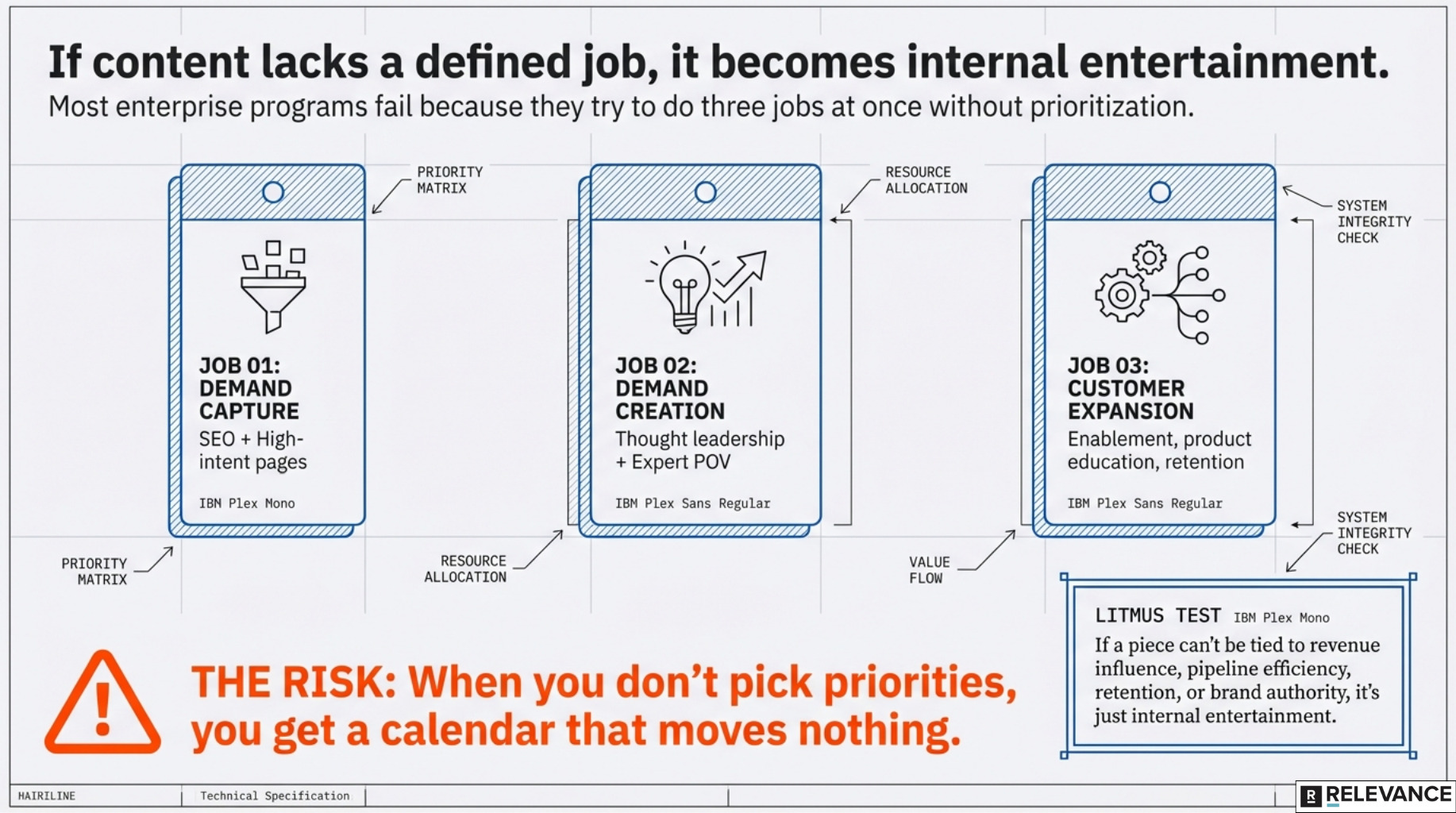
Most enterprise programs are trying to do at least three jobs at once:
- Demand capture (SEO + high-intent pages)
- Demand creation (thought leadership + POV)
- Customer expansion (enablement, product education, retention)
When you don’t pick priorities, you end up with a “content calendar” that pleases everyone and moves nothing.
If a piece can’t be tied to revenue influence, pipeline efficiency, retention, or brand authority, it’s internal entertainment.
Step 2: Build a content operating model, not a content plan
While they might have solid strategies and pitch decks, many enterprise marketing teams fail because nobody owns the system.
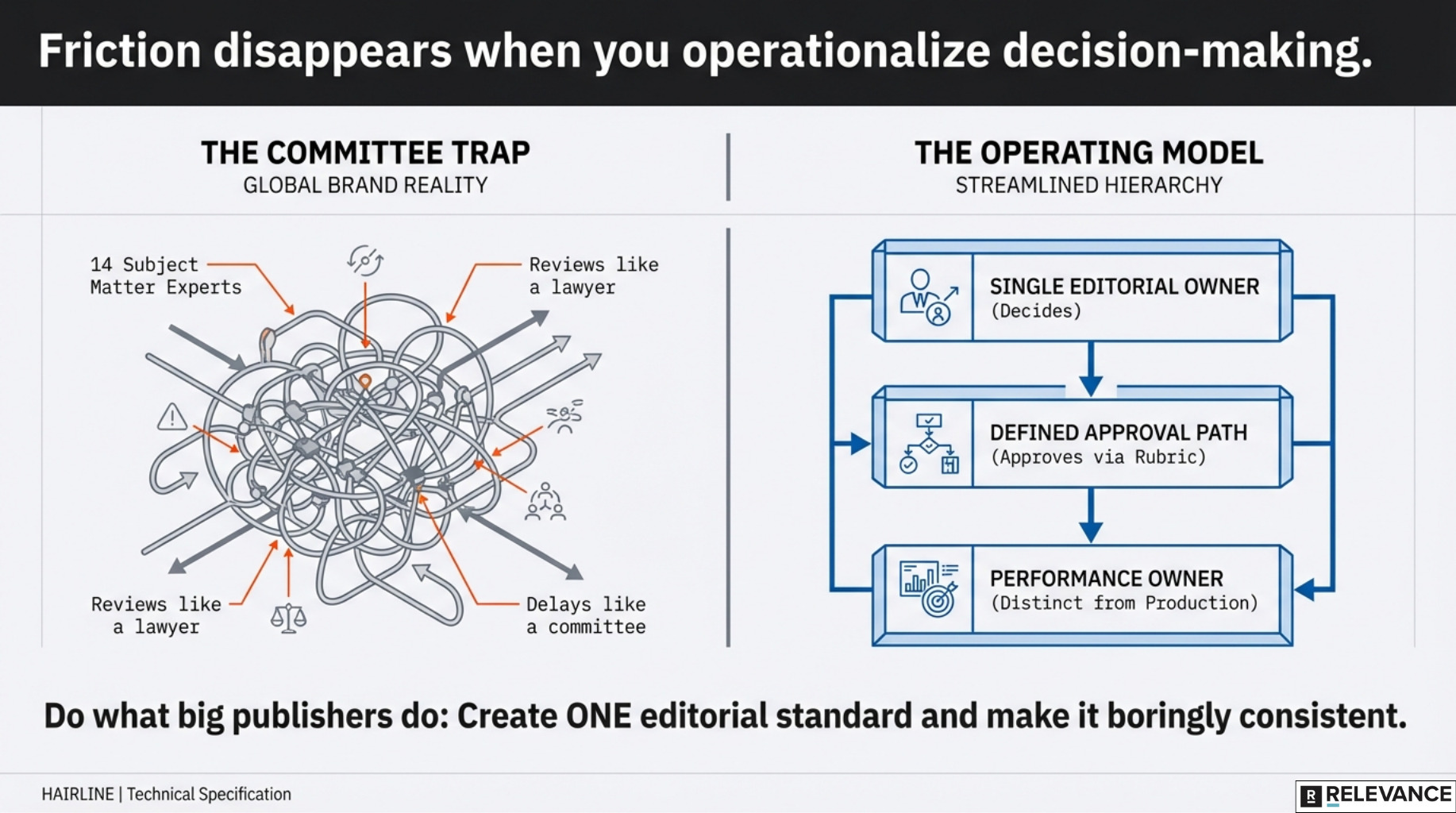
If you want scale, you need an operating model with clear answers to:
- Who decides what gets published?
- Who is responsible for performance (not just production)?
- What is the approval path—and what doesn’t need approval?
- What happens to content after it ships?
This is the part most teams avoid because it’s “political.” But it’s also where scale lives.
The Content Marketing Institute’s enterprise research keeps circling the same reality: big teams feel the drag of complexity—resource constraints, friction across departments, and slower cycles. That friction doesn’t disappear by hiring more writers; it disappears when you operationalize decisions. For example, we often see global brands with 14 subject matter experts who “support content.” But, in reality, each one reviews like a lawyer, rewrites like a copywriter, and delays like a committee. The team thinks they need more content. What they really need is a single editorial owner and a review rubric.
So, to streamline content marketing, we recommend doing what the big publishers do and create one editorial standard and make it boringly consistent.
Step 3: Create your “content supply chain”
Enterprises love dashboards. Great. Use that love to track the thing that actually limits output… flow.
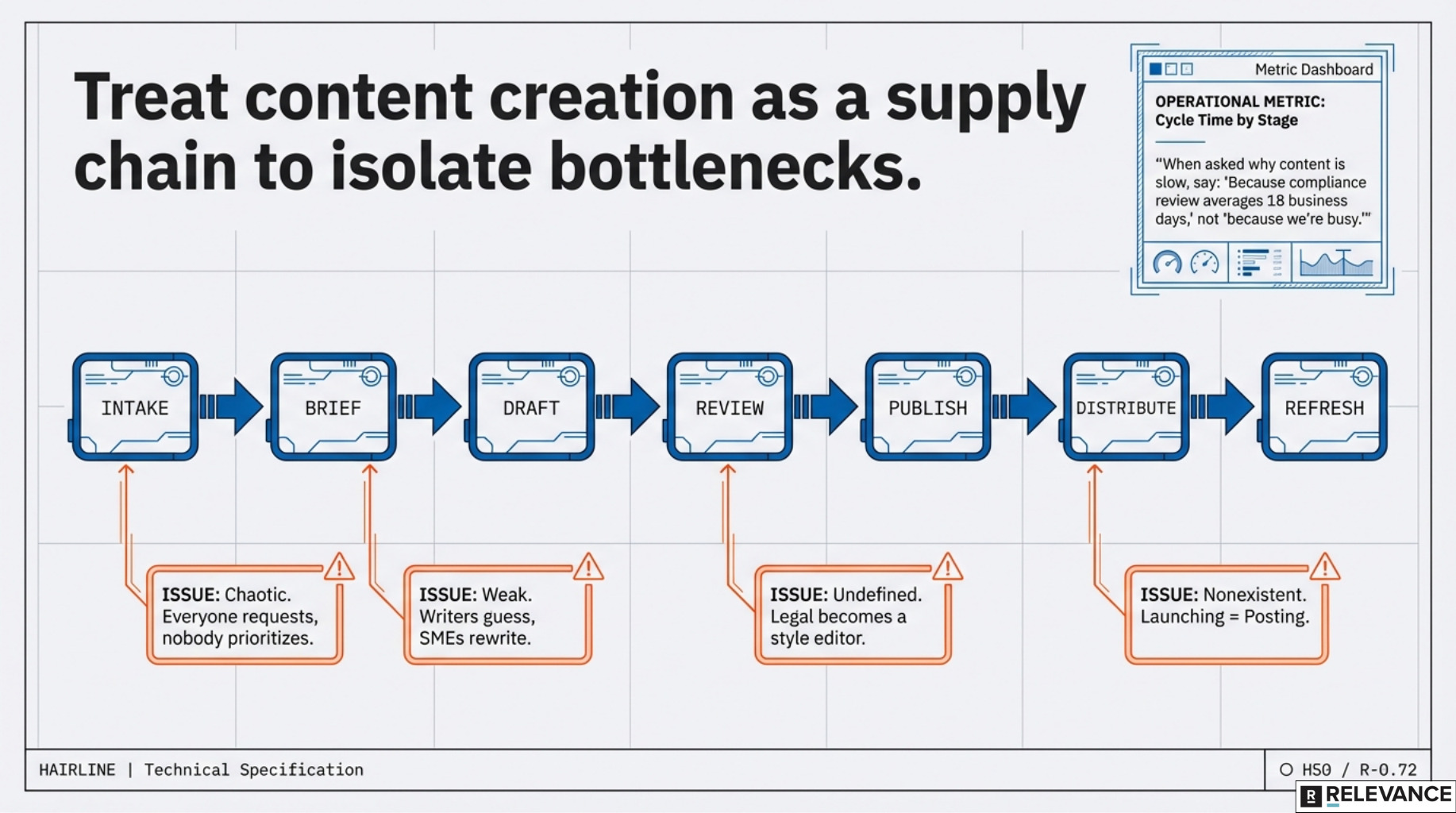
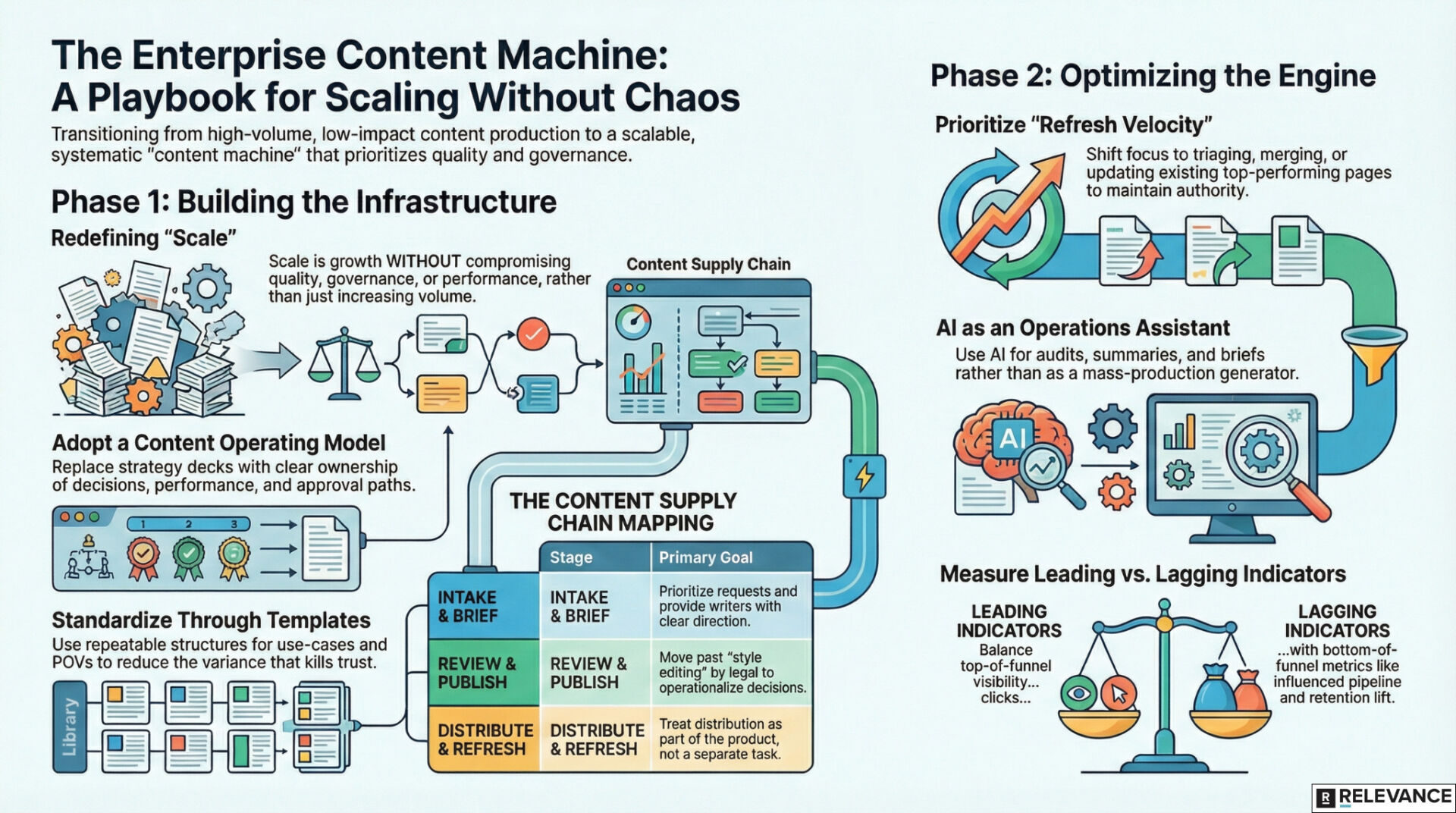
We think about enterprise content like a supply chain: Intake → Brief → Draft → Review → Publish → Distribute → Refresh
If your publish rate is low, your bottleneck is usually one of these:
- Intake is chaotic (everyone requests content, nobody prioritizes)
- Briefs are weak (writers guess, SMEs rewrite)
- Review is undefined (legal/compliance becomes a style editor)
- Distribution is nonexistent (content “launches” by being posted)
Start tracking cycle time by stage. When a stakeholder asks why content is slow, you’ll be able to say, “Because compliance review averages 18 business days,” not “because we’re busy.”
That’s how you get leverage.
Step 4: Standardize formats so you can scale quality
The fastest enterprise teams reuse structure.
When a format works (in our terms, it ranks, converts, earns links, or gets referenced), your team should turn it into a repeatable template.
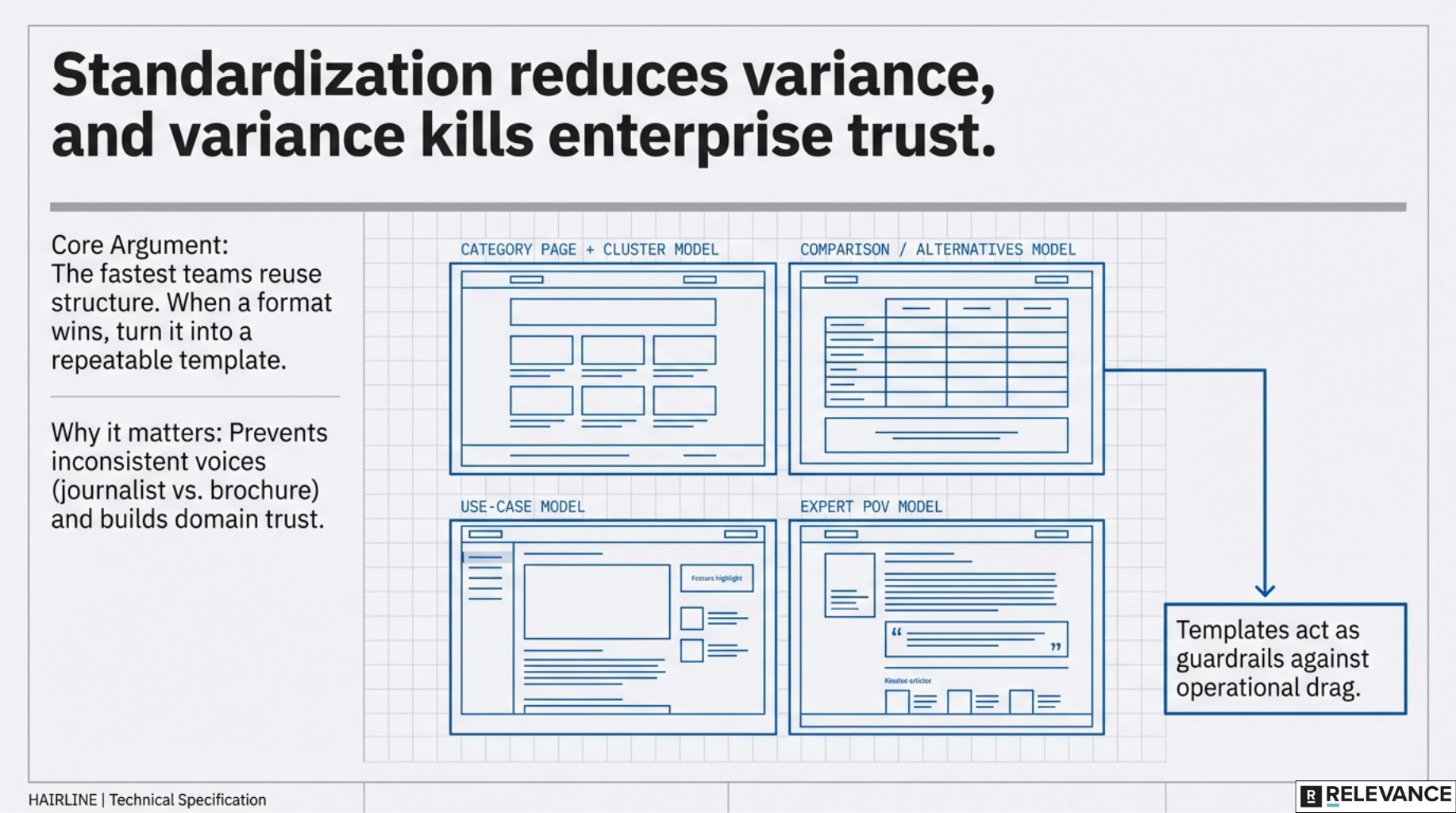
In SEO-led programs, that usually looks like:
- A repeatable category page + cluster model
- A repeatable comparison/alternatives model
- A repeatable use-case model
- A repeatable expert POV model
Templates can seem boring, but they have an important point. They reduce variance. And variance is what kills enterprise content. When one team writes like a journalist and another like a product brochure, and Google (and humans) stop trusting the whole domain.
This also matters more now because AI-driven search is changing how content gets surfaced and cited. CMI’s enterprise trends coverage for 2026 highlights exactly what enterprise teams feel every day: the tension between ambition and operational drag.
Step 5: Treat authority like a product you build
At enterprise scale, you don’t win by publishing “more information.” You win by becoming the most trustworthy source in your category.
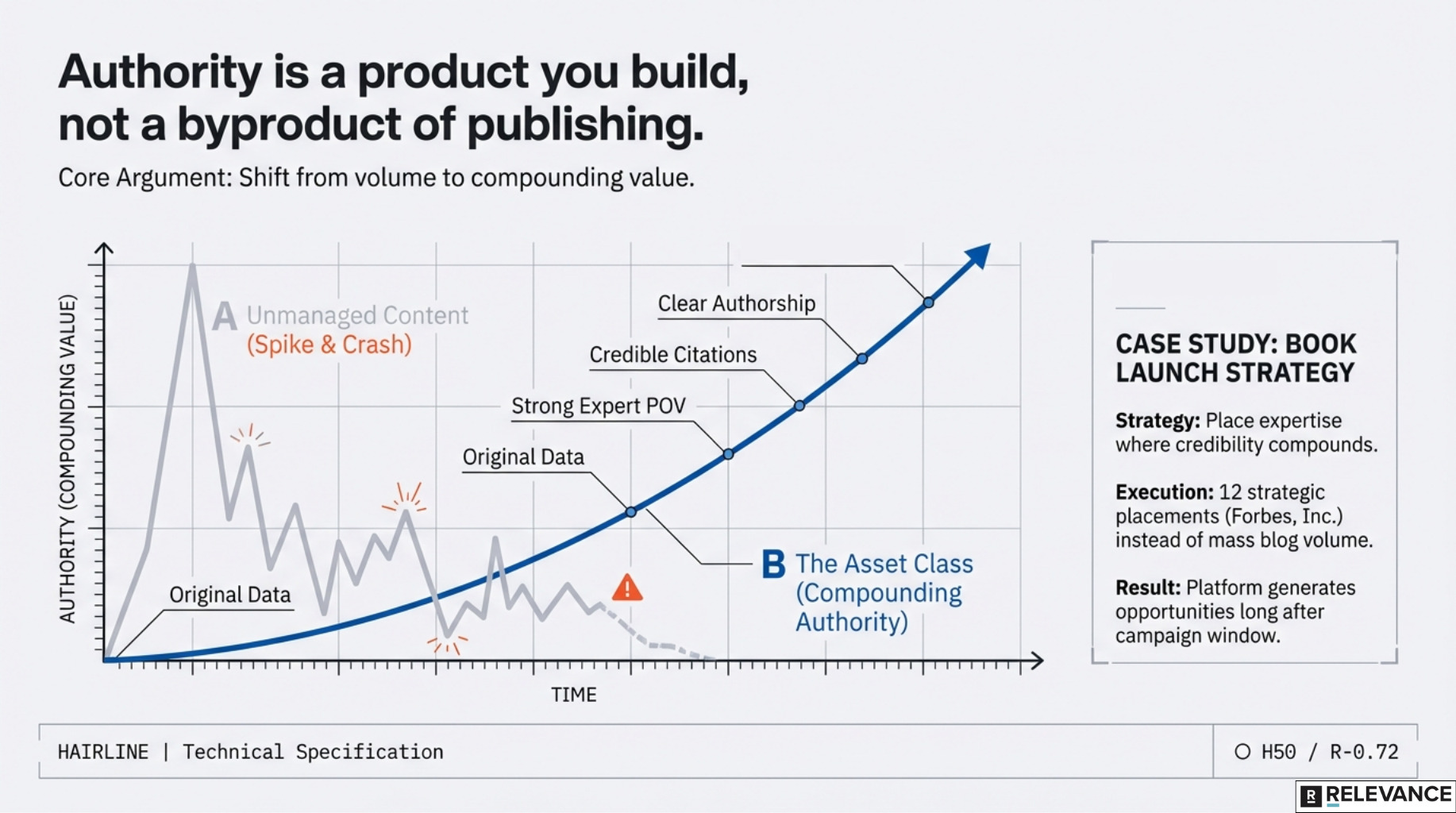
That means building assets that compound:
- Original data
- Strong expert POV
- Credible citations and references
- PR and third-party mentions
- Clear authorship and editorial standards
We’ve seen this play out directly in campaigns where authority was the goal, not just impressions.
For example, in our work supporting a thought leadership push for a bestselling author launching a new book, the strategy wasn’t “write more.” It was “place the expertise where credibility compounds”—premium business publications, expert lists, and repeatable positioning that outlives the launch window. The result was 12 strategic placements across outlets such as Forbes and Inc., building a platform that continues to generate opportunities after the campaign ends.
Authority scales when your distribution and credibility are deliberate.
Step 6: Shift from “publishing” to “refreshing”
There is an uncomfortable truth that most enterprise sites won’t admit.
They just have too much content that’s:
- outdated,
- duplicative,
- misaligned to intent,
- or cannibalizing itself.
Scaling content marketing often means scaling refresh velocity.
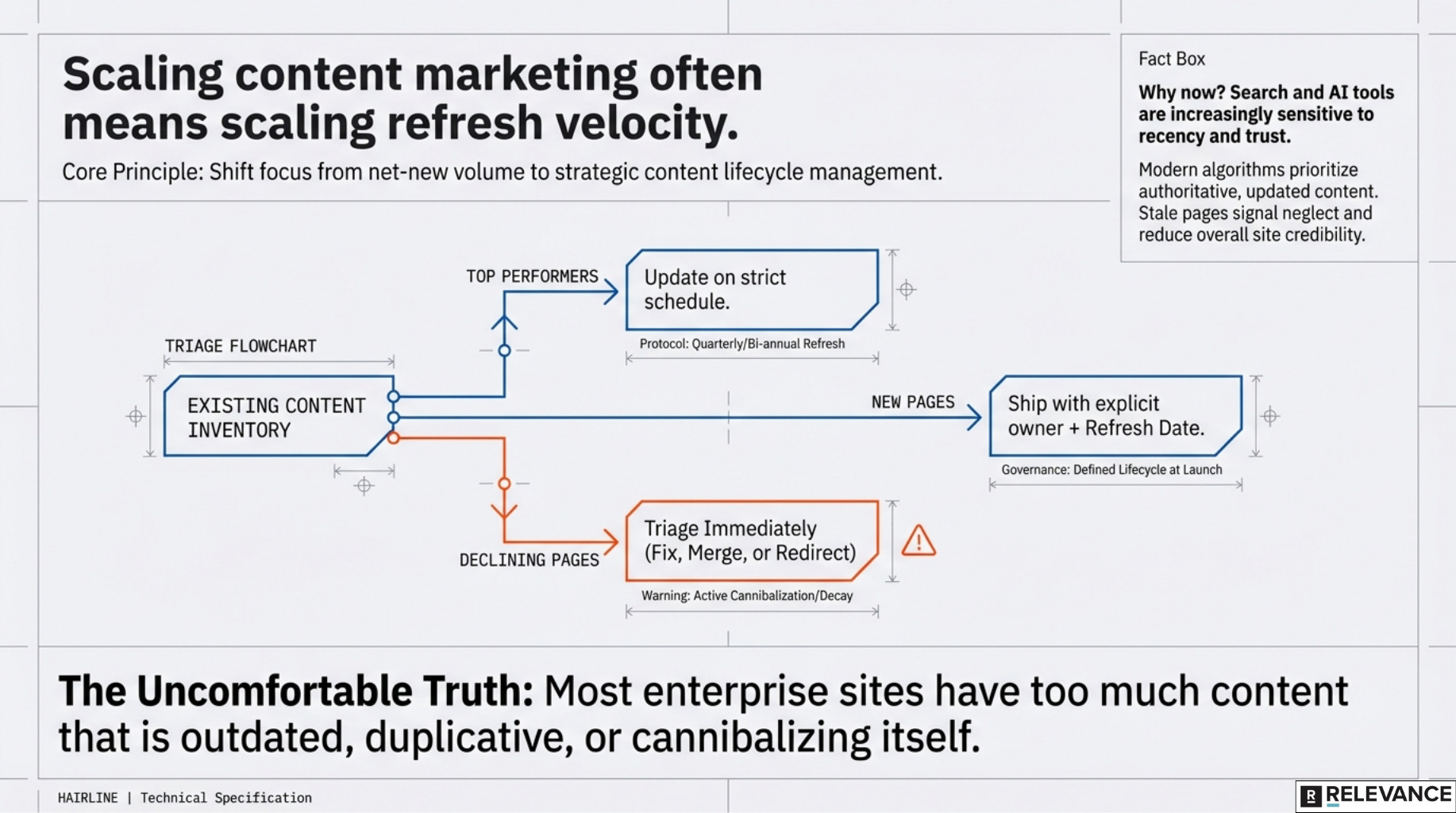
A mature enterprise program has a refresh system where:
- the top-performing pages get updated on a schedule,
- declining pages get triaged (fix, merge, redirect),
- and every new piece ships with an owner and a refresh date.
This matters even more as search becomes more trust- and recency-sensitive in competitive spaces, and as AI search tools pull from what they deem current and reliable.
Step 7: Use AI like an operations assistant, not a content generator
Enterprise teams are under pressure to “use AI.” Fine. But if you use AI to mass-produce content, you’ll create the same problem faster: more pages that don’t earn trust.
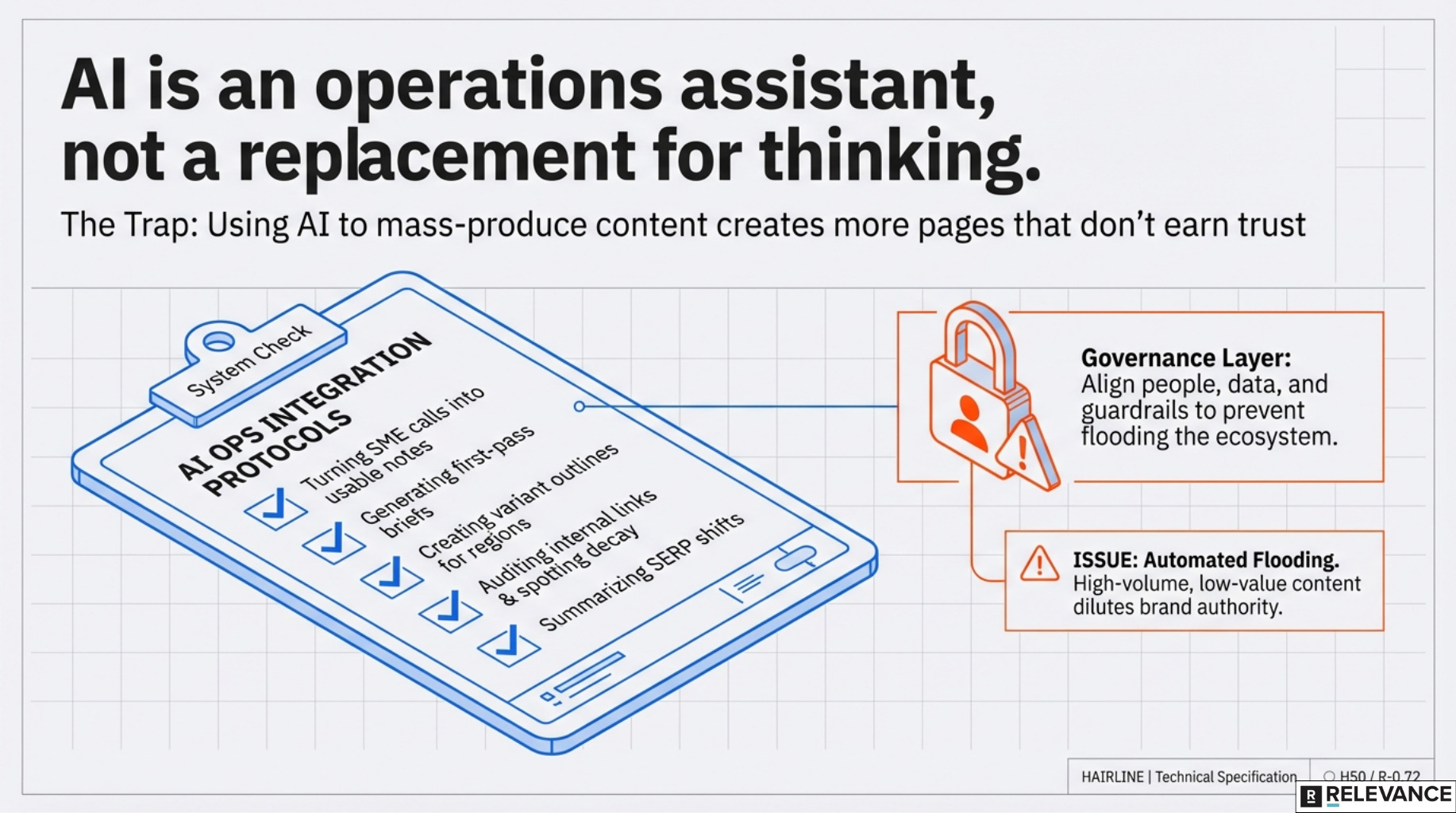
Where AI actually helps enterprise content scale is the unglamorous stuff:
- turning SME calls into usable notes,
- generating first-pass briefs,
- creating variant outlines for regions,
- auditing internal links,
- spotting content decay,
- summarizing SERP shifts.
The goal is to accelerate the system, not replace the thinking.
Gartner’s recent guidance on building AI-ready marketing strategy emphasizes aligning people, data, and governance—because the constraint isn’t the model, it’s the organization.
If you do nothing else, put guardrails around AI use so you don’t accidentally flood your ecosystem with content nobody trusts.
Step 8: Scale distribution the same way you scale production
Enterprise teams often treat distribution as a separate department. It’s not. Distribution is part of the content product.
If your “launch” is “publish and pray,” your program will always feel underpowered.
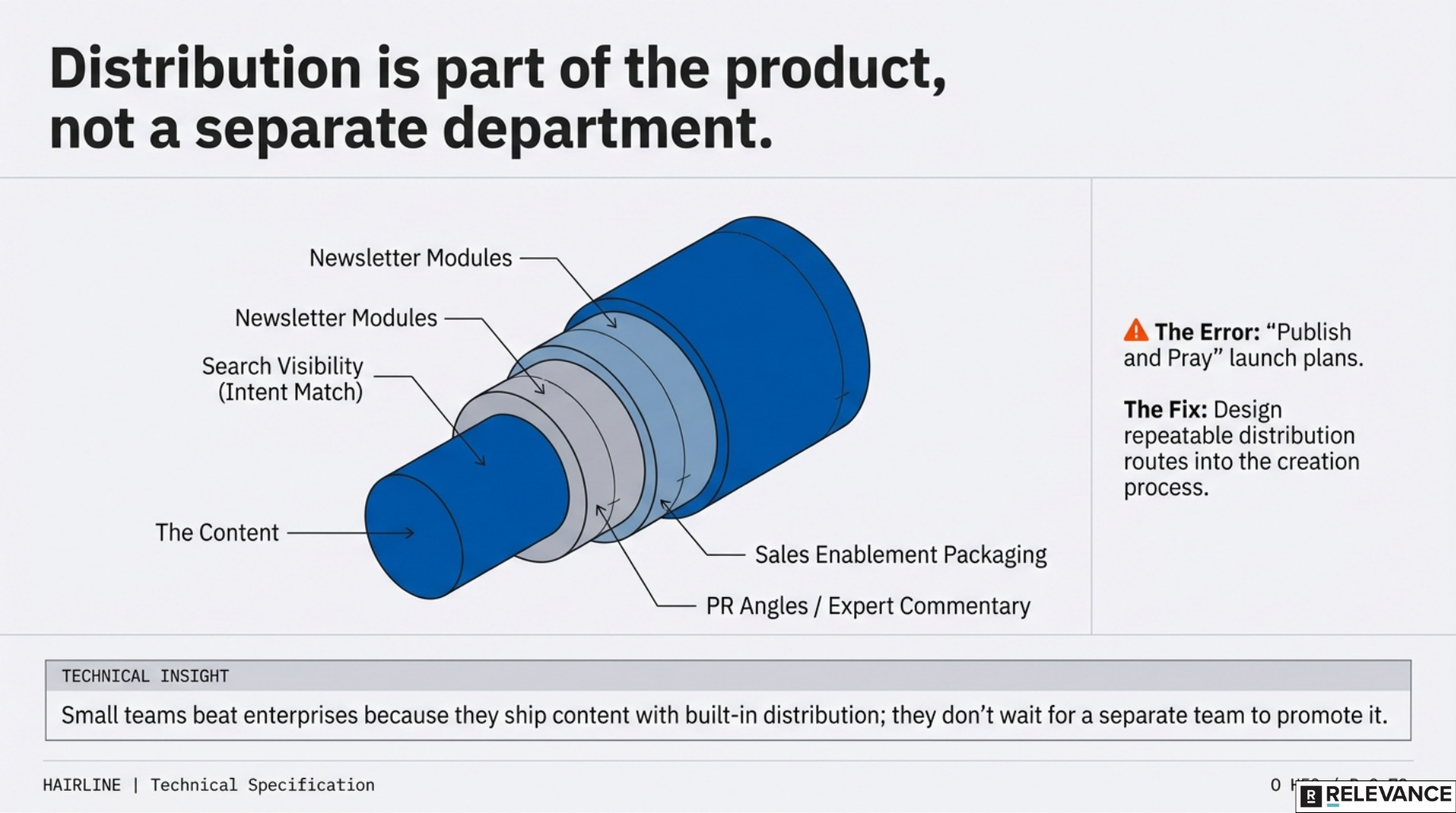
The scalable move is to design distribution routes that are repeatable:
- search visibility (technical + internal linking + intent match),
- newsletter modules,
- sales enablement packaging,
- PR angles and expert commentary,
- social formats that match platform behavior.
One reason enterprises feel like they’re losing to smaller teams is that smaller teams ship content with built-in distribution. They don’t wait for a separate process to “promote” it.
Step 9: Fix the measurement so the content doesn’t get killed by finance
Enterprise content dies when measurement is either too shallow (“pageviews!”) or too strict (“prove direct attribution for every post”).
You need a measurement model that matches reality:
- Leading indicators: rankings, visibility, engagement quality, assisted conversions
- Lagging indicators: influenced pipeline, CAC efficiency, sales cycle impact, retention lift
If you can’t connect content performance to business outcomes, content will always be treated as a cost center—especially when budgets tighten.
And yes, this gets harder with AI summaries reducing clicks in some contexts. Pew Research reports that users are less likely to click links when AI summaries appear in search results. (Related coverage is widely discussed across the industry; the key is building brand demand + authority so you still win the session when it matters.)
What scaling looks like when it’s working
When enterprise content is scaled correctly, a few things become true.
- You stop arguing about what to publish because prioritization is clear.
- You stop being surprised by review cycles because governance is explicit.
- You stop reinventing the wheel because formats and briefs are standardized.
- And you stop needing heroic effort to hit goals, because the machine is doing what machines do: repeating what works.
That’s the whole game.
At Relevance, we view enterprise scale as the ability to produce trusted, high-performing content repeatedly—without relying on a few humans to brute-force it.
Want to pressure-test your current content machine?
If you’re trying to scale content across business units, regions, or product lines, we can help you map the operating model (and identify the real bottleneck fast).
