

When clients ask me whether generative engine optimization actually works, they’re really asking for proof. Not a framework. Not a prediction about the future of search. Proof that someone did specific work and a brand showed up more often in ChatGPT, Perplexity, or Google’s AI results because of it.
That proof is harder to find than it should be. Most of what gets called a “GEO case study” is a blog post with a results slide at the bottom. No timeframe, no baseline, no explanation of what was actually done.
So I went through the published GEO work I could find and pulled out the five examples I think are worth your time. My bar was simple: does it say what was done, what moved, and over what period? And can a marketing team learn something from it on Monday?
Full disclosure up front: I work at Relevance, and the #1 case study on this list is ours. I put it first because I know it inside and out, and because it shares the details I wish every case study did: timeframe, scope, services, and business results, not just visibility numbers. Judge it on that. Everything else on this list is from other agencies or researchers, and none of them paid to be here.
GEO case studies at a glance
What makes a GEO case study worth reading
Before the list, here’s the filter I use. If a case study can’t answer most of these, I treat it as marketing, not evidence:
- What was the baseline and the timeframe? “300% growth” means nothing without “from what, over how long.”
- Which AI platforms were measured? ChatGPT, Perplexity, Gemini, and Google AI Overviews behave differently.
- Mentions, citations, or traffic? Being named in an answer and being linked as a source are different results. Good case studies say which one they’re reporting.
- What work was actually done? Content, technical fixes, PR, or all three?
- Did it touch revenue? AI visibility that never shows up in leads or pipeline is a vanity metric.
One more caveat that applies to everything below: every agency number here is self-reported, including ours. Read them as “what worked for this brand,” not “what will happen for yours.”
1. Relevance × SmartSource: AI visibility that showed up in leads
The client: SmartSource provides event technology, AV production, and mobile event apps for conferences, trade shows, and corporate events. Mid-market B2B, competitive category, long sales cycle.
The problem: Buyers were starting to research event tech in AI tools, and SmartSource needed its expertise to be the thing those tools surfaced and cited. At the same time, they couldn’t afford to lose momentum in traditional search, because that’s where a lot of their leads still came from.
What we did: We didn’t treat this as a page-tweaking exercise. Over eight months, the work covered:
- An AI visibility and technical SEO audit across service, solution, and content pages
- Mapping content clusters around the topics buyers actually ask about: AV event production, corporate event production, mobile event apps, and event engagement technology
- Rewriting priority pages so AI systems could retrieve and quote them cleanly
- Schema, metadata, structure, and crawlability fixes, plus internal linking to tighten entity relationships
- A digital PR and authority-building campaign so SmartSource showed up in the third-party sources AI tools lean on
- Ongoing monitoring of AI citations and search performance to keep re-prioritizing
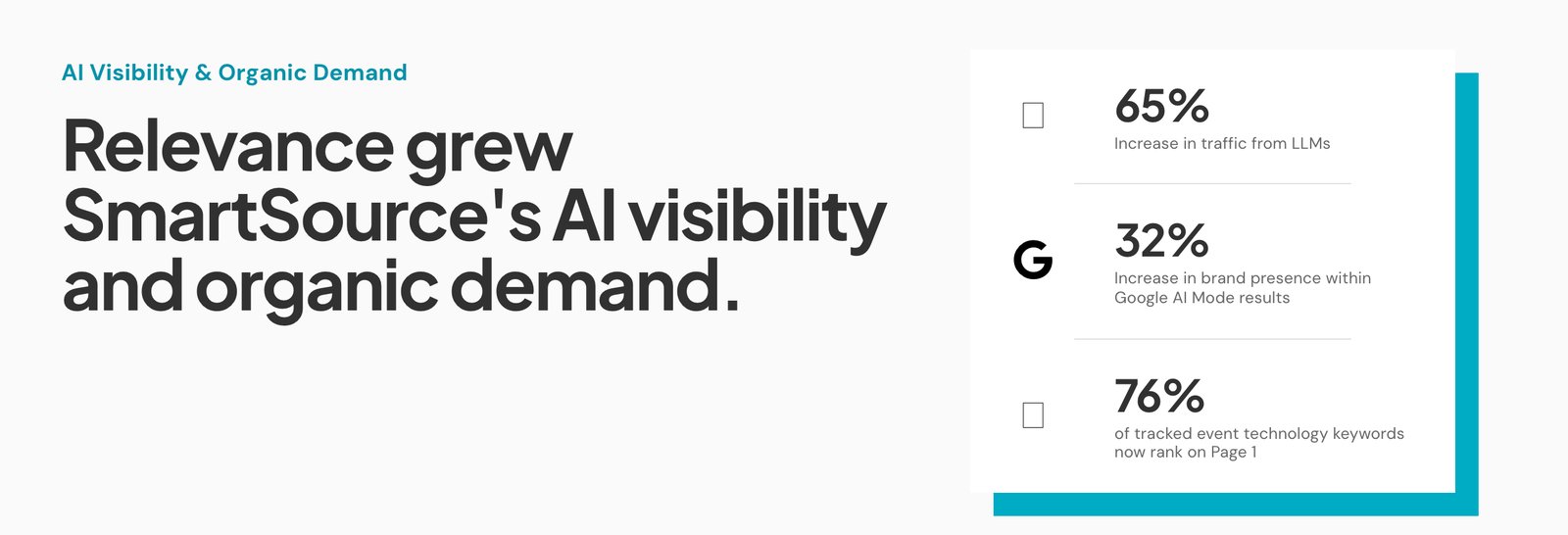
The results (March–May 2026 compared with the previous three months):
- 65% increase in traffic from LLMs
- 32% increase in brand presence in Google AI Mode
- 50% increase in organic leads and 20% increase in total leads
- 76% of tracked event technology keywords on page 1
- 21 tracked keywords improved by an average of 6.5 positions
Why I put it first: The number I care about most here isn’t the LLM traffic. It’s the 50% lift in organic leads. A lot of GEO case studies stop at “we got mentioned more.” This one connects AI visibility to the thing a CMO actually gets measured on.
The other detail I’d point to: one content cluster, AV event production, drove roughly 35–40% of the tracked traffic gains. Focus beat volume. And newly optimized content started earning AI citations shortly after it went live, which tells me the technical and structural work was doing its job.
What you can steal: Pick the two or three topic clusters closest to revenue and go deep on those first. Then pair on-site work with PR, because AI tools trust what other sites say about you more than what you say about yourself.
Fair criticism: The measurement window is three months against three months, and the AI metrics are reported as percentage changes rather than prompt counts. I’d like us to publish the raw “mentioned in X of Y tracked prompts” numbers next time, and that’s on me.
2. iPullRank × telecom brand: when strong rankings weren’t enough
The client: A large U.S. telecom provider with strong organic rankings.
The problem: This is the story I see over and over. The brand ranked well, but it was underrepresented in Google’s AI Overviews, especially on competitive and branded queries. Good SEO, weak AI visibility.
What they did: iPullRank restructured content for semantic clarity, improved technical accessibility, and built entity-rich passages that AI systems could extract and reuse. This is their “relevance engineering” approach in practice: make each passage clearly answer one thing.
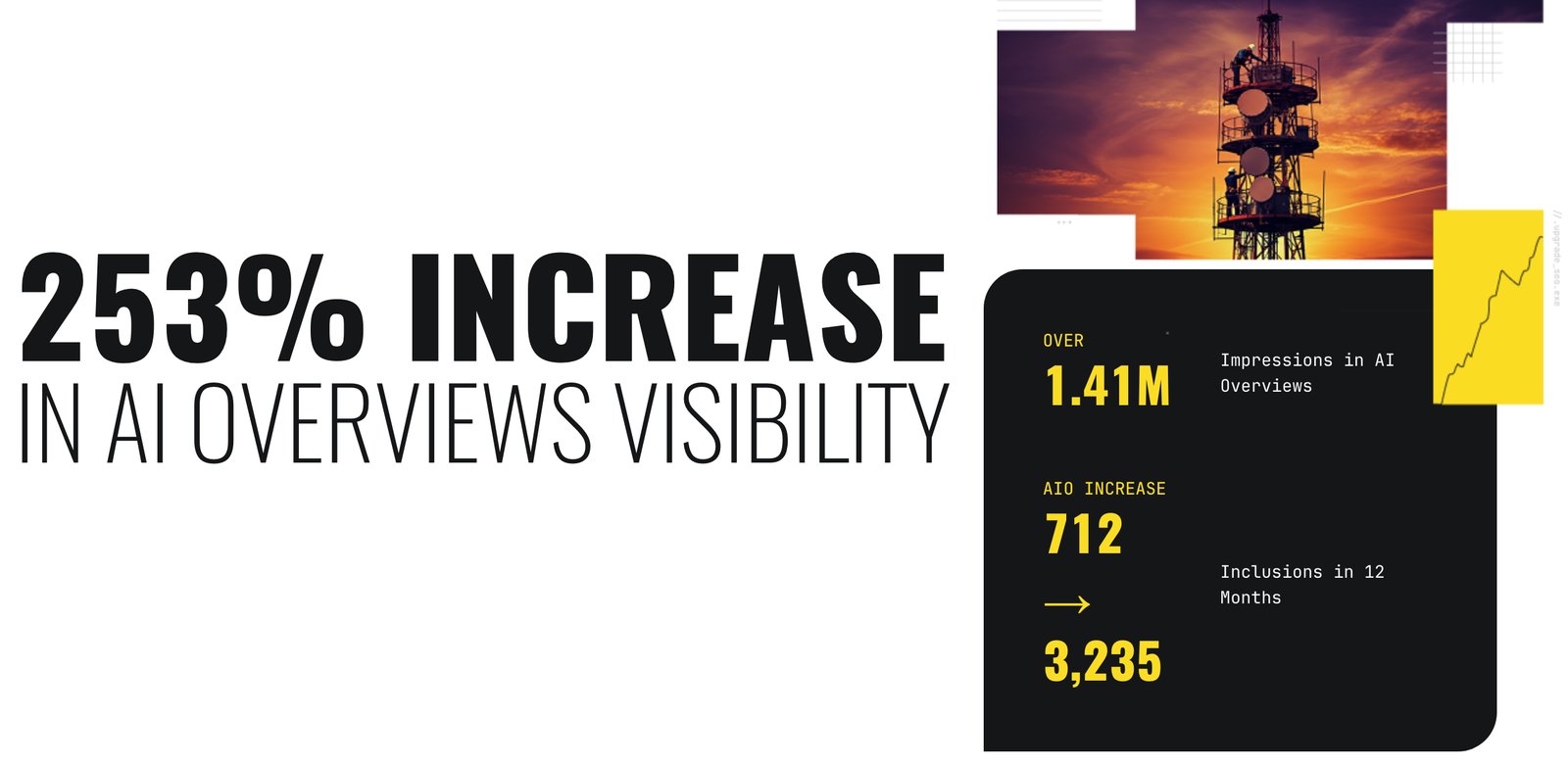
The results: AI Overview inclusions went from 712 to 3,235 over 12 months, which they report as a 253% increase in AI Overview visibility.
Why it’s on my list: I like that they report raw counts, not just a percentage. 712 to 3,235 is something you can picture and check. It’s also the clearest public proof that ranking well and being included in AI answers are two different things.
What you can steal: Audit your best-ranking pages first. If they’re not showing up in AI Overviews, the problem is usually structure, not authority. Break long pages into clearly labeled sections that each answer one question directly.
Fair criticism: It’s focused on Google AI Overviews only, and it doesn’t connect the visibility gains to leads or revenue. The client is also anonymous, which is understandable but makes it harder to verify.
3. WebFX × Thompson Tractor: GEO for a regional B2B brand
The client: Thompson Tractor, a heavy equipment dealer.
The problem: Equipment buyers were starting to ask assistants like ChatGPT and Copilot for recommendations, and Thompson wanted to be the dealer those tools named in their region.
What they did: WebFX ran a combined GEO and SEO program, using its own AI visibility tracking platform to monitor how often the brand showed up across AI tools.
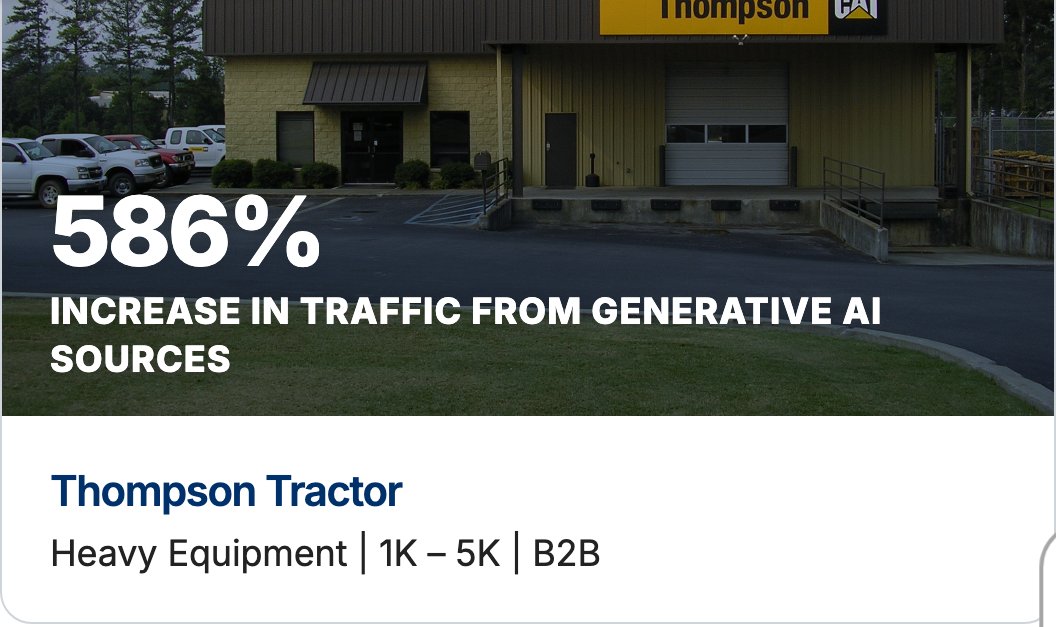
The results: WebFX reports a 586% increase in traffic from generative AI sources and 116% higher visibility in LLMs than Thompson’s closest competitor.
Why it’s on my list: Most GEO case studies are SaaS or enterprise brands. This one proves the playbook works for a regional, industrial business. If you’re a local or regional B2B company wondering whether AI visibility applies to you, it does.
What you can steal: Benchmark yourself against your closest competitor in AI answers, not just against your own past numbers. “We’re named more often than the next dealer” is a result a business owner understands immediately.
Fair criticism: I couldn’t find a full write-up with the baseline, timeframe, or the specific work done. The numbers are summarized on WebFX’s service pages, so treat them as directional until you see the details.
4. Seer Interactive AI Lab: controlled GEO experiments
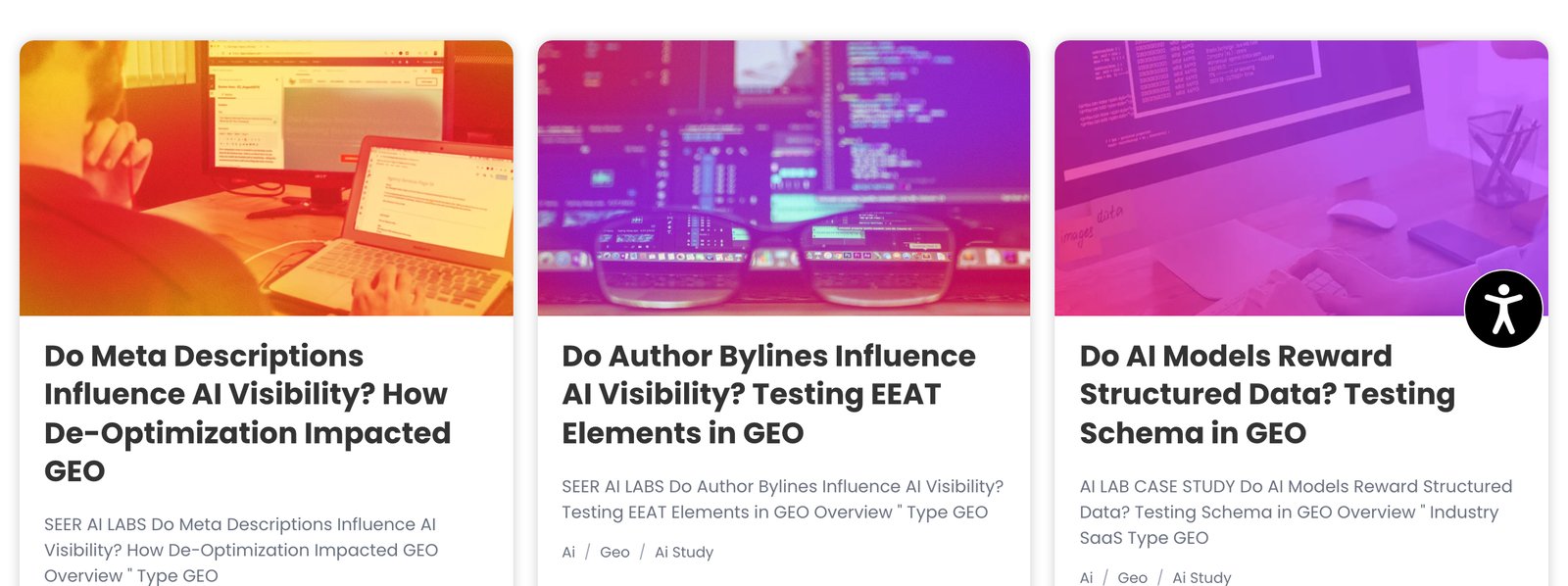
What it is: Not a client story. Seer runs a series of small, controlled experiments that test one variable at a time against AI visibility: Do meta descriptions matter? Do author bylines? Does schema help? Does fresher content win? Does it matter where key information sits on the page?
Why it’s on my list: Client case studies always bundle ten changes together, so you never know which one did the work. Seer’s approach isolates variables. That’s the closest thing our industry has to real evidence about individual GEO tactics, and it’s free to read.
They also publish larger research, including ongoing studies on how AI Overviews affect click-through rates and a large-scale study of brand visibility across hundreds of thousands of LLM responses. If you need to explain to leadership why organic clicks are down while impressions hold steady, start there.
What you can steal: Run your own mini experiments. Change one thing on a handful of pages, leave a similar set alone, and track AI mentions and citations for both over a few weeks.
Fair criticism: Experiments on a small set of pages don’t always generalize, and AI platforms change fast. Treat individual findings as hypotheses to test on your own site.
5. The Princeton GEO study: where the term came from
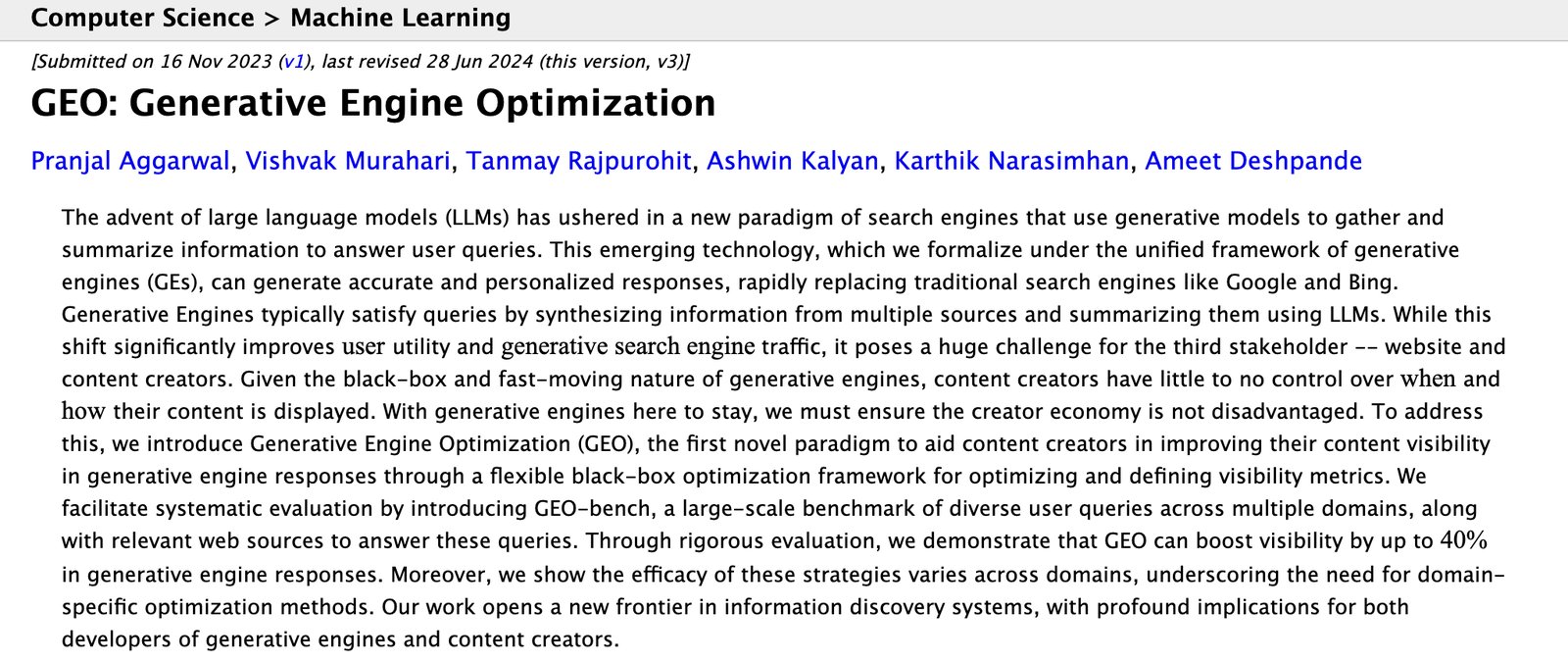
What it is: The 2023 research paper from Princeton and collaborators that coined “generative engine optimization,” later published at KDD 2024. The researchers tested different ways of rewriting content and measured how often that content showed up in AI-generated answers.
The findings: Adding citations to credible sources, quotations from experts, and specific statistics noticeably improved how visible content was in generated answers. Old-school tactics like keyword stuffing didn’t help.
Why it’s on my list: It’s the foundation everything else builds on, and it’s one of the few pieces of GEO evidence that isn’t selling a service. It also lines up with what I see in client work: AI tools like content that shows its evidence.
What you can steal: Go through your most important pages and add real numbers, named sources, and expert quotes. It’s the cheapest GEO improvement there is.
Fair criticism: It was run in a research setting, not on live ChatGPT or Perplexity with real brands, and AI search has changed a lot since 2023. It tells you what kind of content works, not how your brand will perform.
What these case studies have in common
Put these five side by side and the pattern is pretty clear:
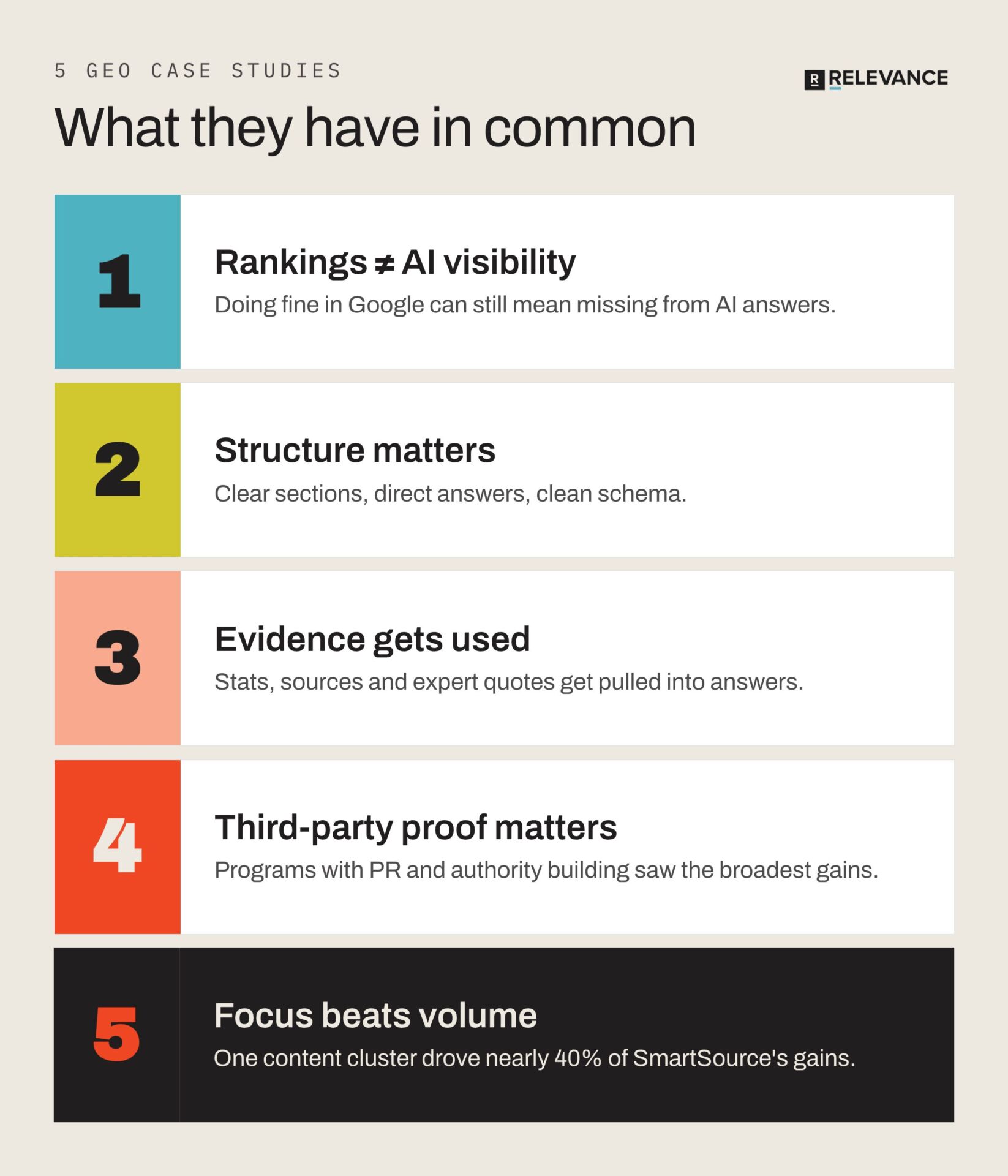
- Rankings and AI visibility are different results. The iPullRank and SmartSource stories both start with a brand that was doing fine in Google and still getting left out of AI answers.
- Structure matters. Clear sections, direct answers, and clean schema show up in nearly every one.
- Evidence gets used. Stats, sources, and expert quotes make content more likely to be pulled into answers.
- Third-party proof matters. The programs that included PR and authority building reported the broadest gains.
- Focus beats volume. One cluster drove nearly 40% of SmartSource’s gains. Nobody won by publishing more.
If you want to see where your brand stands today, I’d start by tracking your brand in ChatGPT and Perplexity on a short list of real buyer questions. You’ll know within an hour whether you have a gap. And if you want a second opinion, our free AI visibility brand audit is a good place to start.
Frequently Asked Questions
Q: What is a generative engine optimization case study?
It’s a documented example of a brand improving how often it shows up in AI-generated answers from tools like ChatGPT, Perplexity, Gemini, and Google AI Overviews. A good one includes the baseline, timeframe, the work done, and the results.
Q: How long does GEO take to show results?
In these examples, results were measured over three to twelve months. Newly optimized content can get picked up faster, especially by AI tools that search the live web, but broad changes in how AI describes your brand take sustained work.
Q: Is GEO different from SEO?
They overlap heavily, but they’re measured differently. SEO is measured in rankings and clicks. GEO is measured in how often AI tools mention you, cite you, and describe you accurately. Every case study here shows you can do well in one and poorly in the other.
Q: Can small businesses benefit from GEO?
Yes. The Thompson Tractor example is a regional equipment dealer, not a tech giant. Smaller brands often have an advantage because their categories are less crowded in AI answers.
