

Are you looking for the most up-to-date AI visibility statistics to map your strategy in 2026?
This page is structured like a “stats hub” you can keep coming back to when you need quick numbers for decks, strategy docs, and stakeholder conversations.
In this article
- Top AI visibility statistics
- AI Overviews and AI Mode statistics
- AI citation and source selection statistics
- Clicks, zero-click, and traffic shift statistics
- AI assistant adoption statistics
- Measurement and tracking statistics
- AI visibility statistics: Your questions answered
- Key trends and takeaways for 2026
Top AI visibility statistics
A snapshot of the most important numbers shaping how AI-driven search and assistants affect visibility, traffic, and discovery today.
- Google’s AI Overviews reached 2B+ monthly users, spanning 200+ countries/territories and 40 languages. (blog.google)
- AI Overviews appeared on 6.49% of keywords in January 2025, climbed to nearly 25% in July, then settled at 15.69% in November 2025 (Semrush analysis of 10M+ keywords). (semrush.com)
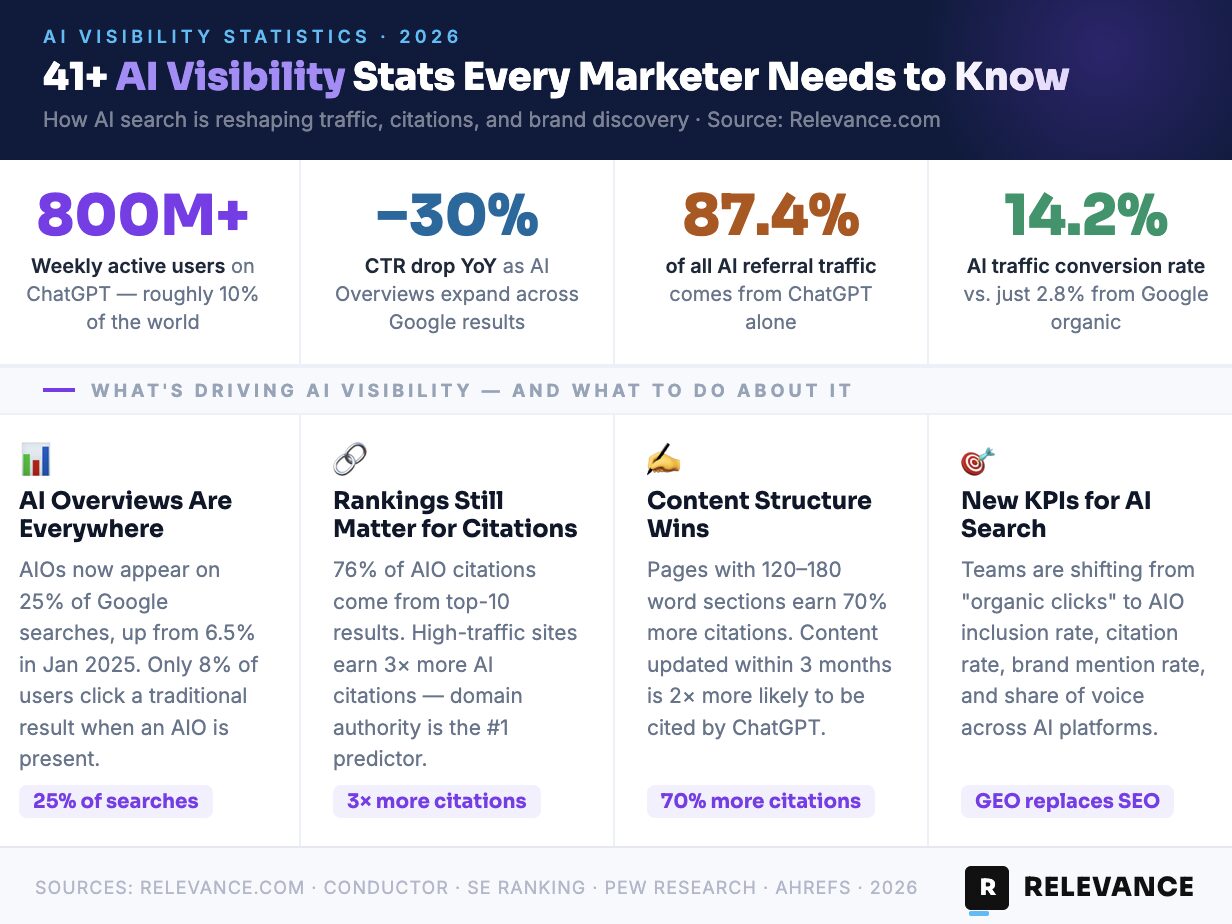
- Google search impressions were up 49% YoY, while CTR was down 30%, attributed to AI Overviews (BrightEdge data reported by Search Engine Land). (Search Engine Land)
- In Pew’s March 2025 browsing-data study, clicks to traditional search results dropped from 15% (no AI summary) to 8% (with AI summary). (Pew Research Center)
- Pew also found only ~1% of visits with an AI summary produced a click on a cited source link inside the AI summary. (Pew Research Center)
- 76% of AI Overview citations come from top-10 ranking pages, and 86% come from pages ranking in the top 100; the median ranking of cited URLs was 3. (Ahrefs)
- AI Overviews “zero-click” dynamics are messy: Semrush found AIOs often appear on queries that already skew zero-click, but on the same terms, clicks were slightly higher after AIOs appeared, and overall zero-click rate for AIO keywords declined since Jan 2025. (semrush.com)
- SparkToro’s clickstream-based study estimated that in the US, only 360 out of 1,000 Google searches lead to a click to the open web. (SparkToro)
- Worldwide search engine market share in Nov 2025: Google 89.94%, Bing 4.22%, Yandex 2.18% (StatCounter). (StatCounter Global Stats)
- As of July 2025, 64.35% of global web traffic came from mobile devices (compiled from StatCounter data). (Soax)
- AI-referred website sessions increased by more than 500% in the first half of 2025 (SearchEngineLand)

AI Overviews and AI Mode statistics
Data that shows how often Google’s AI experiences appear, how they’re evolving, and what types of queries they impact most.
- AI Overviews were called out by Google as a product with 2B+ monthly users in official earnings remarks. (blog.google)
- Google said AI Mode launched in the U.S. and India and was “going well” (earnings remarks). (blog.google)
- Semrush reported AI Overviews were 13.14% of US desktop queries by March 2025 (up from 6.49% in January 2025). (Digital Marketing Depot)
- Semrush found AI Overviews were predominantly informational (~88%), with commercial/navigational rising over time. (Search Engine Land)
- BrightEdge-reported shifts (as covered by Search Engine Land) include 7× growth in 8+ word queries, 48% rise in “technical terminology”, and a 400% increase in citations coming from positions 21–30. (Search Engine Land)
- Google is expanding ads in AI Overviews to desktop and bringing ads to AI Mode (Think with Google / Google Marketing Live 2025). (Google Business)
AI citation and source selection statistics
Insights into which sources AI systems choose to cite, how ranking influences citation, and where opportunities exist beyond position one.
- 76% of citations in AI Overviews are from top-10 pages, 86% from top-100, and cited URLs have a median SERP rank of 3. (Ahrefs)
- Writesonic study of 1M AI Overviews: AI Overviews averaged ~4–5 citations, with a reported maximum of 33 in their dataset. (Writesonic)
- The same Writesonic study reports an 81.10% chance at least one top-10 URL is cited in an AI Overview. (Writesonic)
- Pew found the most frequently cited sources in AI summaries included Wikipedia, YouTube, and Reddit, together representing ~15% of AI summary sources. (Pew Research Center)
- A practical implication of the above: traditional ranking still matters a lot, but “page 1 or bust” is no longer the whole story—especially with rising citation from positions 21–30 (BrightEdge / SEL). (Search Engine Land)
Clicks, zero-click, and traffic shift statistics
Evidence of how AI answers are changing click behavior, reducing traditional traffic, and reshaping what “search success” means.
- CTR down 30% YoY while impressions up 49% YoY, attributed to AI Overviews. (Search Engine Land)
- 8% of visits resulted in a click on a traditional result when an AI summary appeared vs 15% when it didn’t. (Pew Research Center)
- ~1% of visits with an AI summary produced a click on a source link inside the AI summary. (Pew Research Center)
- 360/1,000 US Google searches lead to an “open web” click (the rest end on Google or go elsewhere in-Google). (SparkToro)
- Across 2025, the overall zero-click rate on keywords with AI Overviews slowly declined since January, despite AIOs being more common on historically zero-click query types. (semrush.com)
AI assistant adoption statistics
Usage and growth metrics for AI assistants like Google AI, ChatGPT, Gemini, and Perplexity that define the new discovery landscape.
- Google’s CEO said AI Overviews grew to 2B monthly users, and also cited growth in Google’s AI products in 2025 earnings communications. (blog.google)
- TechCrunch reported an earnings-call update that AI Overviews hit 2B monthly users, up from 1.5B in May 2025, and mentioned Gemini app MAU growth as well. (TechCrunch)
- MarketWatch (citing The Information / Sensor Tower) reported ChatGPT at ~810M monthly active users and Gemini at ~346M MAU (with Google citing higher). (MarketWatch)
- Business of Apps estimated Perplexity reached ~45M active users in H2 2025 (up ~20M YoY). (Business of Apps)
Measurement and tracking statistics
An overview of what can and can’t be measured today, and how teams are adapting KPIs to account for AI-driven visibility.
- Google Search Console currently does not break out AI Overview impressions: when an AI Overview appears, those impressions are counted in the same dataset as “regular” impressions. (Search Engine Journal)
- In practice, that means many teams are shifting KPIs from “organic clicks” to some mix of: AIO inclusion rate, citation rate, brand mention rate, and share of voice across AI answers. (Brightedge)
AI visibility statistics: Your questions answered
Straightforward answers to the most common questions marketers ask about AI Overviews, clicks, and citation behavior.
How often do AI Overviews show up?
Semrush measured AI Overviews at 6.49% of keywords in Jan 2025, peaking near 25% in July, and landing at 15.69% in Nov 2025. (semrush.com)
Do people click the sources inside AI summaries?
Pew’s March 2025 analysis found source-link clicks inside AI summaries happened only ~1% of the time. (Pew Research Center)
Do AI summaries reduce clicks to websites?
Pew found traditional-result clicks were 15% without an AI summary vs 8% with an AI summary. (Pew Research Center)
Does “ranking #1” still matter for getting cited?
It matters a lot. Ahrefs found 76% of AIO citations came from top-10 results, and the median rank of cited URLs was 3. (Ahrefs)
Key trends and takeaways for 2026
Forward-looking insights on where AI visibility is headed next and what teams should prioritize going into 2026.
- Expect more monetization pressure inside the AI layer: Google is already expanding ads in AI Overviews and bringing ads to AI Mode. (Google Business)
- Attribution and linking are now political issues: Google has said it will add more in-line links in AI Mode, amid regulatory scrutiny and publisher pressure. (The Verge)
- Visibility will fragment across surfaces: AI Overviews, AI Mode, Gemini app, and AI-native tools (Perplexity, ChatGPT-style assistants) each have different citation behavior and UX. (blog.google)
