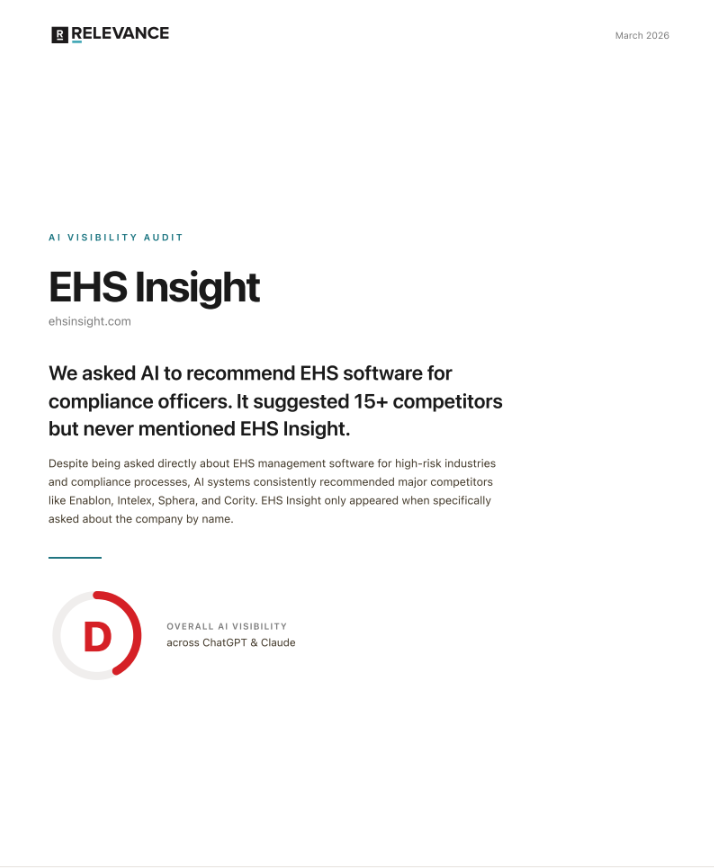
You’re not imagining it. The drop in CTR, the weird gaps in attribution, the “we’re getting impressions but not visits” conversations. Something is shifting in how buyers discover and evaluate products, and AI interfaces are quietly sitting in the middle of it.
The challenge is you’re being asked to justify the budget in a system that wasn’t designed to measure this shift. Leadership still wants clean CAC, clear attribution, and predictable ROI. AI visibility offers none of that cleanly yet.
The teams getting buy-in aren’t proving everything. They’re reframing the problem, quantifying the risk, and showing where revenue is already leaking.
Here’s how they’re doing it.
1. Anchor AI visibility to existing demand capture, not new spend
The fastest way to get this killed is pitching AI as a new channel. It’s not. It’s a redistribution of demand you already pay to capture.
When a buyer searches inside ChatGPT or Perplexity instead of Google, the intent doesn’t change. Your visibility does.
High-performing teams map AI queries directly to their highest-value search terms and show overlap. When leadership sees that “best payroll software” exists in both environments, the conversation shifts from experimentation to missed revenue.
This is especially effective in B2B where 60% to 70% of research happens before a sales conversation, according to Gartner’s B2B buying research. If AI is intercepting even part of that journey, invisibility becomes a pipeline problem, not a marketing experiment.
2. Quantify the revenue leakage from declining CTR
This is where you move from narrative to math.
Instead of saying CTR is dropping, translate it into revenue loss. Even directional math changes the conversation.
Estimated revenue loss framework:
- Monthly impressions for key terms
- Historical CTR vs current CTR
- Conversion rate from organic traffic
- Average deal value or LTV
Even conservative modeling surfaces uncomfortable numbers.
Example from a SaaS client:
- 120,000 monthly impressions
- CTR dropped from 4.2% to 3.1%
- 2.8% site conversion rate
- $8,000 average deal value
That delta equated to roughly $295K in annualized pipeline loss.
No CFO ignores that.
The point is not precision. It’s making the invisible visible.
3. Reframe attribution from clicks to influence
AI visibility breaks last-click attribution. If you try to force it into that model, it will always look like it underperforms.
The shift is toward influence-based measurement, which many teams already use for content and brand.
What leading teams are actually tracking:
- Branded search lift post content deployment
- Direct traffic spikes tied to topic clusters
- Sales call mentions of AI tools or sources
- Win rate differences in influenced vs non-influenced deals
Forrester has been pushing this direction for years with “revenue influence” models, especially in complex B2B journeys.
You’re not abandoning rigor. You’re adapting to a reality where the click is no longer the only signal of value.
4. Position AI visibility as a compounding growth moat
Leadership understands moats. Use that language.
AI visibility behaves much closer to SEO than paid media, but with a stronger winner-take-most dynamic. Once a source becomes “trusted,” it gets repeatedly cited.
Instead of a basic table, frame it as a growth moat comparison:
- Paid search requires continuous spend to maintain position
- SEO builds authority over time but remains competitive
- AI visibility concentrates exposure into fewer, repeatedly cited sources
McKinsey’s research on digital winner-take-most dynamics supports this pattern. Early authority compounds disproportionately.
This is why waiting is risky. Late entrants are not just behind. They are often excluded.
5. Connect AI visibility to category ownership, not traffic
Traffic is a lagging indicator. Category perception drives conversion.
AI interfaces compress consideration sets. Instead of 10 blue links, buyers often see 3 to 5 summarized recommendations.
If you are not in that summary, you effectively do not exist.
The closest parallel is what happened in SEO with featured snippets, but more extreme.
The Nurx case showed what happens when you win concentrated visibility. Organic traffic grew 49.7% and search-driven acquisition increased nearly 6x by owning specific healthcare queries .
AI visibility is that dynamic with fewer slots and higher trust.
This is not about incremental traffic. It’s about being the default answer.
6. Position it as a hedge against platform volatility
Every leadership team has felt platform risk in the last five years.
- Meta CPM spikes
- Google CPC inflation
- Attribution loss from iOS changes
AI visibility gives you exposure in a channel that is still under-monetized and less saturated.
OpenAI and similar platforms are prioritizing answer quality over ad density today, which creates a temporary window where organic influence matters more than spend.
That window will not stay open forever.
Framing this as risk diversification, not just opportunity, resonates especially well with finance stakeholders.
7. Start with controlled experiments, not full-scale rollouts
The teams getting budget approved are not pitching strategy decks. They’re pitching contained pilots.
A strong pilot structure looks like:
- 15 to 25 high-intent queries mapped to revenue
- Content optimized for AI citation and summarization
- Tracking visibility across AI platforms weekly
- Measuring downstream signals over 60 to 90 days
This reduces perceived risk while creating tangible outputs leadership can evaluate.
It mirrors how modern growth teams already operate.
This is the same philosophy used in authority-building campaigns where compounding visibility, not one-off wins, drives long-term ROI .
Expert perspective: validating the financial case
“The biggest mistake I see is teams trying to prove AI ROI with the wrong metrics. The real risk isn’t underperformance. It’s invisibility during high-intent moments. By the time revenue drops, the damage is already done.”
— Head of Growth, Series B SaaS (anonymous for confidentiality)
This aligns with what we’re seeing across accounts. The lag between visibility loss and revenue impact makes early investment feel optional when it’s actually preventative.
Closing
You don’t need perfect attribution to justify AI visibility spend. You need a clear narrative about risk, demand capture, and compounding advantage. The teams winning budget aren’t proving everything upfront. They’re showing where revenue is already leaking and creating structured ways to learn fast. In a landscape where interfaces change faster than measurement frameworks, that’s often enough to move forward.