Relevance is a generative engine optimization company that helps brands become the answer—not just an option—when AI systems respond to your customers’ questions. Our GEO services position your content to be retrieved, synthesized, and cited by AI platforms that shape buying decisions.
Book a strategy call with Relevance
See how your brand shows up in ChatGPT, Perplexity, and Google AI Overviews — and get a prioritized GEO plan.
- Baseline citation & share-of-voice snapshot
- Top GEO quick wins for content, entities, and technical setup
- Clear next steps (no-pressure)
Why Generative Engine Optimization matters today
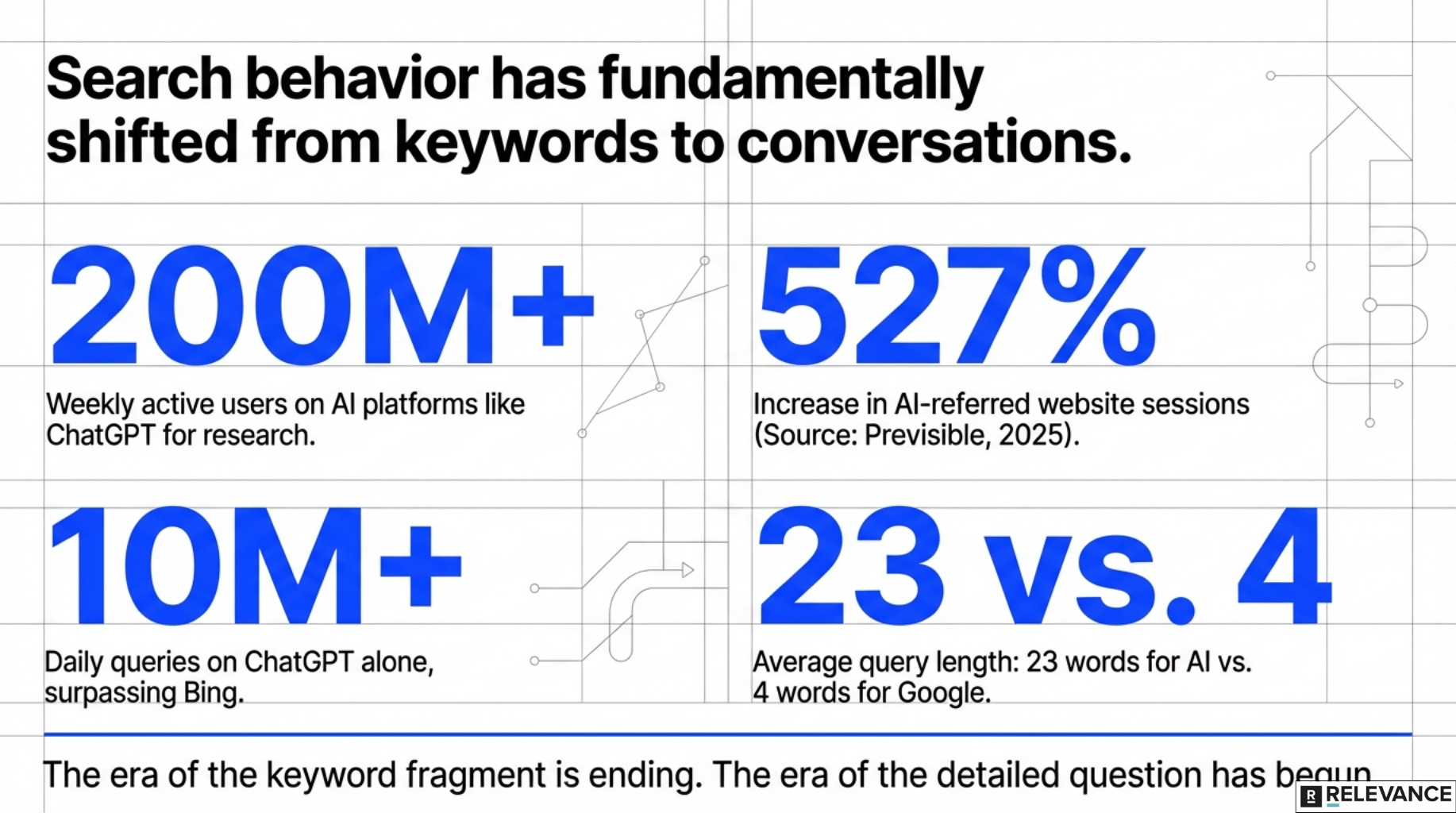
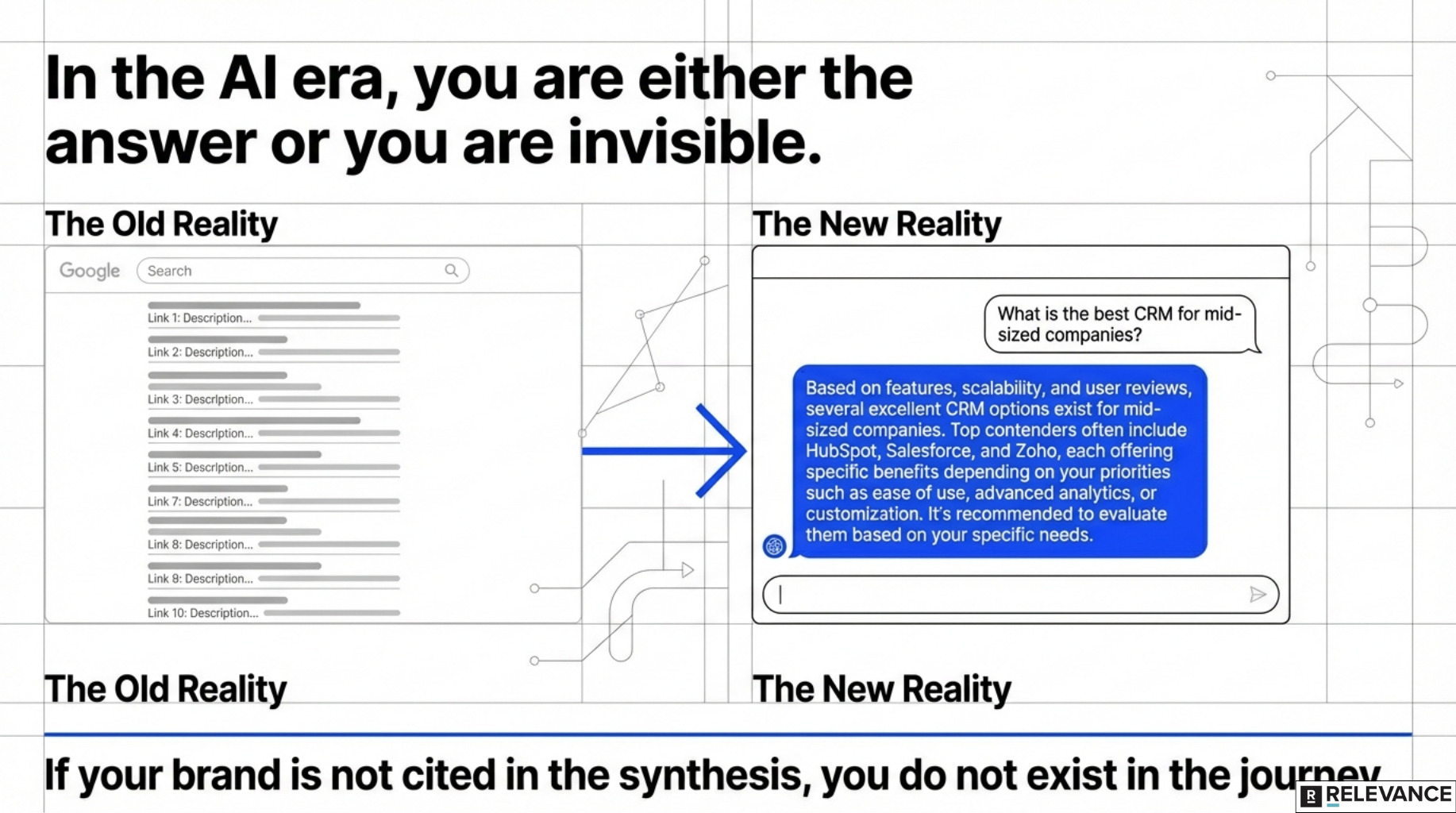
Search behavior has fundamentally shifted. Over 200 million people now use AI platforms like ChatGPT to find information, make purchasing decisions, and research vendors. When someone asks an AI “What’s the best CRM for mid-sized companies?” or “Which agency should I hire for SEO?”—your brand is either part of the answer or invisible.
- 527% — increase in AI-referred website sessions in early 2025 (Previsible)
- 23 words — average AI search query length vs. 4 words on Google (a16z)
- 10M+ — queries per day on ChatGPT alone—more than Bing
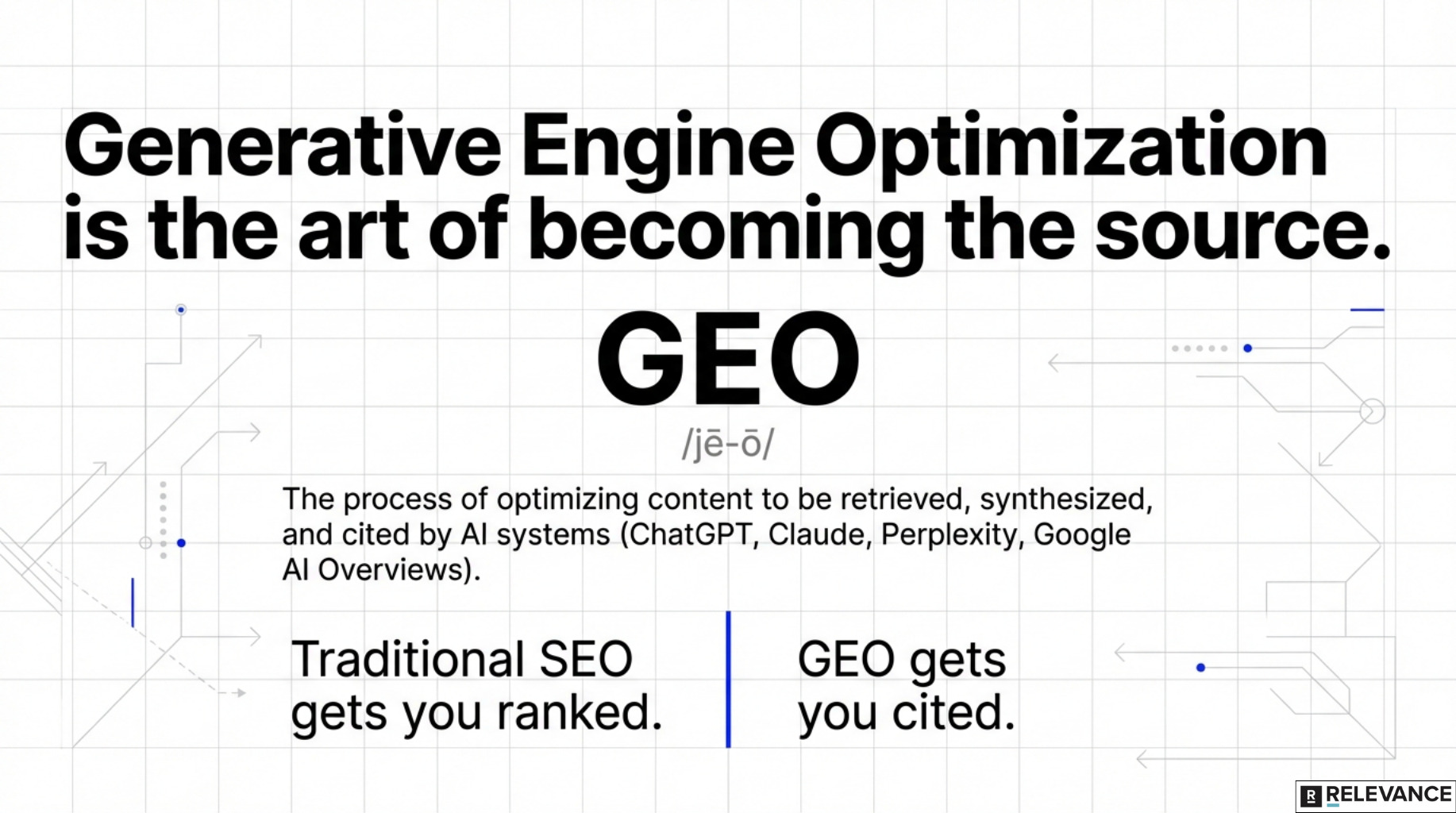
Traditional SEO gets you ranked. Generative engine optimization gets you cited. When AI synthesizes answers from multiple sources, being in the response—not just in the search results—determines whether your brand influences the decision.
What is Generative Engine Optimization?
Generative Engine Optimization (GEO) is the practice of structuring your digital content and managing your online presence to improve visibility in responses generated by AI systems like ChatGPT, Google Gemini, Claude, Perplexity, and Microsoft Copilot.
In simpler terms, generative engine optimization means making your content readable, citable, and trusted by AI engines so they include your information when answering user questions—rather than just helping you rank in traditional search results.
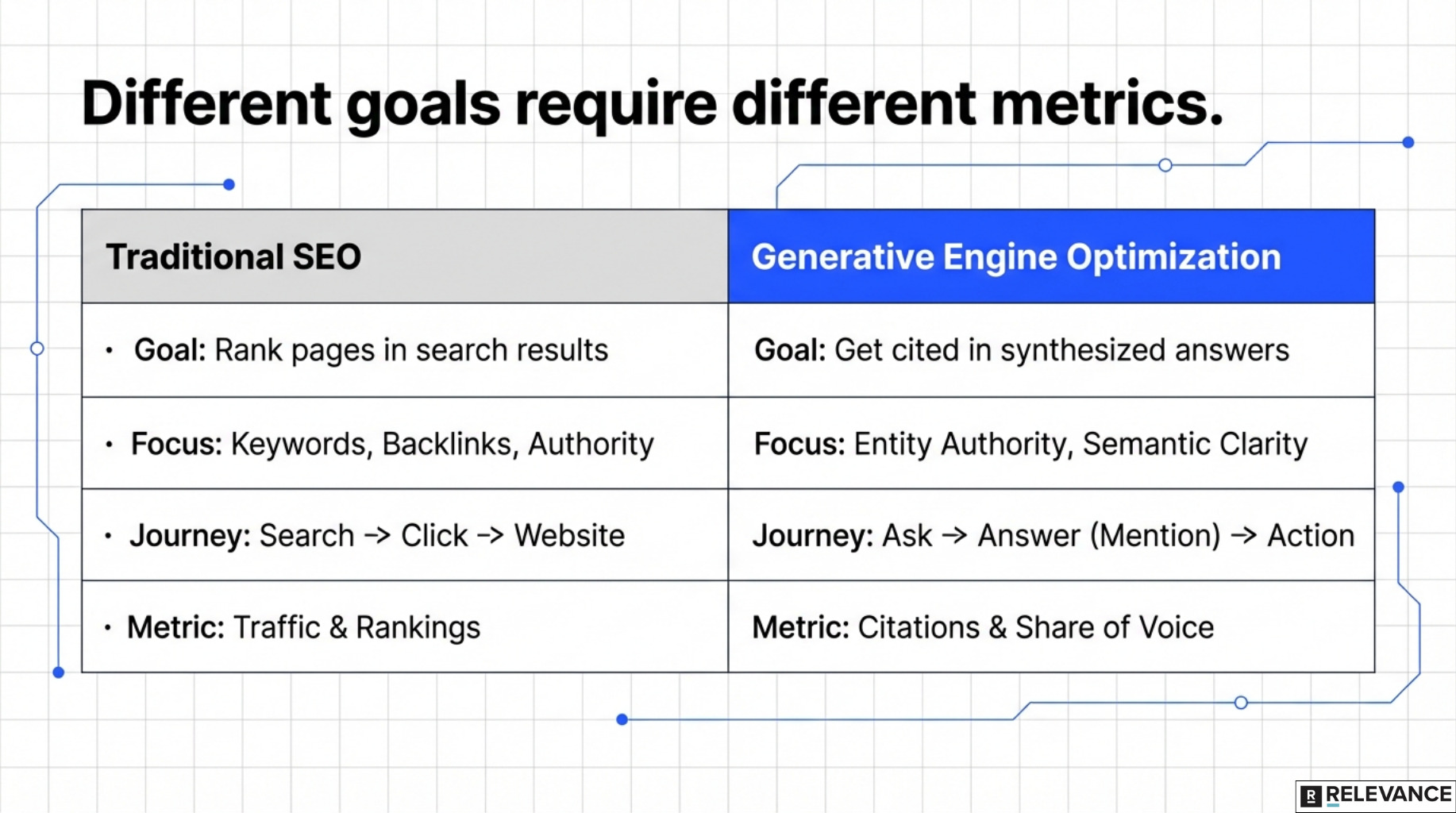
Unlike traditional SEO, which focuses on ranking web pages in search results, GEO focuses on making your content citable, retrievable, and authoritative enough that AI systems include your information when generating answers.
GEO definition
Generative Engine Optimization (GEO) is the process of optimizing content to appear as sources and citations in AI-generated responses from platforms like ChatGPT, Perplexity, Google AI Overviews, and Claude. Also known as generative search optimization, AI search optimization, LLMO (Large Language Model Optimization), or AEO (Answer Engine Optimization).
 How does GEO work?
 How does GEO work?
Generative engine optimization works by shaping your content so that AI systems can understand, trust, and reuse it in their responses—rather than treating it as just another indexed page. Here’s the fundamental process:
1. AI retrieval process
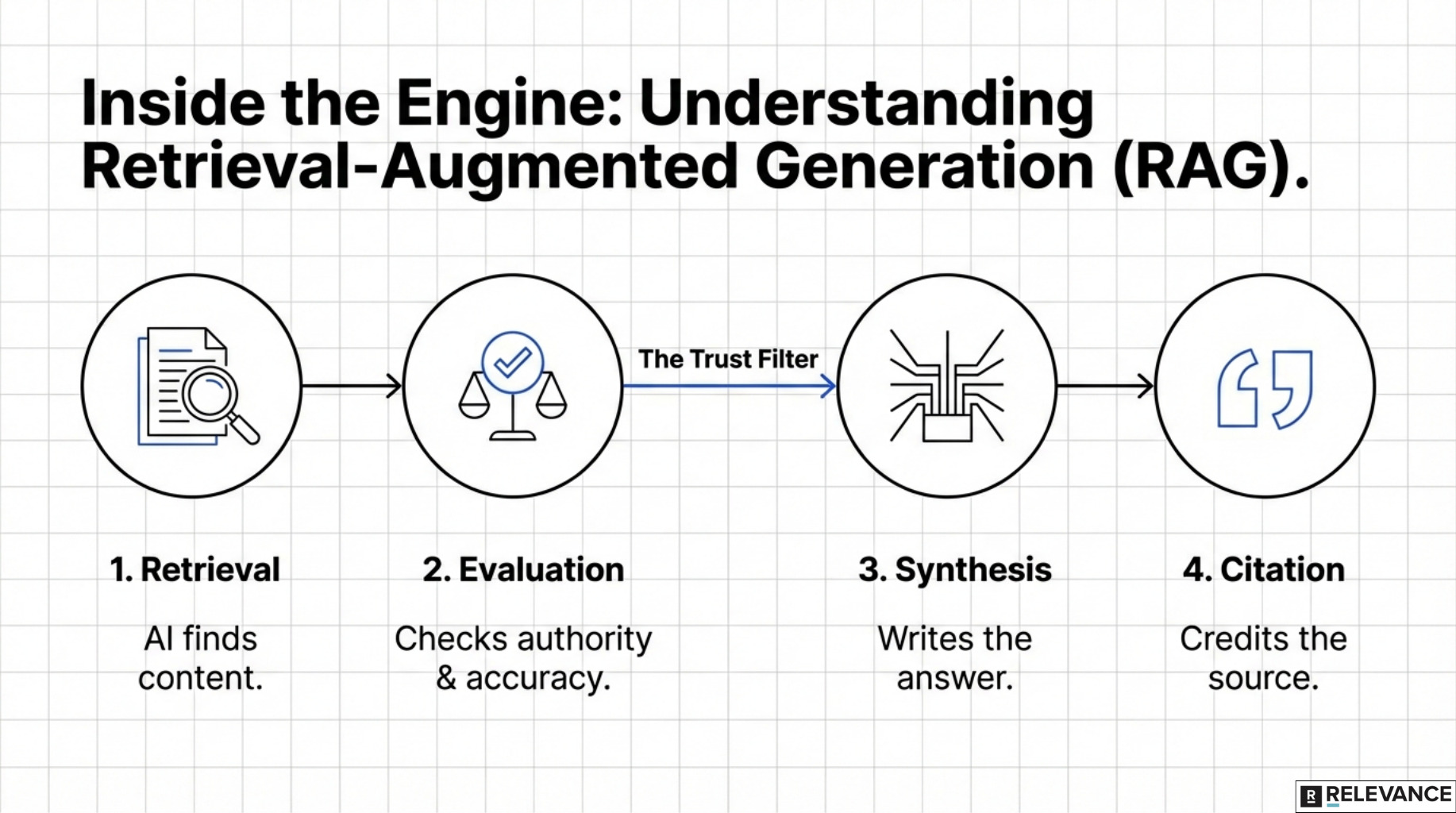
Modern AI search engines use Retrieval-Augmented Generation (RAG) architectures. When a user asks a question, the AI doesn’t just rely on its training data—it actively retrieves relevant content from indexed sources, evaluates it for authority and relevance, and then synthesizes an answer.
2. Content evaluation
AI systems evaluate content differently than traditional search algorithms. They look for semantic clarity, factual accuracy, entity relationships, and signals that indicate expertise and trustworthiness. Content that’s vague, poorly structured, or lacks clear attributable claims is less likely to be retrieved and cited.
3. Answer synthesis
When generating responses, AI systems pull information from multiple sources, synthesize it into a coherent answer, and decide which sources to cite. Your goal with GEO is to ensure your content is selected as one of those cited sources.
4. Citation selection
AI platforms increasingly cite their sources. Getting your brand cited—not just having your information used—builds awareness and drives qualified traffic. GEO optimizes for citation-worthiness, not just information retrieval.
Key Insight: The fundamental shift from SEO to GEO is this: SEO helps you rank so users click through to your site. GEO helps you get cited so users encounter your brand within the AI’s answer—whether they click through or not.
Book a strategy call with Relevance
See how your brand shows up in ChatGPT, Perplexity, and Google AI Overviews — and get a prioritized GEO plan.
- Baseline citation & share-of-voice snapshot
- Top GEO quick wins for content, entities, and technical setup
- Clear next steps (no-pressure)
Generative Engine Optimization techniques
Effective GEO requires a combination of content, technical, and authority-building techniques. Here are the proven strategies for improving your visibility in AI-generated responses:
Content optimization techniques
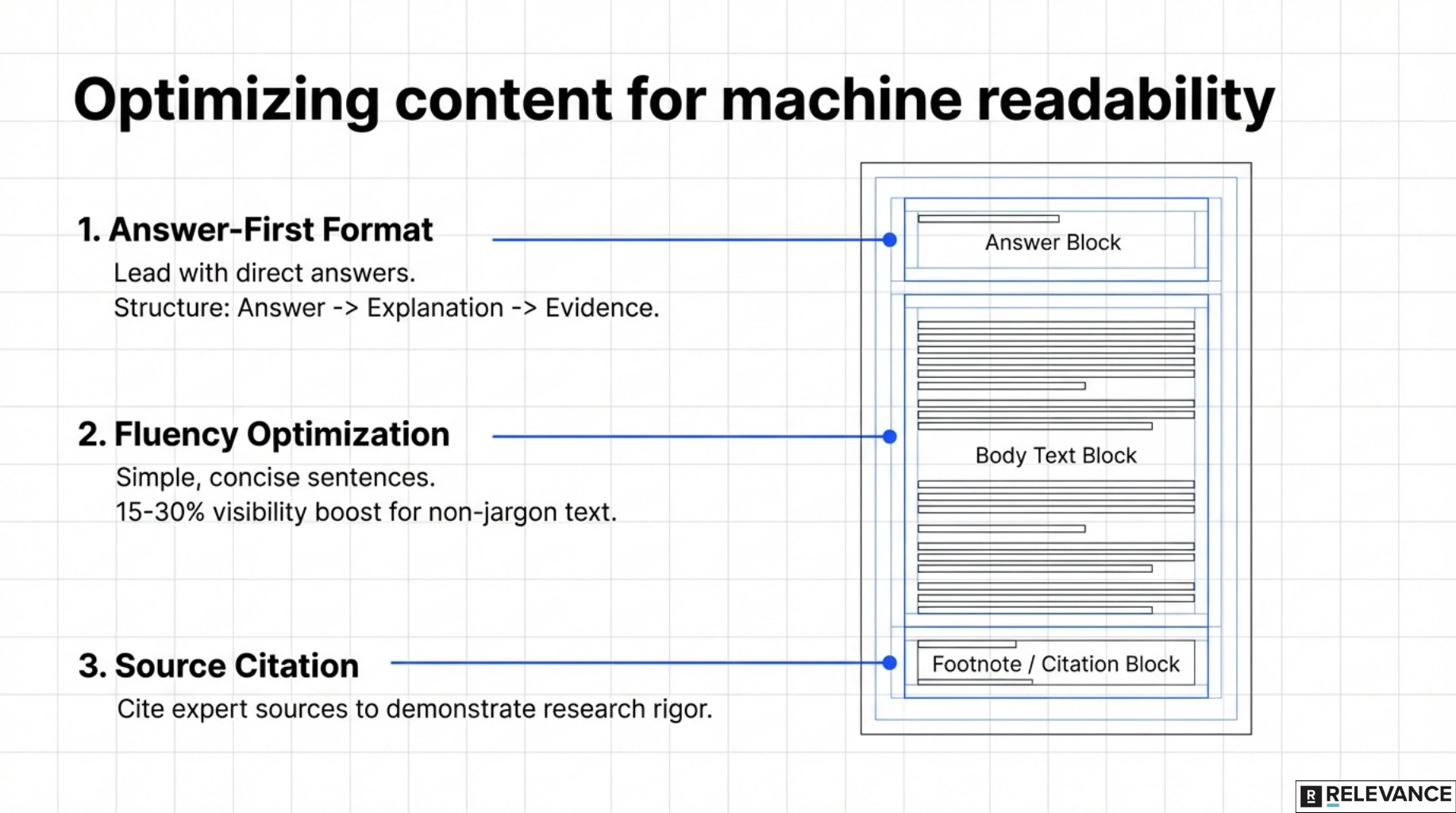
1. Answer-first formatting Structure content to lead with clear, direct answers to questions. AI systems extract information more effectively when the answer appears early and is clearly stated. Use an “answer → explanation → evidence” structure.
2. Statistics addition Include relevant statistics with proper source citations. Research shows that adding statistics can improve AI visibility by up to 37% in certain domains. AI systems favor data-backed claims they can verify and cite.
3. Expert quotations Incorporate quotes from recognized experts with proper attribution. Quotation addition significantly improves citation rates, especially for topics in history, society, and explanatory content.
4. Source citation within content Cite credible sources within your own content. Content that demonstrates research rigor by citing authoritative sources is more likely to be treated as authoritative itself.
5. Fluency optimization Write clearly and concisely. Well-structured, easy-to-read content that AI can easily parse shows 15-30% improvement in visibility. Avoid jargon, use shorter sentences, and organize information logically.
Technical GEO techniques
6. Schema markup implementation Use Schema.org structured data to help AI understand your content’s context. Implement FAQ schema, HowTo schema, Organization schema, and Article schema where appropriate.
7. AI crawler access: Ensure AI crawlers (GPTBot, PerplexityBot, ClaudeBot, Anthropic-AI) can access your content. Check your robots.txt file and don’t inadvertently block these crawlers.
8. JavaScript reduction: Minimize JavaScript dependency for critical content. AI crawlers often struggle with JS-heavy sites. Ensure your key information is accessible in the initial HTML.
9. Content freshness signals: Maintain updated timestamps and refresh content regularly. AI systems favor recent, maintained content over stale pages.
Authority-building techniques
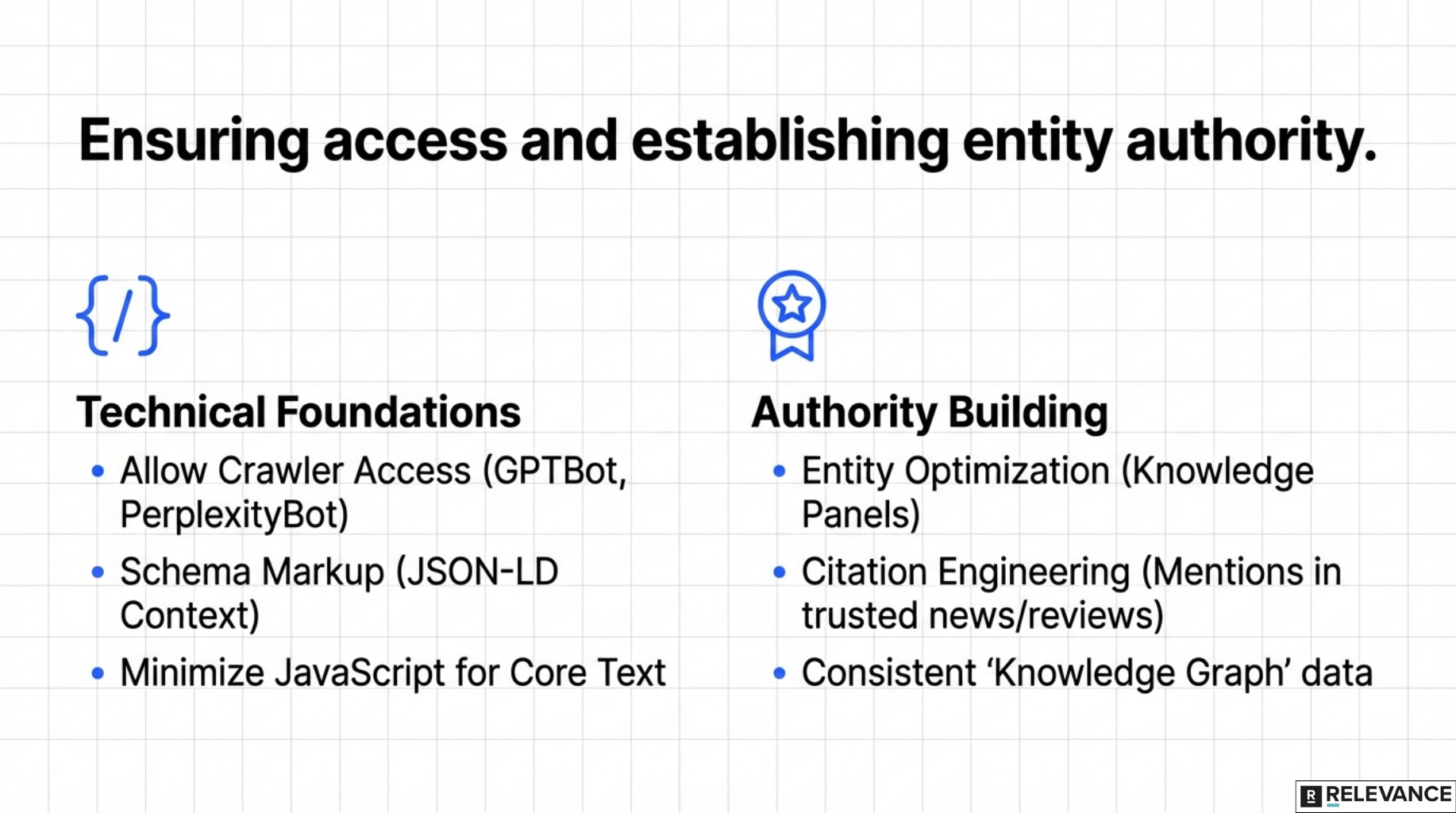
10. Entity optimization: Build clear entity representations for your brand, products, and key people. Claim and optimize knowledge panels, maintain consistent information across the web, and establish clear entity relationships.
11. Citation engineering: Get mentioned and cited by authoritative sources that AI systems trust. This includes industry publications, news outlets, review platforms, and high-quality third-party content.
12. Multi-platform presence: Extend your content across platforms like LinkedIn, Medium, YouTube, and industry forums. AI systems aggregate information from multiple sources, so a broader presence increases the likelihood of retrieval.
What doesn’t work: keyword stuffing. Unlike traditional SEO, keyword stuffing actually decreases visibility in AI responses. Research shows simple keyword manipulation performs worse than baseline in generative engine results. Focus on quality and clarity, not keyword density.
Generative Engine Optimization tools
The right tools are essential for tracking AI visibility, identifying optimization opportunities, and measuring GEO performance. Here’s an overview of the leading GEO tools:
AI Visibility tracking tools
| Tool | Best For | Key Features |
|---|---|---|
| Profound | Enterprise teams | Comprehensive AEO platform, real-time tracking across 10+ AI engines, HIPAA compliant |
| Writesonic | Full-stack GEO + SEO | AI visibility tracking, citation analysis, content optimization in one platform |
| Semrush AI Toolkit | Teams already using Semrush | Brand visibility across LLMs, competitor benchmarking, integrates with existing SEO workflows |
| Ahrefs Brand Radar | SEO teams expanding to GEO | AI mention tracking, brand visibility monitoring, familiar interface |
| HubSpot AI Search Grader | Free visibility check | Free tool for basic AI visibility analysis across ChatGPT, Perplexity, Gemini |
| Otterly AI | SMBs and agencies | GEO audits, page-level optimization recommendations, affordable pricing |
Content optimization tools
- Frase – Question research and answer-first content optimization
- MarketMuse – Content intelligence with GEO-adjacent features
- Clearscope – Semantic content optimization
- InLinks – Entity SEO and internal linking optimization
Technical implementation tools
- Schema.org validator – Structured data validation
- Google Rich Results Test – Schema implementation testing
- Screaming Frog – Technical auditing including AI crawler access
As a GEO agency, we use these tools in combination to provide comprehensive tracking, optimization, and reporting for our clients.
GEO certification & learning resources
As generative engine optimization becomes a critical marketing skill, several certification programs and learning resources have emerged:
GEO certification programs
- Coursera GEO Specialization (Edureka) – Three-course program covering foundations, content optimization, and business strategy. Includes practical projects and a certificate of completion.
- SkillUp AI SEO & GEO Course (Coursera) – Practical course on optimizing content for AI-driven search engines with hands-on exercises.
- Muck Rack GEO Fundamentals – Certificate program focused on monitoring and influencing brand visibility across AI-generated answers.
- Obility GEO Certification – Free educational resources with quiz-based certification for digital marketers.
- GetCito GEO Course – Free 7-day training covering GEO fundamentals with certificate of completion.
Academic research & resources
For those interested in the academic foundations of GEO:
- GEO: Generative Engine Optimization (Aggarwal et al., 2024) – The foundational academic paper from Princeton University and Georgia Tech that established GEO methodology and tested optimization strategies. Available on arXiv.
- GEO-BENCH – The benchmark dataset of 10,000 queries used for GEO research, available on the paper’s GitHub repository.
How GEO Differs from SEO
| Dimension | Traditional SEO | Generative Engine Optimization (GEO) |
|---|---|---|
| Primary Goal | Rank pages in search results | Get cited in AI-generated answers |
| Success Metric | Rankings, clicks, traffic | Citations, brand mentions, AI visibility share |
| Optimization Focus | Keywords, backlinks, page authority | Entity authority, content structure, semantic clarity |
| Content Strategy | Target search intent, optimize for CTR | Create citable facts, structured answers, authoritative claims |
| Technical Requirements | Crawlability, indexability, Core Web Vitals | Schema markup, AI crawler access, semantic structure |
| User Journey | Search → Click → Website → Convert | Ask AI → Get answer with your brand → Direct action |
Key Platforms for GEO
Effective GEO strategies optimize for visibility across the major AI platforms where your audience asks questions:
- ChatGPT (OpenAI) – The largest conversational AI platform with 200M+ weekly users
- Google AI Overviews – AI-generated summaries appearing at the top of Google Search
- Perplexity – AI-powered search engine that cites sources directly
- Claude (Anthropic) – Growing enterprise adoption for research and analysis
- Microsoft Copilot – Integrated across Microsoft 365 and Bing
- Google Gemini – Google’s multimodal AI assistant
What we do for Generative Engine Optimization services
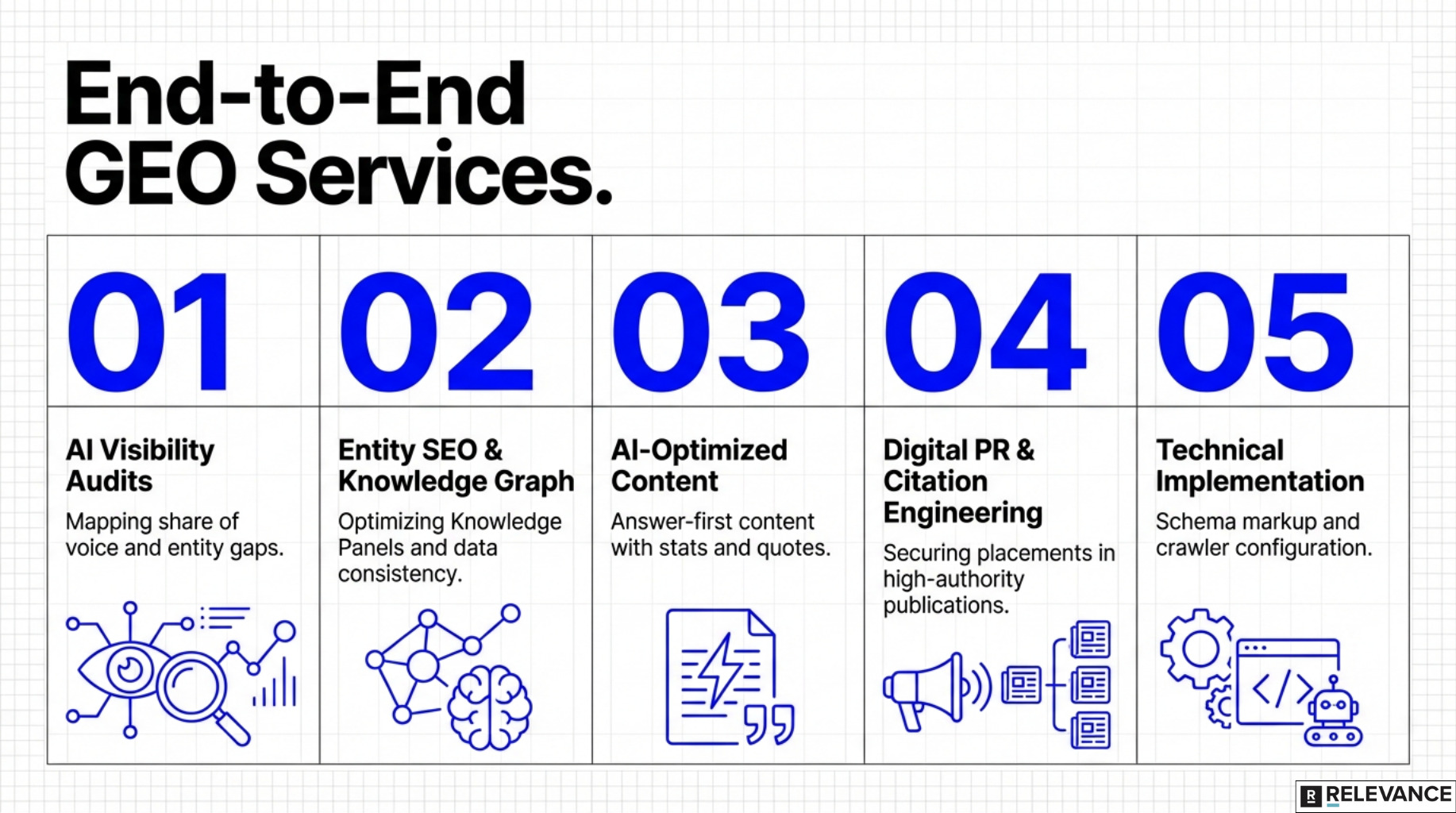
As a full-service generative engine optimization company, Relevance provides end-to-end GEO services designed to increase your brand’s visibility, accuracy, and authority in AI-generated responses.
AI Visibility audit & competitive analysis
We start by mapping how your brand currently appears (or doesn’t appear) across major AI platforms. Our audit reveals:
- Current citation frequency and context across ChatGPT, Perplexity, and Google AI Overviews
- Competitive share of voice in AI responses for your key topics
- Content gaps where competitors are being cited and you’re not
- Entity clarity issues that confuse AI about your brand, products, or expertise
- Technical barriers preventing AI crawlers from accessing your content
Deliverable: Comprehensive AI visibility report with prioritized recommendations and competitive benchmarks.
Entity SEO & knowledge graph optimization
AI systems understand your brand through entities—structured representations of who you are, what you do, and why you’re authoritative. We optimize your entity presence to ensure AI accurately represents your brand.
- Knowledge panel optimization across Google and Bing
- Wikipedia and Wikidata entity development (where appropriate)
- Schema markup implementation for organization, products, services, and people
- Consistent NAP (name, address, phone) and entity data across the web
- Expert author entities with proper E-E-A-T signals
Deliverable: Complete entity audit with implementation roadmap and ongoing monitoring dashboard.
AI-Optimized content development
Content that ranks well in traditional search isn’t always content that gets cited by AI. Our content team creates and optimizes content specifically structured for AI retrieval and synthesis.
- Answer-first content formatting with clear, citable statements
- Statistics and data integration with proper source attribution
- FAQ sections structured for direct answer extraction
- Comparison content and “best of” guides AI systems favor
- Expert quotes and attributable insights that increase citation likelihood
- Semantic topic coverage that establishes topical authority
Deliverable: Monthly content briefs, published content, and optimization of existing high-value pages.
Citation engineering & digital PR
AI systems learn what’s authoritative partly by seeing who gets cited by other credible sources. Our citation engineering approach builds the external signals that establish your brand as a trusted reference.
- Placement in industry publications and high-authority news sources
- Expert commentary and contributed thought leadership content
- Listicle and “best tools/companies” inclusion strategies
- Review platform optimization (G2, Capterra, industry-specific platforms)
- Reddit, Quora, and forum presence development
- Strategic guest posting with proper author attribution
Deliverable: Monthly outreach report, secured placements, and citation tracking dashboard.
Technical GEO implementation
Making your content accessible to AI crawlers and structurally optimized for retrieval requires specific technical implementations beyond traditional SEO.
- AI crawler access configuration (GPTBot, PerplexityBot, ClaudeBot)
- Schema.org markup implementation for enhanced machine readability
- XML sitemap optimization for AI indexing
- JavaScript rendering optimization (AI crawlers struggle with JS-heavy sites)
- Content freshness signals and timestamp optimization
- Structured data validation and testing
Deliverable: Technical implementation documentation, ongoing monitoring, and quarterly technical audits.
GEO performance tracking & reporting
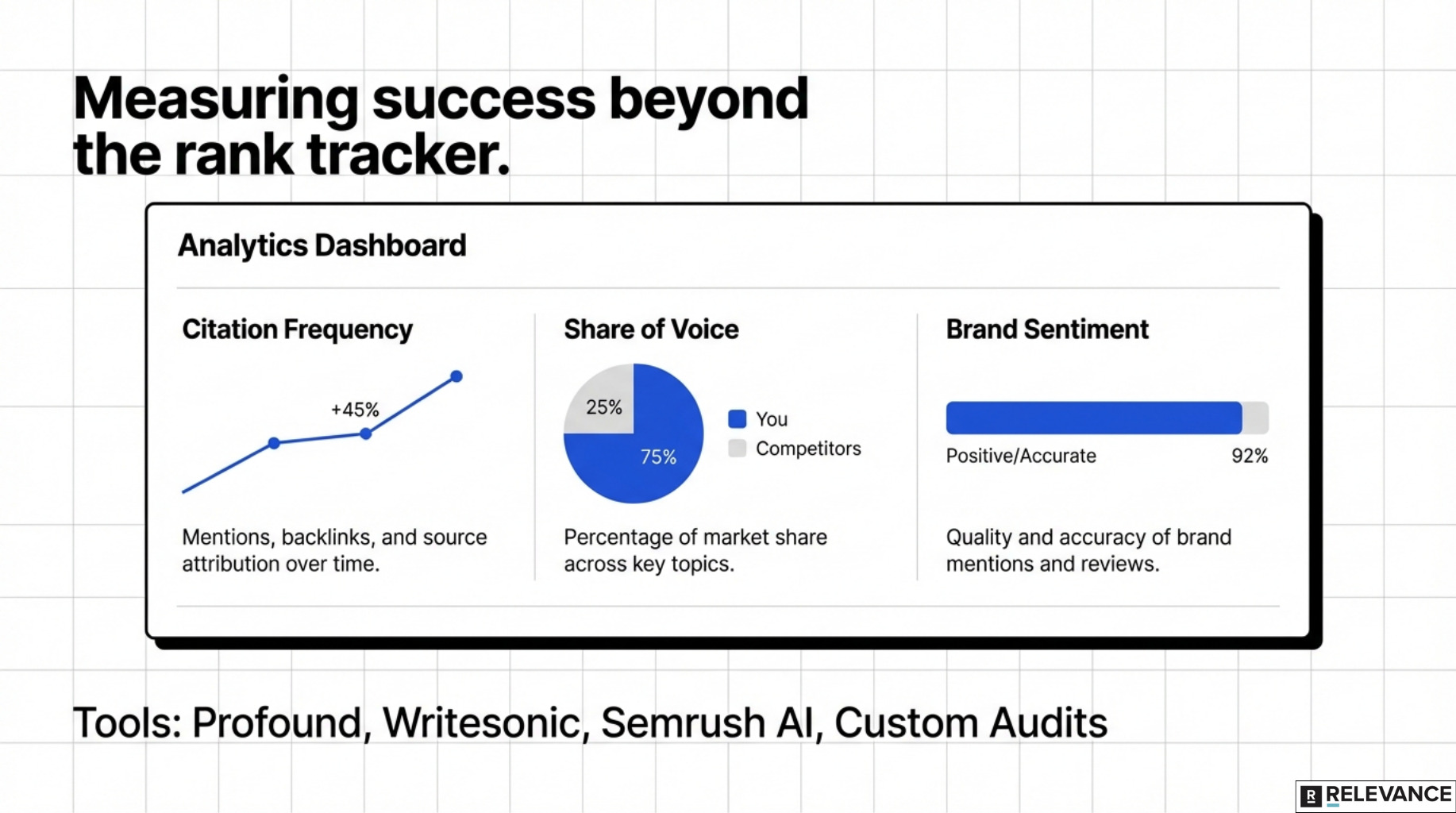
Unlike traditional SEO with established metrics, GEO requires new measurement approaches. We track the metrics that actually indicate AI visibility performance.
- AI citation monitoring across ChatGPT, Perplexity, Claude, and Copilot
- Brand mention sentiment and accuracy tracking in AI responses
- Share of voice measurement vs. key competitors
- AI-referred traffic attribution
- Prompt testing and response tracking for priority queries
- Monthly executive reporting with actionable insights
Deliverable: Live dashboard access, monthly performance reports, and quarterly strategy reviews.
How our GEO process works
Our generative engine optimization methodology combines proven SEO fundamentals with AI-specific strategies developed through extensive testing and research.
- Step 1: Discovery & audit: We analyze your current AI visibility, map your entity landscape, identify content gaps, and benchmark against competitors. This phase typically takes 2-3 weeks and establishes your baseline metrics.
- Step 2: Strategy development: Based on audit findings, we develop a prioritized GEO strategy covering entity optimization, content development, technical implementation, and citation building—tailored to your specific industry, audience, and competitive landscape.
- Step 3: Technical foundation: Before scaling content efforts, we ensure your technical foundation supports AI discoverability. This includes schema implementation, crawler access configuration, and structural optimizations.
- Step 4: Content & citation execution: We conduct ongoing content optimization, new content development, and citation building. This is continuous work that compounds over time as your entity’s authority grows.
- Step 5: Measurement & optimization: We continuously monitor AI visibility metrics, test prompt responses, and refine strategy based on what’s working. Monthly reporting keeps you informed on progress and upcoming priorities.
Research-backed GEO strategies
Our approach is informed by the latest academic research on how generative AI systems retrieve and cite sources, including the foundational GEO research from Princeton University and Georgia Tech.
Book a strategy call with Relevance
See how your brand shows up in ChatGPT, Perplexity, and Google AI Overviews — and get a prioritized GEO plan.
- Baseline citation & share-of-voice snapshot
- Top GEO quick wins for content, entities, and technical setup
- Clear next steps (no-pressure)
What the research shows
The original GEO research paper (Aggarwal et al., 2024) tested multiple optimization strategies and measured their impact on visibility in AI-generated responses:
- Statistics addition: Adding relevant statistics with citations improved visibility by up to 37% in certain domains. Data-driven claims with proper attribution are more likely to be cited.
- Quotation addition: Including expert quotes with proper attribution significantly improved citation rates, especially in domains like history, society, and explanatory content.
- Fluency optimization: Clear, well-structured writing that’s easy to parse improved visibility by 15-30%. AI systems prefer content they can easily extract and synthesize.
- Source citation: Content that cites credible sources is more likely to be treated as authoritative and included in AI responses.
- Keyword Stuffing doesn’t work: Unlike traditional SEO, keyword stuffing actually decreased visibility in AI responses. Quality and clarity matter more than keyword density.
Our content strategies incorporate these findings, creating content tailored to how AI systems evaluate and select sources.
Industries we serve
Our generative engine optimization services work for any brand that needs to be discovered when buyers ask AI for recommendations. We have particular expertise in:
B2B SaaS & technology
Software buyers increasingly use AI to research vendors, compare features, and evaluate options. We help SaaS companies become the recommended solution when prospects ask “What’s the best [software category] for [use case]?”
Professional services
Law firms, consulting firms, and agencies compete for visibility when potential clients ask AI about service providers. Our GEO strategies position professional services firms as the authoritative answer.
E-Commerce & DTC Brands
AI-generated product recommendations are reshaping how consumers discover and evaluate products. We help e-commerce brands get included in AI product recommendations and comparison queries.
Healthcare & life sciences
Healthcare organizations need accurate, compliant representation in AI responses. We help medical practices, health tech companies, and pharmaceutical brands optimize their AI presence while maintaining regulatory compliance.
Financial services
Banks, fintech companies, and financial advisors compete for visibility when consumers and businesses ask AI about financial products and services. Our GEO strategies build trust signals that AI systems recognize.
Manufacturing & industrial
B2B buyers in manufacturing and industrial sectors use AI to research suppliers, evaluate capabilities, and compare solutions. We help manufacturers become the referenced authority in their niche.
Why choose Relevance as your GEO company
Specialized GEO expertise
We’re not an SEO agency that added “GEO” to our services page. Our team has been studying and implementing generative engine optimization strategies since AI search began disrupting traditional discovery. We understand the nuances of how different AI platforms retrieve, evaluate, and cite sources.
Integrated SEO + GEO approach
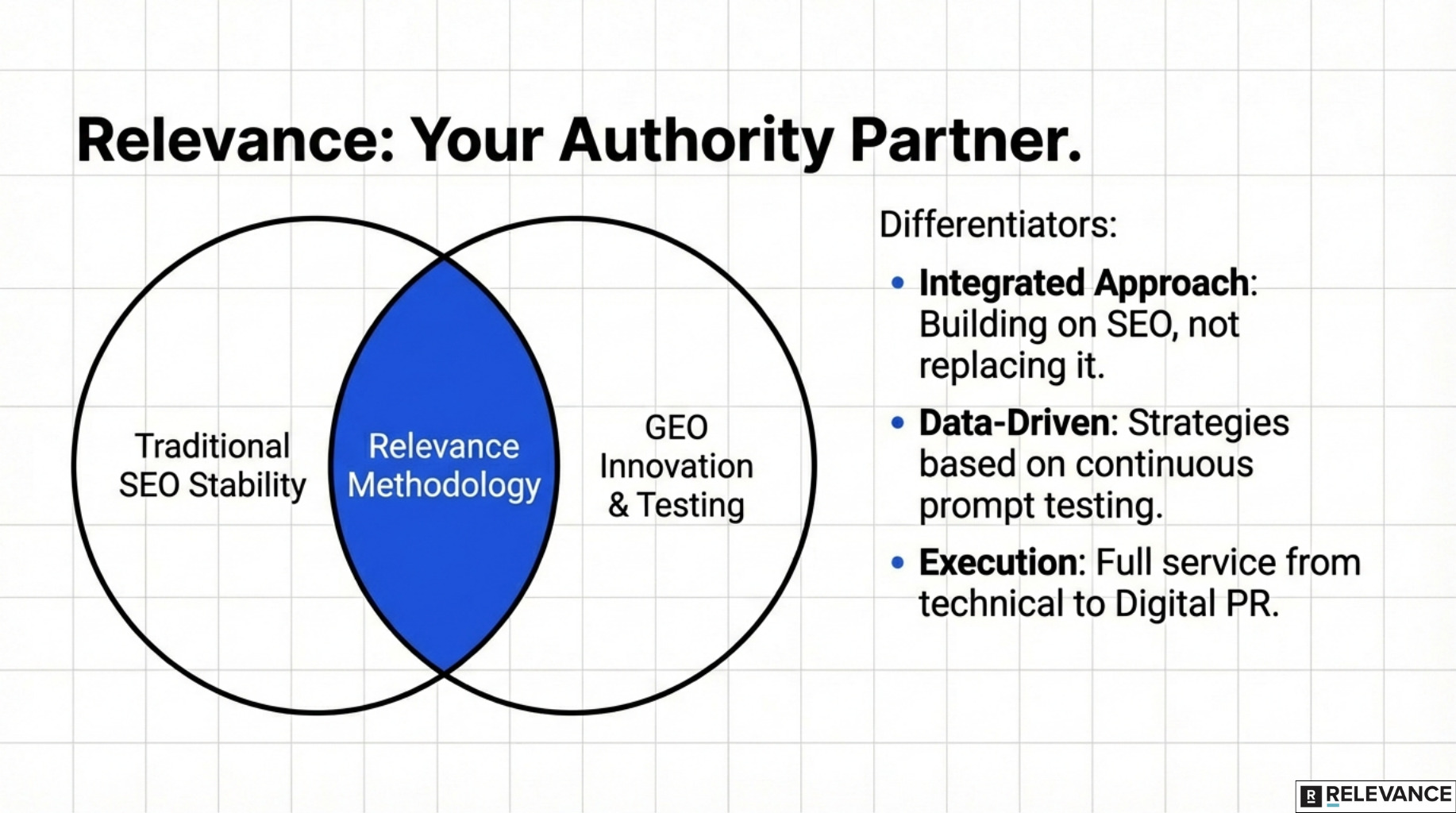
GEO doesn’t replace SEO—it builds on it. Our strategies strengthen your traditional search presence while expanding visibility into AI-generated responses. You get compounding returns from a unified organic strategy.
Data-Driven methodology
We base our strategies on research and testing, not assumptions. Our team continuously tests optimization approaches across AI platforms and measures actual citation impact—so we know what actually moves the needle for visibility.
Transparent measurement
We provide clear reporting on the metrics that matter: citation frequency, share of voice, brand accuracy in AI responses, and AI-referred traffic. You always know where you stand and what progress looks like.
Full-service execution
Strategy without execution is just a plan. Our team handles everything from technical implementation to content production to outreach—so you get actual results, not just recommendations.
Book a strategy call with Relevance
See how your brand shows up in ChatGPT, Perplexity, and Google AI Overviews — and get a prioritized GEO plan.
- Baseline citation & share-of-voice snapshot
- Top GEO quick wins for content, entities, and technical setup
- Clear next steps (no-pressure)
Frequently asked questions
What is generative engine optimization (GEO)?
Generative engine optimization (GEO) is the practice of optimizing your digital content and online presence to improve visibility in AI-generated responses. While traditional SEO focuses on ranking in search engine results, GEO focuses on being cited, referenced, or included when AI systems like ChatGPT, Perplexity, or Google AI Overviews generate answers to user questions.
What’s the difference between GEO and SEO?
SEO optimizes web pages to rank higher in traditional search results, focusing on keywords, backlinks, and technical factors that influence ranking algorithms. GEO optimizes content for retrieval, synthesis, and citation by AI systems, focusing on entity clarity, content structure, authoritative signals, and information that AI can extract and include in generated responses. GEO extends SEO rather than replacing it—both are needed for comprehensive organic visibility.
Is GEO replacing SEO?
No, GEO is not replacing SEO. Traditional search engines still drive most organic traffic, and SEO remains essential. However, GEO is becoming increasingly important as more users turn to AI platforms for information and recommendations. The best approach combines both: strong SEO builds the foundation, while GEO ensures you’re visible wherever your audience asks questions—whether that’s Google, ChatGPT, or Perplexity.
How long does GEO take to show results?
Initial improvements in AI visibility can appear within 4-8 weeks for technical optimizations and content updates. However, building significant entity authority and citation frequency typically takes 3-6 months of consistent effort. GEO is a compounding investment—the longer you build authority signals and quality content, the stronger your AI presence becomes.
How do you measure GEO success?
GEO success is measured through several key metrics: citation frequency (how often your brand is mentioned in AI responses), share of voice (your visibility compared to competitors), brand accuracy (whether AI correctly represents your brand), and AI-referred traffic (visitors coming from AI platforms). We track these metrics across ChatGPT, Perplexity, Google AI Overviews, and other major platforms using specialized monitoring tools.
How much do GEO services cost?
GEO services typically range from $3,000-$6,000/month for small to mid-sized businesses and $10,000-$25,000+/month for enterprise programs with comprehensive content, citation building, and multi-platform optimization. Investment depends on your current AI visibility, competitive landscape, content needs, and scope of platforms covered. Contact us for a custom proposal based on your specific situation.
What AI platforms does GEO cover?
Comprehensive GEO covers all major AI platforms where your audience asks questions: ChatGPT (OpenAI), Google AI Overviews, Gemini, Perplexity, Microsoft Copilot, Claude (Anthropic), and emerging AI search tools. Different platforms have different content preferences and citation patterns, so effective GEO requires understanding the nuances of each.
Can you guarantee AI visibility results?
No ethical GEO agency can guarantee specific citation placement in AI responses, just as no ethical SEO agency can guarantee specific rankings. AI systems continuously evolve, and citation decisions involve many factors outside any agency’s control. What we can guarantee is a research-backed methodology, experienced execution, transparent reporting, and a commitment to continuously improving your AI visibility metrics.
Start showing up in AI responses
The brands investing in generative engine optimization now are capturing AI visibility while competition is still relatively low. As more companies recognize the importance of GEO, the window for early-mover advantage is closing.
Book a strategy call with Relevance
See how your brand shows up in ChatGPT, Perplexity, and Google AI Overviews — and get a prioritized GEO plan.
- Baseline citation & share-of-voice snapshot
- Top GEO quick wins for content, entities, and technical setup
- Clear next steps (no-pressure)