Content is king in digital marketing, with written words still ruling today. But a content marketing trend has become so mainstream it’s hard to ignore its value: visual content.
No wonder Facebook and YouTube are the most popular social networks worldwide. Instagram, Tumblr, and Pinterest are also catching up. Visual elements like images and videos dominate these social media channels, with some of them getting viral.
All-text-without-visuals is a thing of the past—visuals reign in content marketing nowadays. For your campaigns to stay relevant to the times and your audience’s ever-changing needs, beef them up with the right mix of text and visuals.
What our client team is seeing today – December, 2025
From our vantage point today, the center of gravity in visual content marketing has moved to short-form, vertical, AI-assisted video that is anchored in human stories and repurposed across channels.
Here’s what that looks like in practice from our current campaigns and audits:
-
Short-form vertical video is becoming the default “hero” format – Across B2C and a growing share of B2B campaigns we manage, short-form vertical videos (typically 15–60 seconds) are now the primary drivers of reach and engagement, with static images and text-only posts playing more of a supporting role. This mirrors industry data showing that 30–60 second videos are the most effective length for the majority of video marketers and that video is widely viewed as delivering strong ROI.
-
Carousels and mixed-media posts are the workhorses for depth and saves – We consistently see image carousels and posts that mix short clips, screenshots, and simple diagrams outperform single images on saves and shares, especially on Instagram and LinkedIn. These formats act like “mini slide decks” in the feed: they educate quickly, are easy to swipe, and give users a reason to come back to the post.
-
Visual systems are outperforming one-off “pretty posts.” – The brands getting compounding returns aren’t just posting random high-quality visuals—they’re operating from clear visual systems: repeatable templates for hooks, subtitles, product views, and social proof. A consistent visual language makes it much easier to scale creative variations and keep performance stable as algorithms change.
-
Video is now baked into search and demand capture, not just awareness – We’re seeing more conversions and assisted conversions coming from video that’s embedded in landing pages, product pages, and help content—not just from social feeds. This tracks with research showing that video boosts understanding, brand awareness, traffic, and lead generation for most marketers using it.
-
Generative AI is moving into the stack—but “AI-only” content underperforms – In our workflows, AI is most effective when it accelerates production (e.g., concepting hooks, generating b-roll, cleaning up captions) while humans still own the story, script, and on-camera presence. This lines up with wider surveys showing that AI use in marketing is now mainstream, but that both consumers and regulators are wary of misleading or opaque AI-generated content. As a result, we lean heavily on disclosures, brand-safe prompts, and human faces to keep content feeling authentic.
-
Authenticity and trust now function as design requirements. – Our most resilient campaigns build visual trust into the creative: clear labeling when AI tools are used, behind-the-scenes footage, real customers on camera, and minimal “too perfect to be true” AI imagery. This direction is reinforced by studies showing that a significant share of consumers question a brand’s authenticity when they see AI-generated content and are broadly worried about deceptive or AI-manipulated media.
In short: from our experience, the brands winning in 2025 are treating visual content as a system—anchored in short-form video, supported by carousels and long-form assets, and carefully balanced between AI-enabled efficiency and very human storytelling.
What top experts are saying
Our team’s view lines up closely with what many of the most respected voices in content and video marketing are highlighting right now.
-
Video as the default, high-ROI content format – Wyzowl’s long-running State of Video Marketing data shows that video remains a core channel for brands, with the vast majority of marketers reporting good ROI from video and using it to increase brand awareness, traffic, leads, and understanding of their products. Short-form video, in particular, continues to see strong growth and is now a primary investment area for many marketers.
-
Engagement and community as the real edge – Social media strategist Mari Smith is often quoted as saying, “Content is king… but community is queen, and she rules the house.” Her point is that it’s not enough to publish polished videos and graphics; visual content has to spark real conversation, replies, and DMs. That’s consistent with what we see from experts across the social space: formats like Reels, TikToks, and Shorts work best when they are designed for interaction, not just impressions.
-
The play button as a built-in call to action – Michael Litt, co-founder and CEO at Vidyard, famously noted that “The play button is the most compelling call-to-action on the web.” Video strategists often use this idea to argue that if you can replace a static hero image or thumbnail with a strong, on-brand video (or at least a video-style preview), you’ll typically see higher engagement, longer time on page, and better conversion.
-
Content marketing as a conversation, not a broadcast – Doug Kessler, co-founder of Velocity Partners, draws a clear line between old-school promotion and modern content: “Traditional marketing talks at people. Content marketing talks with them.” Applied to visual content, this translates into interactive formats (polls, questions in Stories, comments-friendly hooks) and two-way storytelling instead of one-sided brand monologues.
-
Story-first visuals, not visuals for their own sake – Ann Handley consistently emphasizes that “Great marketing starts with great stories. Be unique, inspire, and connect.” In recent conversations about video and YouTube, she’s argued that the same principles that make great written content—clarity, empathy, and strong narrative—should guide scriptwriting and visual structure. Many thought leaders now frame video as an amplifier of written and strategic assets, not a separate silo.
-
AI as a powerful but sensitive ingredient in visual content – Industry reports and academic work on generative AI in marketing stress two themes: AI can dramatically speed up visual production and testing, but careless use can damage brand equity if visuals feel off-brand, generic, or deceptive. Consumer and ethics surveys echo this, showing that while AI is widely used by marketers, many people remain uncomfortable with AI-generated ads and want clear transparency when AI is involved.
All top marketers should have a visual content strategy
Let’s define first what it means to integrate visuals into a content marketing strategy.
In visual content marketing, you use images, videos, infographics, memes, or other types of visual content (may be accompanied by informative or inspirational text) for your marketing campaigns. Visuals come in an appealing, engaging format to entice people to visit your website, know your brand better, or buy your product or service.
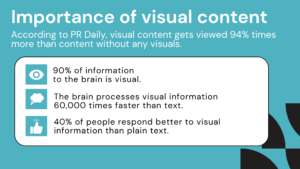
Content marketing becomes successful with the use of well-designed visuals. According to PR Daily, visual content gets viewed 94% times more than content without any visuals.
Marketers see the valuable impact of visual content on growing their business. In the 2018 Content Marketing Institute and MarketingProfs study, B2C marketers chose pre-produced videos (45%) and illustrations or photos (29%) as among the most effective content marketing types for meeting their company’s specific goals.
In the future, visual content will still be the bread and butter of both B2C and B2B content marketing campaigns. Marketers plan to use more pre-recorded videos (77%), images (68%), and live videos (63%), according to a 2018 Social Media Examiner report.
4 benefits of a visual content strategy
If your peers in the digital marketing industry can do it, so can you. Here are four specific ways a visual content strategy can help you achieve your business objectives.
It will raise brand awareness
According to the Social Science Research Network, 65% of people are visual learners – they can retain information better with images, videos, and other visuals than with written words. That’s why UX planning must be a critical element of content marketing strategy.
Additionally, the Wyzowl’s State of Video Marketing 2018 survey found that 83% of consumers who have watched a branded video would consider sharing it with their friends. More shares mean more visibility for your brand.
Want your audience to remember your brand? Use visual content to increase your brand recognition and recall. For one, you can put a watermark of your brand logo in all the visual assets you use online. When an image gets viral, people can easily associate that with your brand.
Check your company website or e-commerce site, as well as your landing pages. Are they just static? Make your brand easier to remember by updating them with compelling photos, videos, and other visuals. Just don’t overdo it.
It will increase website traffic
By 2021, videos will account for 82% of all consumer Internet traffic worldwide, based on the latest forecast by the Cisco Visual Networking Index.
Video production costs a lot of money, but it’s a necessary investment to attract more people to your website. If you hesitate to make videos a part of your content marketing strategy due to budget concerns, consider how much your business will lose in terms of website traffic. Videos have been the rage these days—embrace it.
It will engage customers through visual storytelling
Adding visuals to written content makes your content marketing campaigns more interesting and keeps your audience engaged. Rather than having long blocks of text, for instance, several images that break them up makes your content easier for people to skim and digest.
According to BuzzSumo data, Facebook posts with images had 2.3 times more engagement than those without. Meanwhile, including images to Twitter updates resulted in 150% more retweets than plain text updates.
Visual content also helps you to keep your site visitors on your landing page. This raises the click-through rates to other parts of your website and the visitor’s engagement with your brand.
Why do people prefer to engage with visual content? With just an image that resonates with your audience, you can elicit joy, sadness, shock, fear or anger. That’s how powerful visual storytelling is.
It will improve conversion rates
Ultimately, higher brand awareness, site traffic, and customer engagement from a successful visual content marketing strategy can all lead to increased lead generation and sales.
Video content, for example, is a key driver in the buyer’s journey. The 2018 Wyzowl Video Marketing Statistics Report notes that video has become “a decisive factor” that convinces consumers to purchase or download a product or piece of software.
The report found that a brand’s video influences 81% of viewers to buy a product or service. Also, 95% of people learn more about a product or service by watching an explainer video.
[insert page=’the-role-of-statistics-and-data-in-content-promotion’ display=’single-related-article-02.php’]
Visual content marketing versus content writing
Visual content creation and content writing aren’t mutually exclusive. Together with content planning and promotion, these critical parts make up the content marketing process.
Nevertheless, it helps to know the differences between the two types of content, so you can better strategize your campaigns.
Visual content gets your message across faster
The human brain processes visuals in its visual cortex, a less busy and faster part that’s separate from the busier section that processes words. This is why it’s faster and easier to understand, for instance, a cooking instruction through a video rather than text.
Visuals are easier to remember
Images, videos, and other visuals are processed in the brain’s long-term memory, while words are processed in the short-term memory. When people read text-based information, only 10% to 20% of it gets retained. Add a picture to a written information, and people will recall 65% of it.
Creating visuals is harder than content writing, but not as hard as you think it is
It takes a specialized skill set to produce a stunning infographic or educational video. But even if you’re not a designer, you can still create great visuals. A lot of online visual content marketing tools can help you easily edit images, create memes, and animated GIFs, convert PowerPoint slides to video files, and more.
They’re suitable for different business-customer relationships
Should you use more text or more visuals in your content marketing campaigns? It depends on whether you’re marketing to consumers or to other businesses.
B2C marketers prefer visual content over textual content. The 2018 B2C Content Marketing Report shows that most B2C marketers use pre-produced videos (76%), illustrations or photos (67%), and infographics (59%).
On the other hand, B2B marketers use text-based content more than their B2C counterparts do. According to the 2018 B2B report, B2B marketers use case studies (73%) and ebooks or white papers (71%). Additionally, most B2B marketers said ebooks or white papers (62%) and case studies (47%) were the most effective content marketing type.
Moreover, blogging is more important to B2B (36%) than B2C (22%) marketing, found a recent study by the Social Media Examiner. Meanwhile, more B2C marketers (36%) see the importance of visual content than B2B marketers (25%).
Final Thoughts
Compelling visuals or written words are great on their own. But when you use them both, you can expect greater results.
Do you focus more on visuals or text in your content marketing campaigns? Which one works better for your business? Share your thoughts!
How we wrote this playbook
As a growth marketing, SEO, and PR agency, we built this 2025 visual content marketing playbook by combining what we see every day in live campaigns with fresh, third-party research. Our team reviewed performance across social (Instagram, Facebook, TikTok, YouTube, LinkedIn), search, and owned channels, focusing on metrics like reach, watch time, saves, click-through rate, and assisted conversions for formats such as short-form video, carousels, long-form YouTube, webinars, and static image posts.
To pressure-test those in-platform learnings, we benchmarked them against current industry data. We dug into multi-year video marketing trend reports from Wyzowl and other video analytics summaries to understand how marketers globally are using video, what lengths perform best, and how they’re measuring ROI. We also looked at recent round-ups of content and social media statistics from sources like HubSpot, Forbes Advisor, and other trend reports that track short-form video adoption, TikTok and Reels investment, and how visual formats are impacting sales and lead generation.
Because 2025 visual content is inseparable from AI, we further reviewed current research on generative AI in marketing, including academic and industry work on brand imagery, authenticity, and consumer trust. That included guidance on generative AI and brand visuals, ethical marketing surveys on how comfortable people are with AI in ads, and consumer studies on AI-generated media and authenticity. These resources helped us draw a line between “efficient” AI-assisted production and the kind of over-automated content that can erode brand trust.
Finally, we cross-referenced our own observations with what leading content and video marketing experts are saying today. We reviewed recent interviews, talks, and articles featuring voices like Ann Handley, Mari Smith, Doug Kessler, Michael Litt, and others, along with updated video-trend summaries from platforms and analytics providers such as Tubular Labs and Vidyard. The result is a playbook that reflects both our first-hand client work and the broader direction of the industry going into 2025