

SaaS remains a booming area of the economy, with tens and potentially even hundreds of thousands of apps in existence. It’s crowded out there, and plenty of companies are fighting to stand out from competitors.
That’s where SaaS content marketing comes in. It’s a long-term promotional strategy for SaaS (software as a service) companies. It leans on long-form, optimized, educational content to organically support a marketing strategy over time.
For SaaS marketers, it’s important to realize the power that content can have on marketing initiatives and impact. Let’s take a deeper look at what a SaaS content marketing strategy looks like, why it’s important, how it differs from other marketing, and what it takes to use content to market a SaaS product or service effectively.
What is SaaS Content Marketing?
Before we get too far into the details surrounding SaaS content marketing, let’s expand on the definition of the term itself. Content marketing utilizes various forms of digital marketing content to promote a brand. In the context of a SaaS company, content marketing uses this content to fuel a long-term promotional strategy.
Typically, this kind of marketing consists of lengthy, in-depth content that promotes a B2B customer journey. Over time, SaaS content marketing helps to attract potential users, teach them about a branded solution to their problem, and then convert them into a retained and happy long-term customer.
SaaS content marketing isn’t a “seat of your pants” kind of marketing activity. It requires thoughtful strategy, confident implementation, and prolonged patience if you want to see positive results and a good ROI.
How SaaS Content Marketing differs from content marketing in other industries
SaaS services and products must focus on a lower output of higher-quality content where every piece provides clear value for the user.
This protracted approach is due to the longer commitment that comes with buying third-party software. The last thing a B2B customer wants to do is spend a bunch of money on a SaaS tool, invest in learning it, and then decide it doesn’t work for them. They will make each purchase thoughtfully, and SaaS marketers should oblige with B2B SaaS content that facilitates that journey.
Another difference that separates SaaS content from normal content marketing is the fact that, in the vast majority of cases, a SaaS business is selling to businesses. The B2B sales process requires more red tape and more people involved in making each decision.
This increases the length of the sales cycle. It’s great once you get a potential customer to commit, but getting them to choose your SaaS solution in the first place is the big challenge. Strong content does a lot of that heavy lifting.
The inherently complex nature of a SaaS program also complicates things. You aren’t selling a pair of shoes. Even something like a vitamin supplement might require more customer education, but it isn’t complicated to engage with the product itself.
Even user-friendly SaaS business programs can require a steeper learning curve. They also evolve and are constantly updated, which means ongoing education is often required.
When a SaaS company decides to create content, it can’t be “just another content cluster.” It must be a specific and deliberately crafted resource that bolsters brand awareness and reputation and builds consumer trust at every step.
Why SaaS Content Marketing matters right now
Along with an overwhelming number of competing brands, SaaS platforms face the accelerating nature of AI tools. It has become essential to provide long-form, rich educational content that demonstrates expertise and feeds AI-generated answers.
Two years ago, a SaaS client could still win on volume. Publish enough and something would eventually rank. Those days are over. We’re watching AI-generated answers absorb almost all of the top-of-funnel questions our clients used to capture with thin, 800-word posts.
The pages still earning citations are the ones with a real point of view, original data, and a direct answer in the first paragraph. My advice to most SaaS marketers right now is to cut your publishing volume in half and put the whole budget into depth. One genuinely expert piece is doing the work that ten used to. Work smarter, not harder.
The business case: benefits of SaaS Content Marketing
As is the case with most content marketing, there are some basic benefits that come with developing SaaS content. For instance, when your content is keyword-rich and links to high-quality domains (as well as your own), it can boost your brand awareness.
Dominating SERPs for specific phrases and concepts can also increase brand authority. These naturally lead to higher revenue, often at a fraction of the cost of ongoing PPC (pay-per-click) ads.
Along with these basic content creation benefits, SaaS content functions as a critical resource for end-users. In other words, SaaS resources work as excellent educational tools.
They also help with customer service, providing answers and information to common questions. When a customer knows they can utilize your content to find quality answers to their questions, it has the added benefit of further developing trust and building a stronger long-term connection with your customers.
How SaaS content fits into a growth marketing strategy
The Relevance team sees content marketing as one of the three major parts of a good SaaS growth strategy.
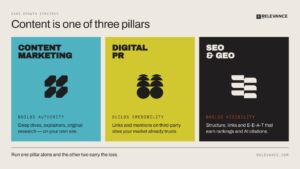
Image Credit: Relevance.com
- Content marketing, which helps build a SaaS company’s authority by creating thoughtful, high-utility onsite content. Deep dives, instructional videos, Q&As, concept pieces, market research — these help establish thought leadership in an industry where authority matters.
- Digital PR cultivates credibility against a backdrop of dozens, hundreds, and even thousands of SaaS competitors. This off-site buzz focuses on brand links and mentions on third-party sites, which signal to consumers, search engines, and AI tools that your company is an important and relevant part of the conversation.
- SEO uses keywords, link building, technical SEO, and other strategies to improve visibility. When your SaaS content meets Google’s E-E-A-T content standards and gains citations in AI tools, it can help your brand show up in organic search results.
7 steps to build a SaaS Content Marketing strategy
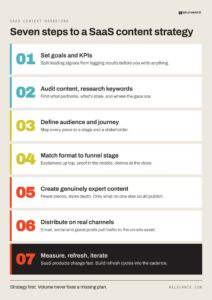
It’s important to develop a content strategy for SaaS marketing that embraces the full potential of the content marketing process. Here is a step-by-step process to make sure you end up with a solid, SaaS-specific strategy you can cater to your brand.
Step 1: Set goals and KPIs
Good content takes time and resources to develop. That’s why you always want to define what success looks like before creating content. Start by researching and establishing the content marketing KPIs that can become your North Star.
In SaaS, SMART goals usually start with tracking awareness. You can also monitor activity in your pipeline through metrics like traffic and engagement, demo requests, and revenue linked to content. It helps to split these into leading KPIs, which signal early momentum, and lagging KPIs, which confirm whether that momentum turned into results.
|
Metric |
What It Measures |
KPI Type |
|
Organic traffic to SaaS content |
Reach and awareness growth from search |
Leading |
|
Content-attributed demo requests |
How many leads a piece moves toward a demo |
Lagging |
|
Pipeline influenced by content |
Revenue in progress tied back to content touchpoints |
Lagging |
|
Retention/expansion tied to onboarding content |
Whether help docs and guides cut churn or drive upsells |
Lagging |
Step 2: Audit existing content and research keywords
Once you have goals, it’s time to review what you already have, content-wise. What is performing? What needs updating? Where are the gaps?
Keyword research helps you align content with search intent. Use it to understand what people are looking for. You can also see where your competitors are getting meaningful visibility this way.
Step 3: Define your audience and buyer’s journey
Map each piece of your content to your customer journey. Where in the sales funnel is each piece relevant? Where should it live? What kind of people do you want to reach at each stage? What are they looking for? What should be motivating them at this point?
For SaaS companies, top-of-funnel should be exploratory and focused on pain points. In contrast, by the bottom of the funnel, you should be addressing specific questions and trying to move readers closer to a decision.
Step 4: Choose the right content types for each funnel stage
Use the format that fits the goal, not just in general but at every step. Here’s what this might look like for a SaaS content strategy:
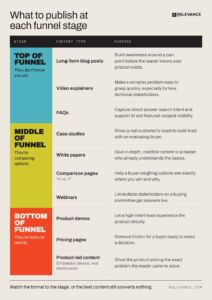
At all stages, channels like social and email can also support distribution and keep people moving through the funnel.
Step 5: Create high-quality, SaaS-specific content
It’s difficult to overstate the importance of the quality of content for a SaaS brand. You want to tailor content to products through things like explainers, pricing, and comparison content.
We recently looked at which pages Google’s AI Overviews actually cite for three of our SaaS clients, in security software, automotive AI, and real estate investing. The pattern held in all three: educational content won.
For one client, two blog posts drew nearly double the AI Overview citations of their three main product pages combined. For another, the two most-cited pages on the entire site were built for specific buyers (one for K-12 IT directors, one for state and local government teams) while the broad category terms their market is named after returned nothing at all. For the third, the most-cited pages were definitional: what a term means, how a process works, how to evaluate an option. Their comparison page was cited directly on searches for a competitor’s alternatives.
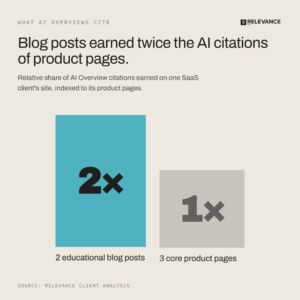
If you’re deciding where content budget goes, that’s a useful signal. The pages earning a place in AI answers are the ones a content program produces…not the product pages, and not the homepage. We’re not saying those CAN’T earn the citations, but don’t overlook the importance of educational comparison pieces in your SaaS content strategy.
Step 6: Distribute across the right channels
Promote content through the channels your audience actually uses. Email, social, guest posts, and other owned or third-party channels can help the piece get traction faster.
Use a third-party platform like social media as a cross-promotional tool, too. (Look for more than one social channel where your target audience congregates.)
Create content distribution synergy by using social posts to drive email sign-ups, answer questions, and push traffic toward your higher-value, on-site content. Just make sure you aren’t spreading yourself too thin.
Step 7: Measure, refresh, and iterate
As you create content, track what is performing. Also, update content regularly to keep it accurate and effective.
Try to prioritize evergreen pieces that avoid dated references when you can. Even then, most pieces still need a refresh from time to time, especially in SaaS where product details and market context change quickly. Build that into your content cadence.
Types of SaaS Content Marketing (Full List)
There are many kinds of content that you can integrate into an effective SaaS content strategy. These include the following:
- Blog posts: Short- and long-form SaaS content that can be timely, opinionated, and packed with thought leadership, like a post breaking down a new integration or API change and what it means for users
- Case studies: Show how real customers achieved results with your product, like a workflow automation platform highlighting how a client saved time.
- Infographics: Condense complex information into a visual format that is easy to scan and share, such as a chart showing how unmonitored tech stacks impact revenue.
- Sales pages: Bottom-of-funnel messaging that pitches your product or service — think a landing page promoting a free trial of your software.
- Whitepapers: These can offer in-depth, high-intent content for readers who already understand the basics, such as a report on scaling your SaaS customer acquisition.
- Demos: Give prospects an interactive, hands-on experience with your product, like a guided demo of a project management app.
- Guest posts: Get your content on third-party sites to build credibility and improve your reach, like getting published in an industry article.
- Social media: Share everything from short posts to long-form LinkedIn updates to build awareness and community. This could be a branded post or even a founder post breaking down a product launch.
- Email marketing: Direct, permission-based content that drives action, like a nurture email walking a free-trial user through an underused feature before their trial ends..
- Video content: Information presented in an engaging visual format — often a product walkthrough or customer tutorial video.
- Podcasting: Branded insights in audio form, easy for a SaaS founder to interview and discuss market trends.
- Ads: Paid content that drives bottom-of-funnel action, like a retargeting ad promoting a free demo.
- User-generated content: Customer feedback, reviews, and shared experiences that build trust — think testimonials from a team using your platform.
B2B-specific considerations for SaaS marketers
If you’re developing a B2B SaaS content marketing strategy, stay focused on your area of expertise. Center all of your content on “pillars” or “clusters” that display comprehensive coverage of focused messages that are integral to your business. Demonstrate your knowledge, as well, to meet Google’s E-E-A-T standards (experience, expertise, authority, and trustworthiness).
If you’re having trouble coming up with relevant content ideas, you can use a tool like Buzzsumo or AnswerthePublic to generate ideas based on your keywords and content needs. You can often get quality content ideas from existing customer feedback and competitor research, too.
Making SaaS content work for AI search (ChatGPT, Perplexity, AI Overviews)
The elephant in the room for any SaaS content strategy is how to rank in AI-generated results and citations. Generative engine optimization (GEO) is where you want to pay attention to things like consistent, clean content structure. Use clear, question-phrased headers to rank in AI Overviews and featured snippets. Integrate clear, relevant FAQs. Directly answer questions early in your content (don’t beat around the bush).
Everything in the GEO checklist (clean structure, question-phrased headers, answering early) is real, and it’s also the easy half. All of it just makes your content legible to a model. None of it makes the model choose you.
What gets cited is the thing that only you could have published: your own data, a position you’re willing to defend, a specific answer to a question the rest of your category writes around. If a model can synthesize your page from three other pages, it will, and you’ll never see the traffic. The bar for SaaS content now isn’t ‘is this good.’ It’s ‘could anyone else have written this.’
Be original with everything you say, as well. Provide unique perspectives and answers to common problems. Use original data when you can, too. If you’re not sure if it’s working, use a good AI visibility tool to check.
Common SaaS Content Marketing mistakes to avoid
Finally, make sure you avoid a few common pitfalls as you create your content:
- Don’t treat your content like a one-time sales pitch. Keep it informative, educational, and evergreen so it can grow with your product and continue to help your target audience.
- Don’t sleep on product-led content. You want to organically showcase what you’ve built as a solution people can count on to help resolve their problems. Work it into everything you naturally can.
- Don’t focus on a single reader buying in. Remember that with ongoing SaaS tools, you’re pitching to multiple stakeholders. Speak to everyone and make sure everyone gets the answers they need.
Here’s a mistake I see constantly: the content team is optimizing for search volume while the sales team answers the same five objections every single day, and none of those five objections are addressed anywhere on the website. Your reps are sitting on the highest-intent content brief in the company and nobody’s asked them for it. Before you start another keyword-driven post, go sit in on demo calls for a week. The gaps are obvious once you hear a real buyer hesitate.
Saas Content Marketing FAQ
What is SaaS content marketing?
SaaS content marketing consists of long-term educational content that attracts, teaches, and converts software buyers. It spans the B2B journey and matters because SaaS is crowded and competitive right now.
How do you measure the success/ROI of SaaS content marketing?
Watch your pipeline, connect SaaS content to revenue, monitor cost-per-acquisition (CAC), and track customer value from content-driven acquisition.
How is B2B content marketing strategy different for SaaS companies?
SaaS content must educate multiple stakeholders making collective decisions. It should support longer buying cycles, too, and needs to stay updated as products change.
What types of content marketing work best for SaaS?
Blog posts, comparison pages, case studies, demos, white papers, guides, and product-led content are all common options. Match content to the buyer journey and the point in the sales funnel.
What KPIs should you track for SaaS content marketing?
Organic traffic, search rankings and AI citations, engagement, demo requests, and similar conversions can help you see if your content is working.
Getting started with a SaaS Content Marketing Strategy
SaaS content must provide clear value to B2B consumers while differentiating your brand from competitors. If you’re struggling to come up with a good strategy, you may want to work with a SaaS content marketing agency.
At Relevance, we specialize in using content as a foundational aspect of long-term growth. Reach out for a free strategy assessment for your SaaS company.
Whether you’re working with us or developing content on your own, make sure to do so with a plan in place. That will give every piece of SaaS content the chance to have an impact as part of your bigger, long-term effort to promote your digital products and services.
