

TL;DR Challenger brands don’t win based on size, budget, or scale of operations. They win because they can compete with larger brands on their own terms. A challenger brand focuses on substance over spending. They lean on proof over polish and, increasingly, focus on visibility optimization designed to substantially show up in AI search results.
The “Challenger Brand” is a concept that sounds exciting on the surface and evokes David vs Goliath imagery. But at Relevance, we don’t see the challenger model as a “little guy overcoming the odds” approach to business. It’s a posture, not a budget, that determines whether a brand wins.
A real challenger finds their own path to success without relying on a large budget to get there. For me, this has never been about scale of spend. It’s about how strategically you use what you have. The brands I’ve watched win are the ones that get strategic with their tactics and dig into the research and information until their strategy is genuinely well-informed, not just well-funded. And when Relevance takes on a brand, we treat their budget like it’s my own money coming out of our own pocket. That’s the mindset that changes everything: when every dollar has to earn its place, you stop asking how to spend more and start asking how to spend smarter.
What Is a Challenger Brand?
A challenger brand doesn’t outspend the competition. They don’t overcome by using the same industry tactics or messaging better. Challengers win based on their unique identity and brand value, not their budget.
Being a Challenger Brand Is About Posture, Not Budget Size
The thing that separates a challenger brand from simply being a smaller competitor with less money is its posture. Challengers aren’t stuck in the mold of brands that came before them. They break out of those predictable tactics and forge their own paths to success.
At Relevance, here are a few of the key factors that we look for that take smaller brands from competitors to a true “challenger posture.” You can use them as a quick diagnostic self-assessment framework.
- Is there a clear competitor or market leader you’ve defined as your top competition?
- Are you changing industry “rules” or copying another company’s playbook?
- Are you playing it safe with business decisions or taking targeted and focused risks?
- Are you trying to be louder than the competition or earn attention through substance?
The way you answer these is important. It reveals if your brand is a challenger or is operating as an underfunded incumbent mimicking the more successful operations that have come before you.
Remember, challenger brands don’t win simply because they’re smaller and need to fight harder. They win by understanding the competition — and then competing on different terms.
Why “Spend More” Stops Working for Challenger Brands
Often, smaller brands make outspending their opponent in key areas, like a specific search term, a core marketing objective. The problem is that, limited budgets aside, the “spend more” approach has diminishing returns after a certain point.
The Diminishing Returns of Chasing a Competitor’s Media Weight
Outspending successful competitors is always tough. Cost per acquisition (CAC) has already skyrocketed by over 200% in the past decade, according to SimplicityDX. This makes simply trying to match or outspend a bigger company’s ad spend a challenge.
Rather than push inflating ad spend upward as a winning tactic, a challenger brand strategy puts what we call a Spend Ceiling in place: the point past which additional ad dollars stop producing proportional returns. Their marketing teams understand that there is a point at which ad spend flattens or even produces negative returns.
This natural reaction makes it imperative for a challenger to find an alternative way to compete. That’s where substance comes into the picture.
What Substance Actually Means: The Positioning / Proof / Presence Framework
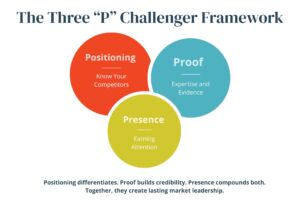
Rather than overspend, a true challenger brand looks for ways to create substance. But what does that mean? A budget is grounded in dollars. What does it mean to focus on “substance” as an alternative? At Relevance, we break this down into three areas, called the Three “P” Challenger Framework.
Positioning: Name What You’re Actually Against
Real challenger brand marketing starts with clarity. You can’t base your strategy on vague concepts about your industry or general market research. Begin by naming your top competitors. Then work to understand what it is they offer and the USPs (unique selling propositions) that you are genuinely competing against.
Proof: Use Expertise and Evidence to Beat Polish
Challengers confront incumbent brands in a variety of different ways. One thing all challenger brand archetypes have in common, though, is that they lean on expertise and evidence. They don’t try to outshine their opponents. They use real, substantial claims and counterpoints to inform their content strategies and other marketing efforts.
Presence: Earn Attention Where Budget Can’t Buy It
Finally, challenger brands find other ways to earn attention outside of paid ad spend. They optimize owned media (targeting human and AI search visibility). They also craft digital PR initiatives that earn unique third-party mentions through their differentiating USPs.
How Challenger Brands Win Attention Without Outspending Anyone
The Three “P” Challenger Framework helps challenger brands posture themselves in the right direction. But what are some of the tools that help put it into motion?
Earned and Compounding Channels Over Rented Reach
When Relevance works as a challenger brand agency, we focus on key areas where substance beats spend.
The first of these is SEO. Search engine optimization has shifted in the AI era, but it’s still very much alive. Optimization has simply adjusted to accommodate AI generative visibility as well as direct blue-link human search queries.
I also already mentioned earned media. This key part of the PESO model feels a lot like paid ad marketing in the sense that it focuses on external channels. The difference is that earned media isn’t a pay-to-play approach. Instead, it focuses on gaining the validation of third-party sources not by paying more but through — you guessed it — substance.
Focus a full guide to growth marketing strategy on these areas and you skip the paid-ads trap. A bigger competitor can always outspend your ad budget. They can’t buy the kind of substance you’re building here. That’s what actually compounds long after any single campaign would’ve stopped paying off.
Should a Challenger Brand Invest in Paid Media at All?
One natural question that comes from the challenger brand strategy is whether paid media is worth it at all. I’m not saying paid is bad. It’s still an important part of the marketing toolbox. It’s just not the main piece, and too many marketers focus on it as the end-all, be-all of a marketing plan.
It’s easy to use paid to get results, but again, renting attention is temporary. The real question isn’t whether to use paid media, it’s when. That answer changes depending on where you are in the funnel and where your brand is in its growth. Here’s how we map it:
| Early Stage | Growth Stage | Mature Challenger | |
| Top of Funnel | Positioning and PR, minimal paid for reach | Positioning-led, paid to extend reach | Both, paid defends share of voice |
| Mid Funnel | Proof-led, small paid tests | Proof-led, paid to test audiences | Both, paid amplifies proven winners |
| Bottom of Funnel | Organic, paid only for launches | Organic-led, paid for retargeting | Both, paid for launches, organic for retention |
Notice the diagonal. The further right you move, the more paid earns a permanent seat at every stage of the funnel, not because substance stops working, but because a mature challenger is defending ground instead of just building it. Early-stage brands can mostly skip paid altogether and lean on Positioning and PR. Mature ones can’t, but even then, paid is playing a supporting role at each stage, not carrying the whole strategy the way it would for a company with no unique position to protect in the first place.
That’s the nuance most “paid vs. organic” debates miss. It was never a yes or no question. It’s a question of proportion, and that proportion shifts as your brand grows.
Why AI Search Changes the Rules for Challenger Brands
Challenger brands have been around for a while, but AI search is changing the game. Now, challengers need to think about AI visibility and generative engine optimization (GEO) alongside things like SEO and earned media.
AI Engines Can’t Be Bought
One of the biggest differences (so far) is that you can’t buy your way into an AI citation the same way you can pay for a slot on a SERP. This means anyone who takes the “pay to play” approach to marketing is at a disadvantage if they want to show up in AI results. This is already a big deal: Pew Research found that when Google shows an AI-generated summary, people click through to a traditional result in only 8% of searches, compared to 15% of searches without one. That gap is exactly why buying your way to the top of a SERP matters less than it used to.
Why Substance Compounds Faster in an AI-Mediated Market
Generative engine optimization is changing the focus. It’s also making it easier for challengers to have their messages heard, even in saturated markets.
Current research shows LLM-based search engines don’t simply favor the sites with the highest traffic. An arXiv study analyzing tens of thousands of queries across six AI search engines found that these systems favor sources with structured, hierarchical HTML and outbound links to reputable references. So if your content is built with that kind of structure and backed by real expertise, it’s more likely to show up in AI citations. Another way to put it? AI rewards substance. GEO is fuelled by brands that are willing to use substance to build better content, not just pay their way to the top.
Real Challenger Brand Examples
Names like Warby Parker, Dollar Shave Club, and Tony’s Chocolonely probably come to mind first, and for good reason, they built real challenger positions. But they’re not the only ones, and they’re not even the most instructive place to look anymore. More brands are putting the Three “P” Challenger Framework into practice right now.
For instance, Oatly disrupted the plant-based milk market by positioning itself not as a “healthy alternative” but as a “better option” against boring traditional dairy, a clear Position, and one it backed up with Proof: blunt, evidence-driven copy instead of polish. Patagonia is another company that built a name through challenger positioning. The clothing brand built a mission-minded operation in a category known for waste, earning its Presence through real accountability rather than an ad campaign.
The lesson doesn’t apply specifically to food and consumer goods, either. Let’s flip over to a completely different area of the economy. Monzo is one of a number of challenger-positioned online banking apps that staked its claim in its market through transparency, using that same transparency as its Proof point. This allowed these platforms to compete against the opaque legacy banking model without having to take their gigantic coffers head-on in a paid ad shoot-out earning Presence through word of mouth instead.
In all of these cases, and hundreds of others, the challenger brands in question found ways to avoid excessive spend and focus on high-quality substance. They found unique Positions, backed them up with Proof, and then carved out a Presence based on their USPs.
How to Apply Substance Over Spend on a Constrained Budget
If you’re working with a marketing budget for small business operations, I get it. Marketing budgets overall have been shrinking. Gartner’s CMO Spend Survey found the average budget slid to 7.7% of company revenue, only ticking back up slightly since. It’s tighter still for smaller teams. Companies under $10 million in revenue are putting a much bigger share of their budget toward marketing than larger companies do, closer to 15.6% on average, just to stay visible in a crowded market. There’s less room for waste, and a bigger reason to make substance-led channels count.
A 90-Day Starting Checklist for Under-Resourced Marketing Teams
- Start by clarifying your challenger posture in a written positioning statement. How are you different?
- Audit your existing content for clarity in messaging. Is your differentiation present? Where is your proof of expertise?
- Identify one or two channels where substance can compound over time. SEO content? Newsletters?
- Aim to publish two or three authority-building pieces. Things like deep guides, case studies, and answers to topical queries all work. What is your audience looking for? (Pro tip: Make sure to structure key pages for GEO, too, including headings, keywords, and FAQs.)
- Start to look for places where you can earn mentions via digital PR or expert contributions. Try to get at least one in the next 90 days.
- As you build momentum, start scaling paid to amplify your strongest expertise and substance-based assets.
- Implement simple reporting. Identify metrics and set KPIs to track things like leads, CAC, and earned versus paid results.
The game may have shifted with AI, but it hasn’t ended. It’s true that smaller companies face larger hurdles when they compete directly. When they take the time to position themselves as a challenger brand, though, they open the door to gain momentum and grow with confidence.
If your team struggles with slipping into a pay-to-play mindset, it can be helpful to work with an outside agency. Our team at Relevance has helped many brands build effective organic and earned media strategies around challenger brand positioning. If you see the need for professional support to reposition your brand for success, book a strategy assessment, and we can build your future together.
FAQ
What is a challenger brand?
A brand that seeks to build a unique identity through differentiating brand value, features, and offerings.
What is challenger brand strategy?
Don’t just outspend your opponents. Look for ways to out-position them.
How do challenger brands compete with bigger budgets?
By building expert content with substance and then looking for organic and earned channels where it can compound.
What are some challenger brand examples?
Companies like Oatly, Monzo, Patagonia, Warby Parker, Dollar Shave Club, and Tony’s Chocolonely are all great examples of the challenger brand concept in action.
What is the Three “P” Challenger Framework?
Position your brand with detailed intention. Create Proof with expertise and evidence-backed content. Build Presence through organic and earned channels.
Do challenger brands need a big marketing budget to compete?
No. While spending on things like content or the support of a growth marketing agency comes with some predictable expenses, removing the need for the perpetual, competition-dictated expense of paid advertising significantly reduces challenger brand marketing costs. It refocuses everything on using substance to earn profitable attention in an AI world.
