

TL;DR What is a growth partner? It’s an outside marketing team that shares responsibility for your business outcomes. You can usually boil hiring one down to five steps. Define the outcome and budget, shortlist three to five partners, and run discovery calls. Then compare proposals and check references. The best partners will also tell you no when they need to.
If you’re figuring out how to hire a marketing agency, start with your own goals, not the agency. When you begin with desired outcomes, it helps you shortlist partners. Look for proof they can get you where you want to go.
From there, run discovery calls to test their marketing strategies and philosophies. Finally, compare proposals and check references before you sign.
What you’re really looking for is a partner that can answer the right questions. You’ve got a challenger brand with a great product and a limited budget. Your partner needs to prove it can help you compete with bigger competitors that have more resources.
What is a growth partner?
A growth partner is an outside team of marketing professionals that shares responsibility for your business goals. There isn’t a single definition. But a growth marketing agency should bring experience, resources, and up-to-date industry knowledge to the table.
Here are some of the ways a growth partner differs from a task-based provider. Keep in mind that every agency is different, and there will be overlap at times.
| Task-Based Provider | Strategic Growth Partner | |
| Who sets priorities? | Set by client | Set collaboratively by partner and client |
| What gets reported? | Deliverables and metrics | Data based on outcomes |
| Who works the account? | Specialists for assigned tasks | Strategist and specialists |
| How does scope change? | Set on agreed-upon deliverables | Adapts based on mutual agreement and growth |
When does hiring a partner make sense?
Working with a growth partner isn’t always the best next step. Make sure these things are in place before you start vetting potential partners:
- Are you ready to compete for market share but missing the internal resources to execute your growth strategy?
- Would the budget for a senior marketing hire go further with a partner’s full team?
- Do you have a sustainable marketing budget to justify working with a growth partner over the long term?
- Do you know what you need within your growth marketing goals? SEO? Generative engine optimization (GEO)? PR?
How do you hire a marketing agency? A 5-step process
You can usually boil the process down into five clear steps:
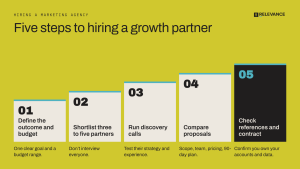
- Define the outcome and budget. What are you trying to achieve as a business? How would a partner contribute? You should come out of this step with one clear goal and a budget range.
- Shortlist three to five partners. Don’t interview everyone, or you’ll end up overwhelmed. Use step one to clarify your options and find the best potential fits.g
- Run discovery calls. Get to know your candidates. Use the questions below to help uncover their competence, strategic thoughts, growth philosophy, and experience.
- Compare proposals. It’s important to know how to evaluate a marketing agency, so you go with substance over flash. Line up scope, team, pricing, and a 90-day plan side by side.
- Check references and contract terms. Look for concrete third-party proof that a partner can deliver on their promises. Make sure the contract also confirms you own your accounts and data.
What questions should you ask a marketing agency?
Here are a few questions to ask a marketing agency and what to look for in the answers.
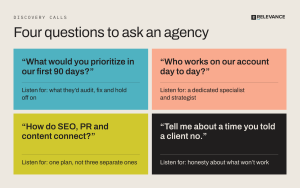
- What would you prioritize in our first 90 days? Specifics can vary, and growth marketing takes time. Still, a confident answer should name what they’d audit first, fix first, and hold off on.
- Who works on our account day to day? Make sure you will have a dedicated specialist and strategist you can lean on for actionable and high-level work, respectively.
- How do SEO, PR, and content connect in your plan? SEO, AI optimization, and earned media PR outreach should all work together in a growth marketing plan. Ask them to explain how. Content gives search and AI tools something to cite, and PR earns the mentions that back it up.
- Tell me about a time you told a client no. A growth partner should know when they can’t help a potential client. Relevance’s Chief Strategy Officer, Emma Robinett, consistently points out that a partner who takes every project can’t be honest about what won’t work. There’s also more chance that they’ll stretch themselves too thin. This fall, a financial services firm sent us a brief for a standalone paid media campaign, and we passed. We run paid alongside SEO, content and PR, not as a solo channel, so a paid-only engagement isn’t where we do our best work. We told them that and introduced them to an agency that specializes in it. Taking the project would’ve meant selling them our second-best work.
How do you test a partner’s AI search capability?
The best test for AI search capability with a potential growth partner is to ask for evidence. How does an agency measure and improve AI visibility when they work with partners? Along with SEO, you need a partner that understands GEO. You can ask for this in a few different formats:
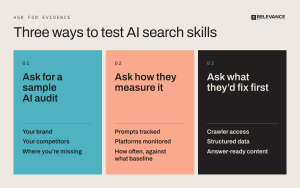
- Ask for a sample AI audit of your brand. A good one isn’t a template. It should be specific and should list your brand and your competitors. It should also show where your brand is missing from AI answers and what would change that.
- Ask how they measure AI visibility. A good strategy should be detailed. It should name the prompts they track and the AI platforms they monitor, like ChatGPT, Perplexity, Gemini, and Google’s AI Overviews. It should also list how often they check and what baseline they compare against. About a quarter of the prospects we talked to this summer asked how to measure AI visibility and tie it to leads. Here’s how we do it. We start with prompt research and benchmark you against the competitors getting cited instead. Then we track mentions, citations and sentiment across ChatGPT, Perplexity, Gemini and AI Overviews. In our proprietary platform, Visibility IQ, we also track AI referral traffic to your site as a whole and to specific pages, and watch conversion rates to see what’s working and what isn’t. Tracing a closed deal back to one AI answer is still hard, but you shouldn’t be guessing.
- Ask what they’d fix first so AI tools can read your site. This should address things like crawler access, structured data, and whether they think you have answer-ready content.
Again, look for the deeper meaning here. AI answers draw on search and PR fundamentals, so their answers show whether they understand how all three connect. What you’re really getting is a sample of how the agency thinks as a whole.
What are the red flags when hiring a marketing agency?
There are some marketing agency red flags that can help you narrow your shortlist down to your best option. Here’s what to look for on the negative side of the equation and what it could indicate:
| Red Flag | What It Could Indicate |
| Guaranteed outcomes a partner can’t control | A partner can commit to the work, deadlines, and clear reporting. Promising things like rankings or AI citations is a sign of overstepping. If a pitch promises a #1 ranking, Google’s own hiring guidance says to find someone else. |
| Lack of ownership of accounts | When an agency needs to control everything, you lose leverage and your data if you leave. Google even recommends read-only Search Console access during an audit. |
| Vague reporting | When reports don’t connect the work to your business outcomes, you can’t tell what’s working. |
| A different team after the pitch | A pitch followed by being passed off to less-experienced professionals indicates a lack of bandwidth. |
| Lack of originality | The same plan for every client points to low creativity and an inability to adapt. |
Guarantees come up on our sales calls more than you’d think, around 15 of about 124 this summer. I get it. You’re spending real money and want something to hold us to. The better question isn’t ‘what do you guarantee?’ It’s ‘what happens in month four if this isn’t moving?’ An agency that can’t answer that clearly is the real risk.
FAQ
How much does a marketing agency cost?
There’s no set price. But a pitch should include structure (Retainer? Project-based? Performance-based?) and multiple pitches let you compare your shortlist for a range. Retainers usually fit ongoing work like SEO and PR, while project fees fit one-time jobs like an audit. Performance-based pricing works best when results are easy to track.
When is it better to go in-house or agency?
In-house makes sense when you have enough ongoing work for a dedicated hire. But things change once you need several specialties and are competing with bigger budgets. At that point, the in-house marketing vs. agency debate often tips toward an agency.
How long until you see results?
Results vary, but that isn’t an excuse for poor projections. Paid media can show data within weeks. SEO and AI visibility usually build over months. Make sure a pitch has clear 30-, 90-, and 180-day expectations around how each piece should build momentum over time.
Want a benchmark before your first discovery call? Request a free AI visibility audit of your brand, and compare it with what other partners show you.
