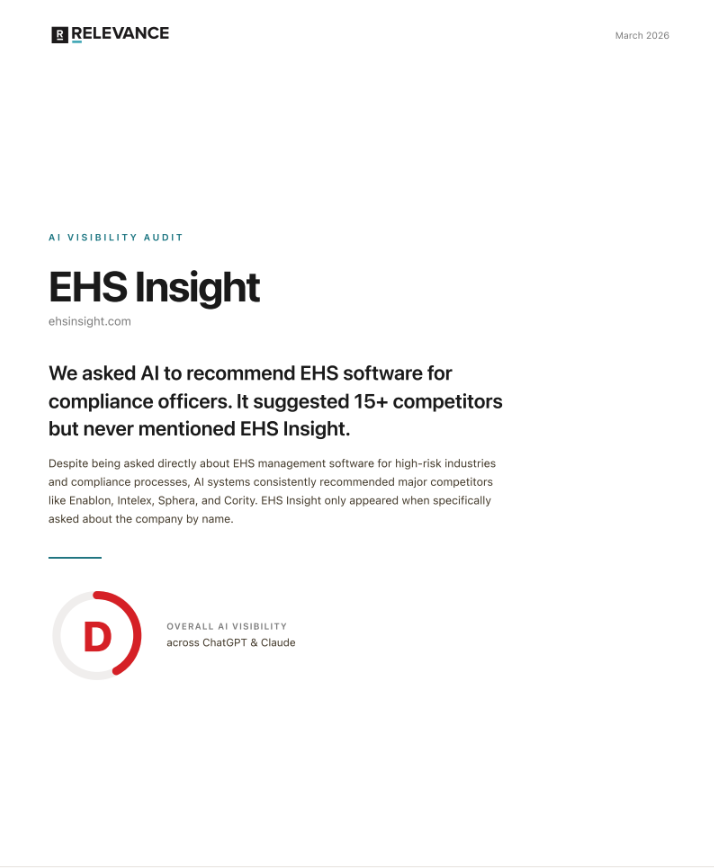
If you’ve watched your organic traffic flatten while impressions hold steady, you’re not imagining things. We’ve seen this across B2B SaaS and ecommerce accounts since early 2024. Rankings stay intact, but clicks drop. Meanwhile, your CEO is asking why competitors keep showing up in ChatGPT or Perplexity answers and your content doesn’t. That disconnect is what makes understanding AI search no longer optional.
This isn’t about “AI is the future.” It’s about how answers are actually being generated today, and what that means for how your content gets discovered, cited, or ignored.
Let’s break down what’s really happening behind the scenes.
AI search isn’t search. It’s synthesis.
Traditional search engines retrieve documents. AI search systems generate answers.
That sounds obvious, but the implications are massive.
When someone types a query into Google, the system retrieves indexed pages, ranks them, and lets the user choose. Even featured snippets still point back to a source. Traffic flows outward.
When someone asks ChatGPT, Perplexity, or Gemini a question, the system doesn’t “return results.” It assembles an answer by predicting the most likely useful response based on training data, retrieval systems, and context.
Which means your content isn’t competing for rank. It’s competing to be used.
That shift alone breaks a lot of familiar SEO assumptions.
There are three layers powering AI search
Most marketers treat AI answers like a black box. In reality, most systems follow a similar architecture. Once you understand it, you start to see why some content gets cited and some disappears.
1. Pretrained knowledge (the baseline)
Large language models are trained on massive datasets that include websites, books, forums, documentation, and more. This forms their baseline understanding.
Here’s the catch. Your content is rarely influencing this layer unless you’re operating at massive scale or publishing something widely referenced. This is why most “write for AI” advice falls flat. You’re not getting into the training data anytime soon.
What matters more is the next layer.
2. Retrieval (the real battleground)
Modern AI search systems use retrieval-augmented generation, often called RAG. Instead of relying only on training data, they pull in fresh information from the web at query time.
This is where your content has a real shot.
When a user asks a question, the system:
- Converts the query into vector embeddings
- Searches a database of indexed content for semantic matches
- Pulls relevant passages, not full pages
- Feeds those into the model to generate an answer
Notice what’s missing. There’s no “ranking page one.” There’s just selection of relevant chunks.
We’ve seen this firsthand. In one campaign for a B2B cybersecurity client, a single 40-word definition buried halfway down a page was cited in Perplexity more often than the page’s H1 topic. Why? Because it cleanly answered a specific sub-question.
That’s how granular this gets.
3. Generation (where attribution gets fuzzy)
Once relevant content is retrieved, the model generates a response. It might cite sources. It might not. Even when it does, the answer is often a synthesis of multiple inputs.
This creates a frustrating reality. You can influence the answer without being credited for it.
Which means your goal isn’t just visibility. It’s inclusion in the answer-generation process.
Why traditional SEO signals only partially matter
A common question we hear is whether domain authority still matters. The honest answer is yes, but less than you think.
AI retrieval systems care about:
- Semantic relevance to the query
- Clarity of the answer within the content
- Topical authority across related queries
- Freshness, depending on the question
Backlinks and domain authority still influence whether your content gets indexed and trusted. But they don’t guarantee inclusion in AI-generated answers.
We’ve tested this across multiple clients. In one ecommerce vertical, a mid-authority site with highly structured FAQ content was cited more frequently in AI answers than a category-leading publisher with stronger backlinks. The difference wasn’t authority. It was answer clarity.
That’s the pattern we keep seeing.
What actually gets your content pulled into AI answers
After analyzing dozens of campaigns where clients started showing up in AI citations, a few patterns are consistent.
First, the content answers specific questions cleanly. Not broadly. Not philosophically. Directly.
Second, the structure makes extraction easy. Short paragraphs. Clear headers. Defined concepts.
Third, the content demonstrates real-world usage, not just definitions. AI systems favor content that reflects applied knowledge.
If you’re trying to operationalize this, focus on:
- Question-level content, not just topic-level pages
- Standalone answer blocks within longer content
- First-hand examples with specific outcomes
- Clear, jargon-light explanations of complex ideas
None of this is revolutionary. But the weighting has changed.
The hidden shift: from pages to passages
Here’s the part most teams underestimate.
AI systems don’t “read” your page the way a human does. They extract passages.
That means your beautifully crafted 2,000-word guide isn’t competing as a whole. It’s competing at the paragraph or even sentence level.
We saw this clearly with a fintech client. Their long-form guide wasn’t getting cited. After restructuring it into clearly defined sections with tight, standalone explanations, AI citations increased within six weeks. No new backlinks. No major content expansion. Just better extractability.
Which means formatting is no longer cosmetic. It’s functional.
What this means for your strategy
If you’re still optimizing only for rankings, you’re missing half the game.
AI search changes the question from “How do we rank?” to “How do we get used in answers?”
That leads to a different set of priorities.
You don’t need more content. You need more answerable content.
You don’t need longer articles. You need more extractable insights.
You don’t need to chase every keyword. You need to own specific questions deeply.
And importantly, you need to accept that attribution will be imperfect. Some influence won’t show up in your analytics. That’s uncomfortable, especially when you’re reporting on ROI, but it’s the reality of how these systems work.
Where most teams go wrong
The biggest mistake we see is treating AI search like a distribution channel instead of a transformation in how information is consumed.
Teams rush to publish “AI-optimized” content without changing how they structure knowledge. Or they over-index on tools instead of fundamentals.
The fundamentals haven’t changed that much. Clear thinking still wins. Specificity still wins. First-hand experience still wins.
What’s changed is how those signals are interpreted and surfaced.
Which means the teams that adapt fastest aren’t the ones chasing hacks. They’re the ones making their knowledge easier for machines to understand and reuse.
The bottom line
AI search isn’t replacing SEO. It’s changing what “visibility” actually means.
You’re no longer just competing for clicks. You’re competing to shape the answer itself.
Once you see that, your strategy shifts naturally. You start writing differently. Structuring differently. Prioritizing differently.
And that’s usually when clients start showing up in places their competitors don’t.