


As a company outgrows its local market, its SEO needs to keep pace. Search visibility that stops at your home market, flat non-branded organic traffic, and organic leads that keep getting more expensive are signs it isn’t. If your in-house team doesn’t have the time or national-scale experience to close those gaps, that’s when to invest in a national SEO agency.
At that stage, you can’t just outsource to anyone who offers SEO services. You need an agency with national SEO experience that knows how to build visibility in markets where customers don’t know your name yet.
Below, we’ll break down what national SEO is, how it differs from local SEO, five signs its time for outside help, and how to hire the right agency.
What is a national SEO agency, and what does it do?
A national SEO agency improves a company’s organic visibility in search across an entire country, rather than one city or region. National search engine optimization focuses on reaching customers through searches tied to what the company sells, rather than relying primarily on location-specific searches.
A national SEO agency typically handles:
- Keyword and content strategy for non-branded, national-intent searches
- Technical SEO that scales, including site architecture, crawlability, and how service and location pages work together
- Authority building through backlinks, digital PR, and customer reviews where relevant
- Reporting by market, so a strong national number doesn’t hide a stalling region
- AI visibility across ChatGPT, Perplexity, Gemini, and Google’s AI Overviews and AI Mode
National SEO vs. local SEO: what’s the difference?
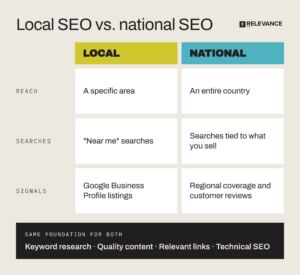
Local SEO focuses on customers in a specific area, often through Google Business Profile listings and “near me” searches. National SEO has to work beyond any single area, which changes the keywords, authority signals, and reporting you rely on. A business with multiple locations can use local SEO in each market while also competing nationally.
The same fundamentals are at play here: keyword research, high-quality content, relevant links, and technical SEO. National SEO applies them beyond a single market.
Start with the searches your customers have in common, then look for regional differences that matter. An article that targets the keyword “best mattresses for hot sleepers” could address humid Southern summers or dry Western summers if customer research supports those differences.
Where customer needs or competition differ by region, relevant regional coverage and customer reviews can help buyers assess your business.
Break up reporting by market, too. A healthy national traffic number can hide a region that’s stalling, so track rankings and conversions for each market where geographic differences affect your business.
AI search adds another layer to this. Buyers now ask ChatGPT and Perplexity for recommendations, and they see AI Overviews at the top of many Google searches. Your content should clearly explain what you offer, who it serves, and the questions buyers need answered. Useful content and credible third-party coverage can support AI visibility and improve your chances of being one of the brands those answers mention.
Five signs it’s time to invest in a national SEO agency
So, how do you know when your growth calls for outside national SEO expertise? These signs can help you identify where your SEO needs attention. An agency becomes worth considering when the work exceeds your team’s capacity or experience.
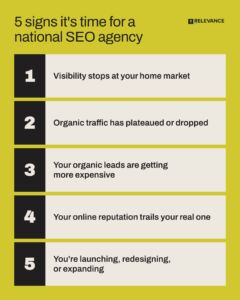
1. Your visibility stops at your home market
If customers outside your home market can’t find you through non-branded searches, your SEO isn’t supporting your expansion.
When a company starts selling in a new market, branded search often picks up first. People hear about you through word of mouth and look you up by name, so it feels like SEO is working. That’s a great sign, but it’s only half the picture. At home, you have years of reviews and people who already know you. In a new market, you’re earning that trust through content and authority, so it’s worth planning for it like a fresh build rather than an extension of what you have.
For example, let’s say you operate a woodworking supply store in Peoria and ship nationwide. Check whether enthusiasts in central Illinois or Chicago can find your business when they search “woodworking supplies”. As you expand to a nationally competitive company, the same test applies for other major metros, like New York City, Atlanta, or Portland.
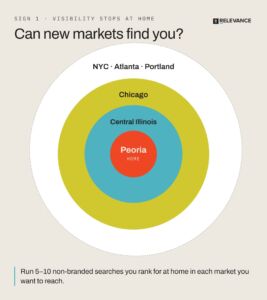
If you want to know if you’re showing up in other markets, identify five to 10 relevant non-branded queries you rank for in your local market. Then, use a rank tracker tool like Semrush that offers position tracking to run those same queries in other major markets where you want to rank. If you don’t show up in the search results for those queries, that’s a sign your SEO isn’t reaching those markets yet.
Relevance helped Gabb Wireless reach more parents searching for safe phones for their kids through search-focused content and relevant media coverage. Monthly organic traffic increased 198% over 10 months. For a specialized brand competing with larger companies, content built around those searches gives parents who haven’t heard of Gabb a way to find it.
2. Organic traffic has plateaued or dropped
One lagging indicator that SEO isn’t keeping up with your growth is organic traffic that stays flat while the business expands.
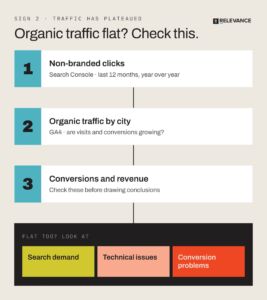
You can see if this is happening by checking two things:
- Pull up Google Search Console and review your non-branded clicks over the last 12 months. Use the non-branded query filter if it’s available, or exclude searches containing your brand name and common variations. Compare the same months year over year to account for seasonality. Impressions aren’t enough. Where are you getting high impressions but low click-through? If that’s happening for searches tied to your core offerings, it needs a closer look.
- Use Google Analytics 4 (GA4) to check organic search traffic by location. To use the previous example, filter to Organic Search and review Chicago at the city level to see whether visits and conversions are growing or shrinking. Use your rank tracker to check rankings there.
If organic traffic is flat, check your organic conversions and revenue before drawing conclusions. If conversions and revenue are flat too, look at shifts in search demand, technical issues, and conversion problems. A national SEO agency can help diagnose the causes and build a long-term strategy around your growth.
3. Your organic leads are getting more expensive
If you’re spending more on marketing every month and getting less back, look closely at which channels are driving your leads. A falling return on investment (ROI) can mean your messages aren’t reaching the audience you’re growing into, or they’re reaching it without converting.
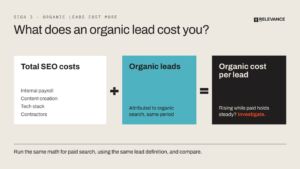
Organic cost per lead shows how efficiently SEO turns spend into leads. Add up your SEO costs across expenses like internal payroll, content creation, tech stack, and contractors. Then divide that total by the number of leads attributed to organic search over the same period.
Run the same math for paid search and compare the two. Include ad spend and related management, creative, and tool costs. Use the same definition of a lead and consistent attribution rules, and check how many leads become customers. A lower cost per lead doesn’t necessarily mean a lower cost to acquire a customer.
If organic cost per lead is rising while paid holds steady, find out why: higher SEO costs, lost traffic, lower conversion rates, or recent SEO spend that hasn’t paid off yet. If you’re leaning harder on paid ads to make up the gap, remember that paid search requires ongoing spending to keep bringing in new traffic.
If organic cost per lead keeps climbing while you’re trying to grow into new markets, your SEO may not be reaching the customers you’re trying to win there. That’s a gap national SEO expertise can help close.
Relevance helped the telehealth brand Nurx reduce its reliance on paid acquisition. Nurx relied heavily on paid advertising, and organic search drove just 4.8% of its user acquisition. After Relevance built out its keyword and content strategy, organic search grew to 28.7% of acquisition, nearly six times its starting share, while organic traffic rose 49.7% year over year.
4. Your online reputation trails your real one
Sometimes, you can see a gap between stellar word-of-mouth marketing and a weak online perception of your brand. If that gap is making it harder to establish credibility in new markets, it’s a good sign you need a national SEO agency.
Even if your reputation is strong in your local market, online content can tell a different tale. If you’ve ever read a terrible review of a restaurant online only to have a close friend contradict it, you know exactly what this looks like. Buyers in a new market usually don’t have a friend to ask, so they go by what they find in search results, reviews, and AI tools like ChatGPT.
Start by searching your brand name and reading through the review sites in your industry. Check whether there’s credible coverage or content that shows your expertise, too. If what you find doesn’t match what your customers would say about you, that’s the gap to close.
A national SEO agency can help strengthen credible coverage and make evidence of expertise easier to find. It can bring your product or service to the attention of the customers you’re seeking through digital PR and social proof, like customer reviews and mentions. Together, these can create a similar word-of-mouth effect online, boosting SEO across multi-regional markets.
5. You’re launching, redesigning, or expanding
A launch, redesign, or expansion is a good time to bring in a national SEO agency when you’re preparing to shift from local to regional or national offerings. Strategies that worked locally early on often need a bigger-picture approach as your customer base grows.
As you make that shift, don’t let SEO get overlooked. A redesign that changes URLs or drops old pages can disrupt rankings you spent years building, so plan SEO into the project from the start.
For example, if a product category page moves to a new URL, redirecting the old URL to the new one helps keep the rankings and links that page has earned.
How to hire a national SEO agency
If you decide it’s time to go national with your SEO strategy, look for an agency that can show case studies of growing visibility across multiple markets, not just general SEO support. Before you hire someone, here are five questions to ask the agency:
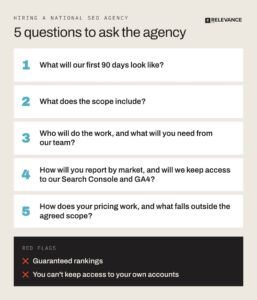
- What will our first 90 days look like? A good agency should be able to tell you which markets they’ll start with, what they’ll fix first, and what deliverables you should expect to see by the end of month three. If the answer is vague, the scope probably is too.
- What does the scope include? Look for deliverables, target markets, milestones, and AI visibility. Also ask how the agency earns links and evaluates their relevance and quality.
- Who will do the work, and what will you need from our team?
- How will you report results by market, and will we keep access to our Search Console and GA4 accounts?
- How does your pricing work, and what falls outside the agreed scope?
Be wary of guaranteed rankings or an agency that won’t let you keep access to your accounts. Google itself warns that no one can guarantee a #1 ranking.
If you’re looking for a national SEO partner with a proven track record, book a free strategy assessment with Relevance. Ask us the questions, hear our ideas around your brand, and together, we’ll assess the opportunities in the markets you want to reach and walk you through a clear approach for getting there
FAQ
How do I know if I need a national SEO agency?
You likely need national SEO expertise if you sell beyond your home market but don’t show up for non-branded searches there. An agency makes sense when your team doesn’t have the time or experience to close that gap on its own.
How long does national SEO take to show results?
The timeline depends on your starting point, competition, and the work involved. Fixing a technical issue and building visibility for competitive searches are different tasks. Ask what the agency will deliver in the first 90 days, which improvements may appear early, and when it will assess progress toward leads and sales.
How much does a national SEO agency cost?
Pricing depends on strategy depth, the number of target markets, technical complexity, timelines, and internal support. Agencies may charge fixed project fees, retainers, or hourly rates. Ask what’s included in the fee and which services or expenses are billed separately.
How do I know if my national SEO agency is working?
Always make sure you have clear metrics and goals in place at the start of the relationship. Track organic leads, sales, or other meaningful conversions alongside search performance in each target market. If AI visibility is included, report mentions, citations, and referral traffic from AI tools separately. Ask for consistent reports against those goals.
