

TL;DR The best SEO examples in 2026 aren’t generic best-practice checklists. They’re real moves brands like NerdWallet, Beehiiv, GoDaddy, HubSpot, and Zapier use to capture demand and convert it: topic clusters tied to revenue keywords, free product-led tools, programmatic pages, decay-refresh sprints, paid-plus-organic SERP coverage, and digital PR for authority links. Below are 15 examples we’ve either run for clients or studied closely.
Companies that treat SEO like a checklist tend to plateau …fast. After running SEO campaigns for over 500 brands, our team at Relevance has learned that even in an AI era, the investing in AI matters. When you treat it like a portfolio of revenue plays, instead of a “to-do” item, it keeps generating returns for years.
We’ve seen a single content refresh double demo requests in 90 days. We’ve also watched six-figure SEO investments stall. Not because the work was bad. It was just disconnected. There was no purpose, focus, or intent behind all the keywords, backlinks, and metadata.
After working with so many brands, one of the most common problems I see is that a good team fails to achieve success with their SEO strategies because their marketing is siloed. A siloed strategy means no single piece gets to truly meet its potential. They can have great keywords, great backlinks, and a strong technical foundation, but if there is no strategy, that means we are missing the connective tissue of marketing that helps take solid ideas from the whiteboard to actual ROI in the boardroom.
The ultimate takeaway we’ve found over the years? Never let your SEO strategy exist in a vacuum. Blind execution leads to wasted resources and low ROI. If you want SEO marketing to work, you need to tie every SEO decision back to your larger business goals and KPIs.
I want to break down what modern SEO marketing looks like, why it still matters in an AI age, and how to build your own SEO marketing strategy. Generic advice isn’t enough in this area anymore, either. I’ll back up all of these concepts with over a dozen rock-solid examples of how major brands have used these SEO strategies to succeed (often with the help of our team at Relevance).
Ready? Let’s dive in.
What is SEO marketing?
SEO marketing is the practice of enhancing a website’s content, structure, and authority so search engines — and AI tools — connect the right audience to the right page at the right moment. It combines keyword research, link building, and technical optimization to attract, convert, and retain customers, turning organic search into a compounding revenue channel.
The 4 types of SEO marketing
Optimizing your site’s content for search engines takes a multi-pronged approach that we tend to break into four different categories.
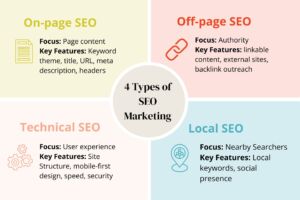
On-page SEO involves creating high-quality content centered on one keyword theme. You can optimize your content by including the keyword in your page’s title, URL, meta description, and headers.
To master off-page SEO, you must build your backlink strategy. Once you’ve created linkable content, identify external sites where your audience gathers. Then, ask for a backlink (be sure to clarify what’s in it for them and their audience).
Technical SEO might sound complicated, but it’s really as simple as providing a good user experience. You can do this by following web design best practices when it comes to things like your site structure, mobile-first design, load speed, and security.
If your business serves customers in a particular geographic area, local SEO is critical. Incorporating local keywords into your content and having an active social media presence can help your brand show up to in-market searchers nearby.
Why SEO marketing matters
The average internet user now spends 6 hours and 38 minutes online each day. The younger a person is, the more likely it is that the number goes up. That means your target audience (and the people behind them, growing into the next generation of customers) are online a lot.
What does this have to do with SEO marketing? As a digital marketer, one of your primary marketing goals is to get a segment of the billions of people online to spend a little piece of that time paying attention to you.
SEO helps you improve the visibility and ranking of your website, whether it’s in search results and traffic from a traditional search engine or social platform, or it comes from an AI-generated source list. When this happens organically, it means you didn’t pay for it with ads.
Paid vs. organic traffic
Both traffic sources have their place, but organic traffic is often considered more valuable for a few reasons. First, BrightEdge research has found that 68% of online experiences start with a search engine, which means ranking organically can put your brand in front of people at the moment they are already looking for answers, products, or services.
You don’t have to pay for organic traffic directly. You earn it through branding and content strategy efforts. Those efforts do require investing resources, but that investment pays dividends over time.
Organic traffic also tends to have a higher conversion rate, because those visitors are actively seeking out your content, products or services. For these reasons, SEO marketing is seen as a long-term investment in your brand that increases in value as you keep putting in the work.
The AI angle with SEO
It’s important to point out that AI isn’t replacing SEO. If anything, as AI tools improve and come alongside traditional search in more meaningful ways, it is making SEO more important — good SEO, that is.
The biggest mistake I am seeing right now is companies trying to choose between SEO or AI, and seeing them as competing strategies. Across our clients, the brands I am seeing perform well in AI search are the ones that regularly and consistently invest in SEO efforts as well. It shouldn’t be a “one or the other” situation, but both strategies should be implemented and executed in tandem to truly see success and growth.
Simple SEO tactics and shortcut techniques are no longer good enough. A clean, comprehensive SEO strategy ensures that your content not only ranks high in the SERPs. It is also easy for AI tools to cite it when they use it to craft an answer.
This is important in a world where the presence of an AI Overview summary drops clickthrough rate (CTR) from 15% to 8%, and 60% of Google searches end without a click. SEO lets you make sure people know it’s you talking, even if they never actually reach your site — and that has value in the form of brand awareness and trust-building, at the least.
SEO marketing for beginners
If you’re looking for an SEO for beginners approach, the SEO world might feel huge (and it is). The good news is that you don’t need to go far to take your first steps toward optimization. To reach SEO success, you need to take four steps:
1. Perform Keyword Research
There are SEO tools dedicated to keyword research. But as a beginner, don’t over-complicate this step. When optimizing your website content to keywords, go with what you know best – your business and your customers. Ask yourself:
- What do we sell?
- Who do we help?
- What would someone search for if they were looking for what we sell?
If you sell clothing for dogs, some keywords that might come to mind are:
- Dog clothing
- Dog sweaters
- Clothes for big dogs
- Winter coats for dogs
For more inspiration, use Google or an AI tool to search for other related keywords and see what’s suggested. If anything jumps out to you, add it to your list. It’s important to pick a relevant keyword based on the search intent. And don’t worry about including every keyword under the sun – four or five keywords might encompass your offering.
2. Work the keywords into your web content
Match each keyword to a web page on your site. If a keyword is on your list but doesn’t fit any of your content, that’s a sign that you might need a new page for that topic.
Once you’ve paired each relevant keyword with a page, make sure it appears in these key areas:
- Title tag
- Slug (URL)
- Meta description
- Headers
- Body
Incorporating your keyword shouldn’t be difficult or sound unnatural. If you have a hard time working it in, it might not be the best keyword for that page.
3. Create a content plan
Because search engine algorithms prioritize fresh content, you should consider starting a blog if you don’t have one already. Posting a high-quality blog post consistently is one of the most effective ways to build your credibility and start ranking higher for the keywords that are important to your business.
Thanks to the keyword brainstorming you’ve already done, you should have some good ideas for topics. Keep your team on track by putting together a simple content calendar with each article’s topic, author, and target publish date.
Your SEO content plan should also include regular reviews of your static web pages. Depending on how dynamic your organization is, auditing your website content two to four times per year is usually enough.
4. Link building
One of the main signals search engines use to determine your authority is the number of backlinks. That is, how many times are other sites linking to your content? Link building is a great SEO tool to support your SEO efforts. If your content has a lot of backlinks, people likely find it helpful and reliable.
Once you’re consistently publishing high-quality content, you’ll collect some backlinks without trying. Look at you go! But to really take your SEO strategy to the next level, you’ll need a link-building plan. Earning a backlink can be a simple off-page SEO technique. Start with these steps:
- Identify your best SEO content. This could be an article, page, guide, or case study.
- Decide who to reach out to. Whose audience would be interested? If your content is a guide to dressing your dog for winter, you might identify dog associations (American Kennel Club), lifestyle publications, and veterinarians’ websites.
- Craft your pitch. Do your best to find the person responsible for your target’s content and reach out to them. Send a message detailing how your piece can help their audience. Make their life easier by suggesting where to insert the link and the anchor text (the words linked to your site).
How to build your SEO marketing strategy
As you get better at SEO, you’ll find SEO strategy can come in many shapes and sizes. We’ve narrowed them down to three key strategic approaches — here they are, with the examples that follow showing how each one looks when you use it in real life.
1. On-site technical optimization
Technical SEO is the foundation on which the rest of your SEO strategy is built. We’re talking about things like website speed, navigation, and accessibility. They aren’t sexy, but they hold up the rest of the metaphorical house. These optimizations might not be apparent in your content, but your readers will definitely notice them.
2. A keyword-driven content strategy
On-page SEO encompasses everything from your topic to keywords to embedded media. If technical SEO is the house’s foundation, on-page is everything inside it – from the furniture to the trendy wallpaper. And solid on-page SEO starts with a thoughtful, keyword-driven content strategy with an E-E-A-T focus.
3. Acquiring backlinks
Backlinks are part of an off-page SEO strategy that focuses on links from external domains that point to your content. Search engine algorithms view backlinks as an indicator that other users find your content helpful. Consider them the “A-list guests” whose testimonials prove your metaphorical house is worth visiting.
Now, let’s see what these look like when you encounter them in real-life SEO examples that have not just followed the concepts but proven them.
14 SEO marketing examples (by funnel stage)
Below are 15 SEO examples, organized in three groups: acquisition plays, authority plays, and retention plays. They follow the funnel from discovery through the customer journey. Each one includes a real brand executing an SEO tactic, why it works, and the metric we’d hold it accountable to.
Acquisition plays (capturing new demand)
- Building topic clusters around revenue keywords, not vanity terms
The Example: When HubSpot wanted to invest in SEO, we created a “marketing hub” cluster. This started with a pillar page on marketing automation. We supported it with over 40 supporting articles on lead scoring, email workflows, CRM integration, and attribution. Every page funneled back to the pillar and to a product CTA. Their cluster ranked for over 8,000 keywords tied directly to their ideal customer profile (ICP).
The Lesson: Early on, we made the same mistake most SEO teams make: chasing volume. Big keyword numbers, impressive traffic charts, happy clients, until someone asked, “How many of those visitors became customers?”
I remember one client who came to us with a keyword they wanted to focus on. I had a call with them 12 months later when they said they wanted to leave because they weren’t seeing any leads from that keyword. That discussion led to a change in how I viewed SEO strategy. It was at that time that I realized we needed to take more of a lead on strategy. Since then, we’ve stopped focusing on the flashy keywords but on the ones that will actually lead to strong business outcomes.
Every SEO engagement at Relevance now starts with revenue data, not keyword tools (though the right keyword research tools are still essential). We pull from things like CRM notes and sales-call transcripts. The phrases prospects use when they’re comparing vendors or justifying budget rarely have the highest search volume, but they convert at as much as five times the rate. From there, we build clusters around up to three “money terms” supported by comparison pages, use-case content, implementation guides, and objection-busters.
Metric: A pipeline influenced by cluster URLs, not sessions.
- Ship a free, product-led SEO tool
Example: Ahrefs’ free Backlink Checker earns roughly 6,000 referring domains on its own and feeds the paid product. We modeled our own free GEO audit tool on the same idea: in competitive SERPs, utility outranks opinion every time.
Lesson: Free tools earn backlinks passively, generate branded searches, and capture leads exactly when someone is evaluating whether they need help. An ROI calculator, audit grader, pricing estimator, or template generator tied to a real pain point will outperform most blog content on a per-page basis. Start narrow. Solve one specific problem well. Iterate on it like a product, not a one-off marketing asset.
Metric: Referring domains earned per quarter and tool-to-trial conversion rate.
- Programmatic SEO for templated, high-intent pages
Example: Zapier’s “[App A] integrations with [App B]” page generates tens of thousands of templated pages from a single schema. Each one targets a real long-tail query. The pattern works because each page solves a specific integration problem. It’s not thin content dressed up.
Lesson: If your product solves variations of the same problem across industries or use cases, programmatic SEO can be a cheat code. Define a strong page template, then generate pages targeting “[solution] for [industry]” or “[use case] software” queries.
The success variable is quality control, not volume. You need tight templates, real value on each page, guardrails against duplicate content, and a workflow for pruning what doesn’t perform. On one B2B SaaS rollout, we launched 600 programmatic pages and only kept the top 120 that drove assisted pipeline within six months.
Metric: Indexed-and-clicked ratio (pages that earn at least 1 click/month).
- Turn customer questions into search-optimized “answer hubs”
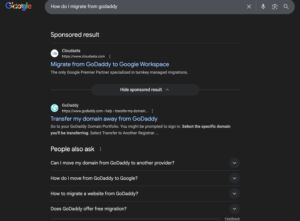
Example: GoDaddy’s help-center articles routinely outrank third-party blogs for “how to” queries about domains, email, and hosting. They mined support tickets to build the content map.
Your customers have already written your SEO roadmap in your support tickets, chat logs, and sales objections. High-intent questions like “How do I migrate from [competitor]” or “What does implementation look like for [use case]” often have strong search demand and weak content in the SERPs.
Lesson: Pull a few months of support and sales conversations, cluster similar questions, and turn each cluster into a search-optimized answer hub. Include text, short video clips, screenshots, and templates your team already uses.
Metric: Support deflection rate on hub pages combined with organic demo requests from hub URLs.
- Refresh decaying content instead of only chasing new topics
Example: We’re in the middle of refreshing our own blog as this is written. Over 1,600 articles, most older than a year. We’re not doing it because it’s fun. We’re doing it because we’ve watched what decay does to a content library, both ours and our clients’.
Lesson: Run a quarterly refresh sprint. Update examples, add fresh data, improve internal links, tighten CTAs, and realign with current search intent. Dedicated content optimization tools make this faster. Don’t be afraid to consolidate thin or overlapping posts into a single stronger asset.
For one B2B client, we refreshed 18 mid-funnel articles and saw a 27% increase in organic demo form fills over 90 days. No new content. We were just being smarter with what already existed.
Metric: Percentage of refreshed URLs that improve position by at least 5 spots within 60 days.
- Coordinate paid and organic to dominate the entire SERP
Example: NerdWallet’s piece on “best credit cards” runs paid sitelinks at the top of the SERP and holds the #1 spot for organic. The whole above-the-fold belongs to them.
Lesson: SEO and paid search often sit in separate silos, which wastes a lot of potential. Treat the SERP itself as your focus for both. Start with a short list of “make or break” queries. For those terms, align ad copy, sitelinks, and organic title tags so the whole SERP tells one coherent story.
Use paid to test messaging. Then roll winning angles into your SEO titles and meta descriptions. Use organic search-term reports to find cheaper long-tail queries worth bidding on.
Teams that run search this way usually find better blended customer acquisition costs (CAC) across channels, even if individual return on ad spend (ROAS) metrics fluctuate.
Metric: Blended CAC on priority keyword cluster, not channel-isolated ROAS.


Authority plays (earning the right to rank)
- Treat local SEO like a performance channel, not directory cleanup
Example: Domino’s Pizza store-locator pages. Every location has a unique, conversion-optimized landing page with hours, photos, reviews, and an order CTA. They treat it like an ad account, not a directory listing.
Lesson: If you have any physical presence or service area, local SEO is a performance channel. Many multi-location brands find that a handful of high-performing local profiles can drive a disproportionate share of high-intent customer actions, including calls, direction requests, and website clicks. SOCi research found that a one-star improvement in average Google rating was associated with a 44% increase in Google profile conversions, while every 10 new reviews improved profile conversion rate by 2.8%. Define your core Generative Engine Optimization (GEO) keywords, build location-specific landing pages that actually convert, and update profiles weekly, not annually.
A practical stack includes consistent NAP (name, address, phone) data, location pages with real photos and social proof, localized offers in the copy, and reviews managed as a KPI with an owner and a playbook for asking customers. We break the four categories down in our guide to the 4 types of SEO, and our local SEO complete guide walks through implementation.
Metric: Calls and direction requests per profile, per month.
- Use digital PR and data content to earn real authority links
Example: When Relevance worked with a telehealth brand, we paired anonymized client data with relevant news angles and earned over 700 media placements that contributed to a 6X lift in organic customer acquisition. That’s not link building in the traditional sense. It’s authority Google rewards.
Lesson: At some point, on-page optimization hits a ceiling. You need authority. This is where our PR and SEO teams at Relevance work together in a way most agencies can’t: both disciplines live under one roof. Digital PR turns your brand into a source journalists cite, not just another blog competing for the same keywords.
We pair original data, surveys, or anonymized client insights with compelling angles. Then we pitch to relevant publications. The goal isn’t vanity placements. It’s relevant, high-authority links to commercial pages.
Metric: Referring root domains earned per quarter to commercial URLs.
- Run technical SEO as an experiment backlog, not a one-time audit
Example: Most clients we inherit from other agencies arrive with the same artifact: a 60-page technical audit PDF that no one implemented. We rebuild it as a ranked, scored backlog tied to revenue impact.
Lesson: Treat technical SEO as a running experiment backlog tied to crawl efficiency, indexation, and page performance. Prioritize everything by revenue impact, not by how scary the issue looks in a crawl report. That might mean fixing Core Web Vitals on top revenue pages before cleaning up every 404. Agree on success metrics in advance, such as organic revenue for affected templates and time to first byte on key URLs.
When growth, product, and engineering align on a ranked backlog, technical SEO shifts from a scary black box into a series of manageable sprints.
Metric: Revenue-weighted issues resolved per sprint.
- International SEO as a deliberate expansion lever
Example: Canva’s localized landing pages. They don’t just translate; they re-shoot photos, swap testimonials, adjust pricing, and rewrite headlines for each region. Their international organic share is one of the highest in SaaS.
Lesson: If you’re already seeing traffic and trial signups from other countries, international SEO might be your cheapest expansion path. The mistake is adding hreflang tags and calling it a day. Pick one or two markets, commit to localized content, and align everything from pricing pages to testimonials with that region.
Start with existing “pull” as your guide. Which countries already show strong usage or revenue per user? For those markets, build localized versions of your highest-converting pages, not just your home page. Work with native speakers so the copy reads native, not translated.
Metric: Organic-sourced trials per priority market, per month.
- Optimize for AI Overviews and generative search (GEO)
Example: Investopedia and Healthline now show up inside AI Overviews far more often than competitors because their content structure (clear summary up top, scannable subheads, defined terms, citable stats) maps cleanly onto how generative engines extract answers.
Lesson: Generative engines like Google’s AI Overviews, ChatGPT Search, and Perplexity pull from sources that demonstrate clarity, citation-worthiness, and topical depth. According to Relevance’s AI visibility statistics, AI Overviews appeared on roughly 15% of US queries by late 2025, and click-through to traditional results dropped almost in half when an AI summary appeared.
What that means in practice: lead each article with a tight, factual summary. Structure the body with descriptive headings and short paragraphs. Cite original data. Write product and service pages so an LLM can confidently identify what you do and who you serve. The best AI SEO tools we’ve tested help operationalize this without inventing fake “GEO hacks.”
Metric: Share of voice in AI Overviews and traffic from AI assistants in your analytics.
Retention plays (Compounding gains)
- On-page SEO that actually gets a response
Example: Beehiiv’s onboarding articles (“How to monetize your newsletter”) rank for high-intent queries because the on-page work is meticulous. They include a descriptive H1 that matches the searcher’s exact phrase, internal links to the product, schema for how-to steps, and one clear primary keyword per page.
Lesson: On-page basics still work well. They create synergy when they work together, too. Write a title that matches the searcher’s actual phrase. Use one primary keyword and two to three supporting variants per URL. Add internal links with descriptive anchor text. Use H2s to answer the questions a reader would Google next.
Metric: Average position improvement on optimized URLs in 30 days.
- Use SEO to power lifecycle and retention content
Example: Beehiiv (again) wins on retention because their “how to grow your newsletter” and “how to monetize” guides double as activation playbooks for new users. The SEO content and the in-product onboarding reinforce each other.
Lesson: SEO is usually framed as a top-of-funnel acquisition channel, but it’s also incredibly effective for activation and retention. Help docs, onboarding guides, and “how to get value from [product]” content all have search demand, often from customers who are struggling quietly. Meeting them in the SERP can reduce churn and unlock expansion. A small CTR uplift on these pages — from a sharper title tag, nothing more — adds up fast at scale. We have a full playbook on writing meta description tags that actually generate leads and a primer on broader SEO best practices if you want the foundation work.
Map your lifecycle emails (a solid email marketing platform and marketing automation tools are helpful here) and in-product education to search behavior. For every major activation milestone, ask “what would someone search for when they get stuck here?” Then build content for that query. In one PLG motion, weaving SEO-friendly activation guides into onboarding reduced time-to-first-value by 18% for organic cohorts.
Metric: Activation rate on cohorts that touched a retention SEO URL.
- Document everything as a case study (and publish it)
Example: Relevance’s own case studies in content marketing and SEO. They’re not just sales collateral. They earn backlinks from journalists looking for original SEO data, and they rank for “[industry] SEO case study” queries.
“SEO case study” pulls roughly 1,900 monthly searches in the US with a relatively low keyword difficulty (KD) of 14. Most companies do the work, but never write it up. If you’re running real campaigns, documenting them publicly (with permission) earns links, builds authority, and ranks for searches your prospects are doing during vendor evaluation.
Metric: Referring domains and branded search lift after you publish each case study.
What ROI can SEO marketing deliver?
If you’re wondering how SEO can grow your revenue, let’s look at a hypothetical example. Say your website gets 1,500 visitors per month from a mix of organic and paid sources. Your conversion rate is 5%, and your average sale is $85.
1,500 x 3% = 45 sales x $85 = $3,825 per month
By implementing some simple SEO strategies, let’s say you spend $1000 on a blended SEO strategy. The result is that you increase your number of visitors to 2,800 per month. Your revenue is now:
2,800 x 3% = 84 sales x $85 = $7,140 per month
That’s a $3,315 boost. While the results aren’t always predictable, well-done SEO does boost organic search. And organic search conversion benchmarks are at 4.9% (nearly as high as paid, but without the ongoing cost). When done right, your SEO content will pay for itself — and then some — over time.
How long does each SEO tactic take to rank?
If you’re wondering how long SEO takes to kick in, here are some estimates from our team for different SEO approaches:
SEO tactic comparison chart
| Play | Funnel stage | Time to impact | Best owner | Quick win? |
| Topic clusters | Acquisition | 3-6 mo | SEO + content | No |
| Free product-led tool | Acquisition | 3-6 mo | Product + growth | No |
| Programmatic pages | Acquisition | 6-12 mo | SEO + engineering | No |
| Customer-question hubs | Acquisition | 1-3 mo | SEO + support | Yes |
| Content refresh | Acquisition | 30-90 days | SEO + content | Yes |
| Paid + organic SERP | Acquisition | 30-60 days | SEO + paid | Yes |
| Local SEO operationalized | Acquisition | 1-3 mo | Local marketing | Yes |
| Digital PR + data | Authority | 3-9 mo | PR + SEO | No |
| Technical SEO backlog | Authority | Ongoing | SEO + engineering | Mixed |
| International SEO | Authority | 6-12 mo | SEO + localization | No |
| AI Overviews / GEO | Authority | 1-3 mo | SEO + content | Yes |
| On-page optimization | Retention | 30 days | SEO | Yes |
| Lifecycle SEO content | Retention | 3-6 mo | SEO + lifecycle | No |
| Meta + title rewrites | Retention | 14-30 days | SEO | Yes |
| Published case studies | Authority | Per launch | Marketing + SEO | Yes |
Build your SEO strategy as a portfolio, not a checklist
SEO isn’t a marketing “to-do” item. Nor is it a checklist. Make it an integral part of your marketing strategy. Invest in it as a way to establish a stronger brand presence and generate long-term visibility for your brand over time.
When I started at this agency 7 years ago, we were able to help secure clients backlinks and could see great movement in their keyword rankings and in turn, their organic traffic. Over time, that’s shifted as SEO has become more sophisticated and AI visibility has joined the scene. Because of that, we’ve moved into a more exciting stage of marketing. We can’t depend on isolated tactics like we used to, but instead have to build stronger brands, understand our audiences better, and honestly be stronger and more strategic marketers to see the wins we want to see. If you ask me, its a more exciting and challenging time in marketing.
Visibility engineering may be taking the place of traffic generation in the AI era, but SEO remains a driving focus behind both. Make sure it’s at the heart of your digital marketing plan in 2026 and beyond.
SEO Marketing FAQs
What is SEO in marketing?
SEO marketing uses search engine optimization to attract, engage, and convert visitors from organic search as part of a broader digital marketing strategy.
What are the 4 types of SEO?
The four types of SEO are on-page, off-page, technical, and local. Each covers different areas, from content and backlinks to site performance and maps listings.
What are the 3 main SEO strategies?
Three core SEO strategies are technical optimization, keyword‑driven content, and authority building via backlinks and digital PR. Together, they form a repeatable SEO strategy example you can adapt into full seo campaign examples.
How do I start SEO as a beginner?
Start with simple keyword research, fix basic technical issues, and publish a few focused articles. If you’re asking how to do SEO or where to start, Use this guide to find an example of SEO before inventing your own.
Is SEO marketing worth it, and what’s the ROI?
Yes, SEO marketing is usually worth it when tied to revenue. A solid SEO marketing strategy compounds over time into steady traffic, leads, and sales as you learn how to build your strategy.
How long does SEO take to work?
Each SEO tactic takes a different amount of time to have an effect. A topical cluster might start showing results in three months, whereas on-page optimization can show results in 30 days. The key is to give all SEO time. Don’t rush the results. Do your research, set KPIs and benchmarks, and then measure results over time.
SEO vs. PPC — which is better?
This is a common question. In reality, SEO is a long-term strategy, while pay-per-click (PPC) is a tactic that gives an immediate advantage through paid traffic to a site. Both are valuable and they can create better results when used together as complementary parts of the same strategy. Read more here.
