

You know that feeling when a stakeholder slacks you a screenshot of an AI answer and says, “Why aren’t we in this?” It’s not even a Google SERP. It’s an AI Overview, or Gemini, or Perplexity, or ChatGPT. No blue links. Just an answer. And your brand, the one you’ve spent months building demand for, is missing like it never existed. That’s the recognition moment: search visibility is no longer just rankings. It’s whether a model chooses your site as evidence.
Our research and experience
At Relevance, we sit in the unglamorous middle of growth reality: you still need pipeline, you still need CAC to behave, and you still need organic to compound even while the surface area of “organic” keeps mutating. Over the last two years, we’ve been pulled into more and more “AI visibility” work that started as an SEO question and ended up as a mix of technical SEO, content strategy, digital PR, and entity management. That’s become the real job: not “write posts,” but “become the source the model trusts.”
To ground this guide in what’s true right now, we leaned on a mix of first-hand patterns we’re seeing across client accounts (B2B SaaS, ecommerce, local, and publisher-style content) and primary documentation on how modern AI search experiences behave. Google has been unusually explicit lately about AI Overviews and AI Mode from a site-owner perspective, including the fact that these systems can use “query fan-out” (multiple related searches) and that SEO fundamentals still apply.
We also pulled in data-led research on citations and overlap between classic rankings and AI citations (Ahrefs has done some of the most actionable work here), plus the underlying technical architecture that powers “LLM retrieval” in practice (retrieval-augmented generation, embeddings, vector search).
What this guide covers
We’re going to make LLM retrieval feel concrete, not mystical. You’ll learn how models “know” things (and when they don’t), what AI search systems actually pull from at prompt time, why citations behave differently than rankings, and how to build a brand footprint that keeps showing up even as Google pushes deeper into AI Mode. You’ll also get a realistic implementation roadmap that won’t require a moonshot replatform or a 12-person content team.
What LLMs are doing when they “retrieve information”
Let’s clear up the biggest confusion first: most LLMs don’t retrieve anything by default.
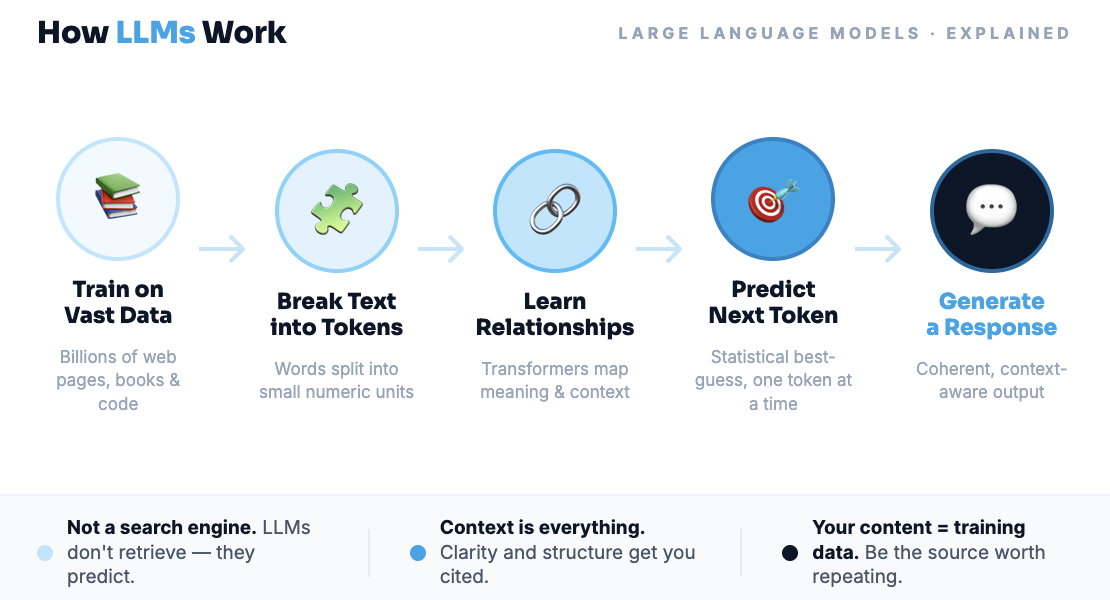
A base LLM generates text from patterns learned during training. That’s “parametric memory,” meaning facts and associations are baked into the model weights. It’s why models can confidently answer things they’ve seen a million times, and also why they can confidently hallucinate if they’re outside their depth.
When you see an AI answer that references sources, pulls “fresh” info, or cites specific pages, you’re usually looking at an LLM plus a retrieval system.
The industry term for that is retrieval-augmented generation (RAG): the system retrieves relevant documents and injects them into the model’s context so it can answer using external evidence. The original RAG framing (Lewis et al., 2020) explicitly describes combining parametric memory with a dense vector index you can retrieve from at generation time.
Here’s the marketer-friendly mental model: AI answers come from three layers of “knowledge” working together.
- What the model remembers (training)
- What the system can fetch (search indexes, documents, tools)
- What the model decides to say (the synthesis)
Which means “GEO” is really about influencing layers 2 and 3, because layer 1 is mostly out of your control.
A plain-language definition of generative engine optimization
Generative engine optimization (GEO) is the practice of increasing how often your brand, pages, and claims get used as supporting evidence in AI-generated answers across AI search and AI assistants.
Search Engine Land’s definition frames GEO as adapting content and presence for generative AI systems rather than classic ranking lists.
The key shift: you’re not just fighting for position. You’re fighting to become a source.
And in a world where Google says AI Overviews and AI Mode may issue multiple related searches (“query fan-out”) and then select a broader set of supporting pages while generating the response, you’re optimizing for eligibility + selection + quotability, not just “rank #3.”
GEO vs SEO vs AEO vs digital PR
People are mashing these together right now, and it’s causing bad decisions (usually expensive ones).
Here’s a clean way to separate them:
| Discipline | Primary goal | Primary surface | Success looks like |
|---|---|---|---|
| SEO | Rank pages for queries | Blue links + SERP features | Positions, clicks, revenue |
| AEO | Be the direct answer | Featured snippets, voice | Answer box inclusion |
| GEO | Be the cited evidence | AI Overviews, AI Mode, assistants | Mentions, citations, influence |
| Digital PR | Build authority + corroboration | Publications, backlinks, knowledge graphs | Brand trust signals everywhere |
Now the important part: GEO doesn’t replace SEO. Google literally says there are “no additional requirements” and that SEO best practices remain relevant for AI features like AI Overviews and AI Mode.
So if someone is selling you “GEO magic prompts” while your technical SEO is leaking indexation and your brand is barely corroborated off-site, you already know how that ends.
How Google and other “AI answer engines” pull sources
Google AI Overviews and AI Mode
Google has been direct about two mechanics that matter for marketers:
- These AI features surface relevant links and can create new opportunities for more sites to appear.
- They may use query fan-out, issuing multiple related searches across subtopics and data sources, and identify additional supporting pages while the response is being generated.
That fan-out detail is the giveaway: you’re not optimizing for one keyword. You’re optimizing for a cluster of implied sub-questions the system may run behind the scenes.
Also, eligibility is blunt: to appear as a supporting link, your page must be indexed and eligible to show a snippet in Google Search. No snippet eligibility, no AI feature eligibility.
“Cited pages are usually already ranking” is true, but not complete
Ahrefs analyzed 1.9M citations across 1M AI Overviews and found that about 76% of cited pages rank in the top 10.
That’s the part executives like because it sounds comforting: “Just do SEO.”
But the more useful part is what comes next: a meaningful chunk of citations come from outside the top results, and Google’s own documentation suggests AI responses can pull a wider, more diverse set of links than classic search because of fan-out and real-time page selection.
Translation: ranking is necessary more often than it’s sufficient.
The citation layer is unstable by design
One of the weirdest things marketers are noticing is that AI answers can be semantically similar but cite different sources. That’s not your imagination. Recent reporting on Ahrefs data found AI Mode and AI Overviews can cite different URLs even when the answers look similar.
So if your entire “AI strategy” is “we got cited once,” you don’t have a strategy. You have a screenshot.
Why this matters more than most teams want to admit
The uncomfortable truth: a growing share of discovery is turning into zero-click behavior, and AI answers accelerate that. SparkToro’s clickstream-based work (covered widely in the SEO space) has shown the majority of Google searches end without a click, and the trendline has been heading that direction for years.
On top of that, publishers and analysts have been sounding alarms about clickthrough loss when AI summaries appear.
If you’re a lead gen site, that doesn’t mean “SEO is dead.” It means your measurement system is about to feel dumber than it already does. You’ll need to account for influence that happens in the answer layer, and then shows up later as branded search, direct, referrals, and “sales said they keep hearing about us.”
The four pillars of brand visibility in LLM-driven discovery
When a model decides what to cite, it’s basically asking: “What’s the cleanest evidence I can use without getting myself in trouble?”
That decision tends to cluster around four pillars.
1) Entity clarity
Models don’t love ambiguity. If your brand name is also a common noun, if your product category is fuzzy, or if your positioning shifts every quarter, you make retrieval harder.
Entity clarity is the boring work: consistent naming, consistent descriptions, consistent “about” language across your site and across corroborating sources. When you’re clear, the model has an easier time matching a user’s intent to your brand as the entity.
2) Corroboration footprint
If the only place a claim exists is your own website, a cautious system hesitates.
This is where digital PR quietly becomes GEO. Independent coverage, third-party reviews, industry association listings, credible directories, “best of” roundups that are actually editorial. Not because of the backlink. Because it gives the model permission to treat your claim as real.
Google’s AI features explicitly talk about grounding, and Google-Extended (the control token) clarifies that content crawled from sites may be used for training Gemini models and for grounding at prompt time in Gemini apps and Vertex AI, separate from Search inclusion.
You don’t need to obsess over that mechanic. You do need to understand the implication: corroborated facts travel.
3) Retrieval alignment
Most modern retrieval systems rely on embeddings, chunking, and semantic similarity rather than exact-match keywords. Microsoft’s RAG guidance spells out the basics: chunk documents, generate embeddings, store them for vector search, retrieve relevant chunks, then inject them into the prompt.
If your content is one giant marketing narrative with no scannable “facts,” it chunks poorly. It retrieves poorly. And even if it ranks, it may not get selected as evidence.
4) Conversation conversion
Even when you “win” a citation, you might lose the business if the click is cold and confusing.
Google has stated that clicks coming from AI Overviews can be “higher quality” in the sense that users are more likely to spend more time on-site. =That only helps you if your landing experience actually matches the promise the AI answer made on your behalf.
Core tactics that actually move the needle
Let’s talk execution. This is where most GEO advice becomes either fluff (“be authoritative”) or spam (“write for prompts”).
Here are tactics we’ve implemented that consistently increase “model visibility” without torching your SEO fundamentals.
Build a “source-first” content layer on your site
Most sites have two layers:
- demand capture (blog posts, landing pages)
- demand convert (product pages, pricing, demo)
You now need a third:
- evidence layer (definitions, benchmarks, comparisons, hard answers)
This layer is where you publish the cleanest, most quotable version of what you know. If you’ve ever watched Ahrefs or Intercom win organic, you’ve seen the pattern: they don’t just write posts. They create canonical references people reuse.
What “evidence layer” looks like in practice:
- A tightly written “What is X” page in your category with definitions that don’t dodge the point
- A comparison page that admits tradeoffs instead of pretending you’re perfect
- A benchmarks page that updates quarterly
- A glossary that doesn’t feel like it was generated by a toaster
The goal is not “more content.” The goal is retrievable chunks that answer sub-questions in fan-out.
Write for chunking, not just reading
If you’ve played with RAG systems at all, you know how brutal chunking can be: headings get split, context gets lost, disclaimers get separated from claims.
You don’t need to over-engineer this, but you do need to structure pages so that any 200 to 500 word chunk can stand alone without sounding like nonsense.
A simple pattern that works:
- 1 to 2 sentence definition
- 3 to 5 “key facts” written plainly
- one example with a real number or constraint
- a short “when this is a bad fit” section
That format retrieves well, and it reads well. Which is the whole point.
Use structured data as alignment glue, not a hack
Google is explicit that there’s no special schema you need to add for AI features, and you shouldn’t invent “AI files.”
Still, structured data matters because it reduces ambiguity (entity clarity) and keeps your visible content aligned with your machine-readable representation.
So yes, your Organization, Product, FAQ, HowTo, and Review markup hygiene still pays off. Not because it’s “GEO schema.” Because it makes you easier to interpret.
Expand your corroboration footprint deliberately
This is the part most SEO teams under-resource because it feels like PR, and most PR teams under-resource because it feels like SEO.
Pick one or two claims you want the market to associate with you, then build corroboration around them:
- A data study (even a small one) that others can cite
- A partner co-marketing piece with a credible brand
- A founder POV in an industry publication that isn’t pay-to-play sludge
- A Wikipedia-worthy narrative if you’re actually notable (and if you’re not, don’t force it)
If you’re thinking, “That sounds like brand,” you’re right. Rand Fishkin’s recent commentary on AI and zero-click keeps circling back to the same idea: branding and memorability are what survive when clicks get squeezed.
Make your “About” and “Editorial” surfaces boringly strong
Models lean on trust signals. Humans do too, but models are less forgiving.
At minimum, your site should make it easy to answer:
- Who wrote this?
- Why should anyone believe them?
- When was it updated?
- What’s the company behind it?
Google’s own best-practice language keeps pointing site owners back to “helpful, reliable, people-first content.”
You don’t need to cosplay E-E-A-T. You do need to remove doubt.
The tactical GEO playbook for marketers
Most teams want a checklist. I get it. Just don’t treat it like a one-week sprint.
If you want the shortest set of actions that tends to create real lift, it’s this:
- Pick 20 “fan-out queries” that sit above your product keywords
- Create 5 canonical evidence pages that answer sub-questions cleanly
- Ship 10 corroboration placements (PR, partners, credible mentions)
- Fix snippet eligibility issues (indexing, renderability, thin content)
- Track citations + branded demand monthly, not weekly
That’s it. Everything else is variations.
Measurement and ROI when “wins” don’t always click
Google says AI feature traffic is included in Search Console’s performance reporting, inside the “Web” search type.
But the practical reality is messy: you often can’t isolate “AI Overview impressions” cleanly inside the default UI, and a lot of the value shows up as downstream behavior anyway.
There are three measurement moves that work without requiring a data science team:
- Query class tracking: pick a stable set of non-branded queries and track whether you are cited, mentioned, or absent (manual sampling is fine if you’re consistent).
- Branded lift monitoring: if you start showing up as evidence, you usually see branded search rise 4 to 12 weeks later, especially in B2B categories where buyers research before they buy.
- Assisted conversion analysis: tag sessions that land on evidence-layer pages and watch assisted conversions and return visits.
Also, understand how Google counts this stuff. In Search Console terms, clicking a link in an AI Overview counts as a click, impressions follow standard visibility rules, and all links in an AI Overview can share the same position because the Overview occupies a single position.
That nuance matters when a stakeholder asks, “Why did average position jump?”
Getting started: a realistic implementation roadmap
Phase 1: Foundation (Weeks 1 to 3)
Start with the plumbing and the target list.
Audit indexation and snippet eligibility first, because Google is clear: AI feature eligibility depends on being indexed and able to show a snippet.
Then build your “fan-out map” by taking your core category terms and listing the 5 to 10 implied sub-questions buyers ask before they’re ready for a vendor comparison.
Deliverables by the end of Phase 1:
- one-page GEO target brief (queries + intents + desired brand association)
- technical SEO fixes list tied to snippet eligibility
- a prioritized list of “evidence layer” pages to build
Phase 2: Evidence layer build (Weeks 4 to 8)
Ship 3 to 5 canonical pages that are designed to be retrieved:
- definitions
- comparisons
- benchmarks
- “how to choose” frameworks
Don’t over-publish. Make them surgically useful.
If you can only do one thing in this phase, do this: create a page that answers the question you wish prospects would ask before they end up in a sales call misunderstanding your category.
Phase 3: Corroboration sprint (Weeks 6 to 12)
While the evidence layer is going live, build third-party reinforcement.
This is where you pitch your data, your benchmarks, your category POV. It’s also where you clean up listings, partner pages, and industry profiles that currently misrepresent you or contradict your own positioning.
Phase 4: Optimization and scaling (Months 4 to 6)
Once you have a baseline presence, you iterate:
- tighten sections that get cited but don’t convert
- expand pages that consistently rank but never get selected as evidence
- update benchmarks and “freshness-sensitive” content regularly
Ahrefs’ work suggests AI citations correlate strongly with top rankings, but also that AI systems can pull from beyond the top results. So in this phase you’re improving both: rank and retrievability.==
What our research team is seeing today
Across client audits this year, the biggest separator isn’t “who used AI to write more pages.” It’s who turned their website into a clean source of record.
When we rebuild a category page into an evidence-style page (definition, constraints, examples, tradeoffs), we typically see two things within 60 to 120 days: (1) more long-tail impressions on “messy” queries that don’t map neatly to a keyword, and (2) an uptick in branded search and direct traffic that correlates with those pages being reused elsewhere. The teams that win here usually publish fewer pieces, but update them more aggressively. They treat “freshness” like a product, not a blog schedule.
The other pattern is political: the first time a sales rep hears “I asked ChatGPT” on a discovery call, leadership suddenly funds the work. If you’re waiting for perfect attribution, you’ll be waiting while your competitors become the default answer.
What top experts are saying
A lot of the best commentary right now isn’t coming from “AI gurus.” It’s coming from search practitioners who’ve been forced to reverse-engineer what’s happening.
Aleyda Solis has done practical, trackable breakdowns of AI Overviews rollout behavior and how SEOs can monitor changes, which is useful because most teams are still flying blind on what triggers Overviews and how volatile they are.
Mike King (iPullRank) has been one of the loudest voices pushing the idea that search is becoming an AI-mediated discovery layer and that marketers need to think in terms of relevance engineering, not just classic ranking tactics.
Rand Fishkin keeps hammering the point that zero-click is the bigger structural shift, and AI is gasoline on that fire. His stance forces the right strategic question: if fewer people click, are you building a brand that still sticks?
And from the platform side, Google has doubled down on two messages that matter: AI Mode relies on query fan-out, and AI features still rely on the same foundational SEO best practices. That’s basically Google telling you not to look for a “GEO loophole.”
Common mistakes we see (and how to avoid them)
The first mistake is treating GEO like it’s a new channel you can “hack.” The fastest way to waste a quarter is to publish a bunch of prompt-bait content while your core pages are thin, your brand is inconsistent, and your site isn’t even reliably eligible for snippets.
Another one: optimizing only for citations. A citation that lands users on a vague homepage is a fancy-looking bounce.
We also see teams ignore corroboration. If you’re in a competitive category and the only authoritative claims about you live on your own site, you’re asking a cautious system to take your word for it. That’s not how these systems are designed to behave.
Last, teams measure the wrong thing. If you only track “did we get clicks from AI Overviews,” you’ll miss the brand lift and assisted conversion reality that shows up weeks later.
Who should prioritize GEO right now (and who shouldn’t)
Prioritize this if you sell into a market where buyers research, compare, and ask “what is” questions before they talk to sales. That’s most B2B SaaS, many healthcare and fintech categories, and a lot of considered ecommerce where trust matters.
Deprioritize if you need leads next month and you have no organic foundation. In that case, spend on demand capture you can control (paid search, paid social, outbound), and build GEO as a parallel track once your SEO fundamentals and messaging are stable.
Also, if your category is tiny and people don’t search questions about it, GEO can still matter, but it becomes more like PR and partnerships than classic content.
Final thoughts
LLMs don’t “replace SEO.” They change what SEO is for.
Your job used to be earning a click. Now it’s earning a role in the answer, and then earning the buyer’s trust when they finally show up. Google is telling you AI search will use fan-out and surface supporting links, and Ahrefs is showing citations still heavily overlap with top rankings. Both can be true.
So build the boring foundation, then build the evidence layer, then build corroboration. Do that for six months and you’ll stop chasing screenshots and start showing up as the default source.
How we research articles at Relevance
Relevance is a growth marketing, SEO, and PR agency. Our guides are written from the perspective of practitioners who have to make this work under real constraints: limited resources, stakeholder pressure, and messy attribution. Our starting point is what we see across audits, content programs, and organic growth work for clients.
For this article specifically, we consulted:
- Google Search Central documentation on AI features, eligibility, controls, and reporting (Google for Developers)
- Google’s product update describing AI Mode mechanics like query fan-out (blog.google)
- Ahrefs studies on AI Overview citations and overlap with rankings (Ahrefs)
- The foundational RAG research paper (Lewis et al., 2020) (arXiv)
- OpenAI’s cookbook example showing how file search and retrieval workflows work in practice (OpenAI Cookbook)
- Industry practitioner perspectives from Aleyda Solis, Mike King, and Rand Fishkin (Aleyda Solis SEO)
