After a decade of writing titles for clients at Relevance, we’ve learned something slightly annoying: the “best” title is rarely the clever one. It’s the one that gets the click and sets up the content to deliver.
We’ve watched perfectly good articles die because their titles were vague, self-centered, or sounded like every other post on page one. And we’ve watched average drafts outperform because the title hit the moment the reader was in.
So, here are the 10 title strategies we keep coming back to—the ones that consistently lift CTR, earn shares, and (most importantly) drive the right traffic.
1) Lead with the outcome, not the topic
Most titles describe the category. Winning titles describe the result.
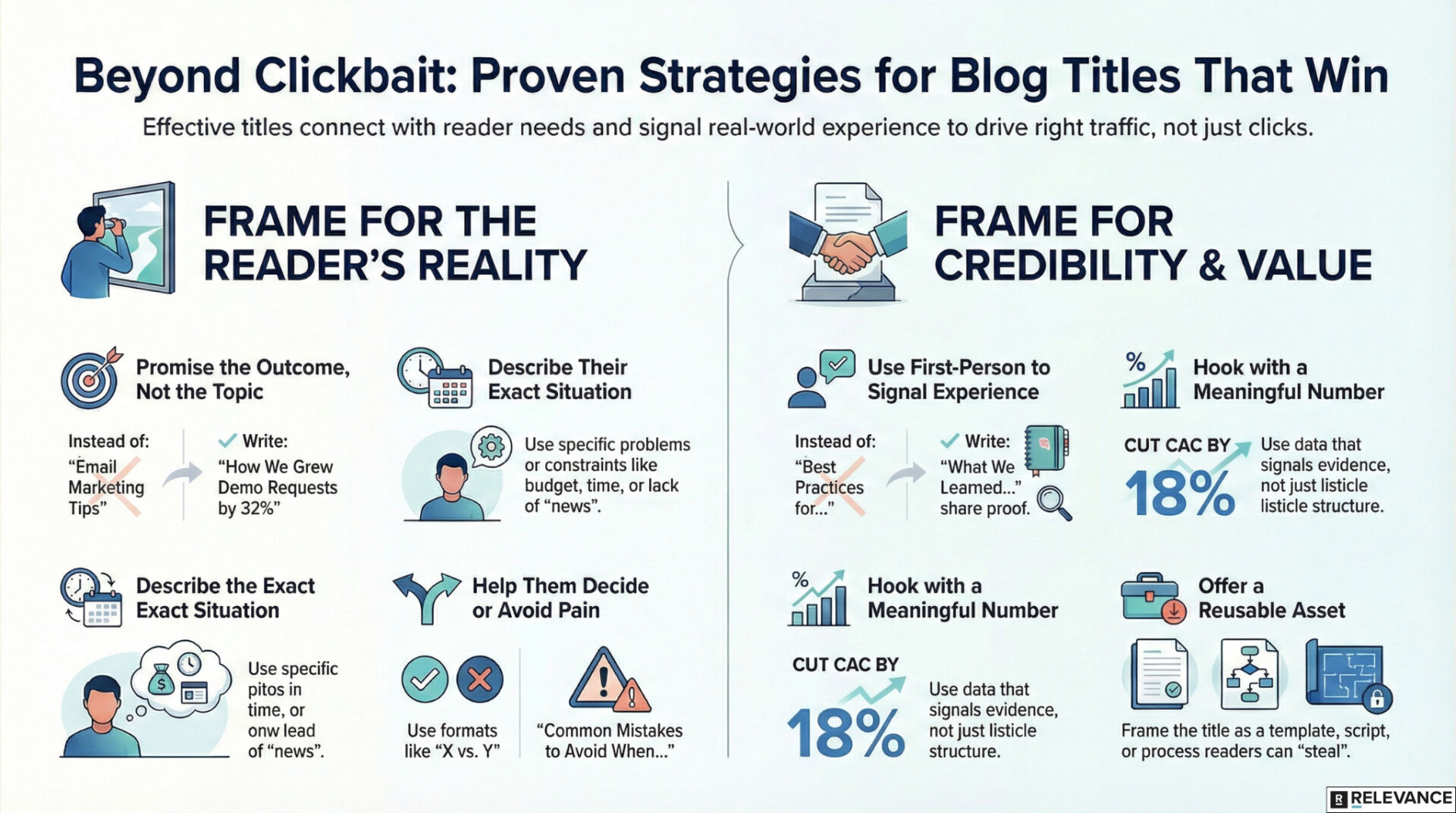
“Email marketing tips” is a topic. “How we increased demo requests from email by 32%” is a promise. Even if your post is educational, you can still anchor it to what someone gets on the other side.
If your title could be the label of a folder in Google Drive, it’s probably too generic.
2) Add a real constraint (time, budget, team size)
Constraints make titles feel lived-in. They also filter in the right reader.
One of our favorite patterns is: result + constraint + context. Like, “The 30-minute content update that saved a ranking” or “The SEO refresh we do when we don’t have time to rewrite the whole post.”
Constraints work because they answer the reader’s unspoken question: “Will this work for my reality?”
3) Use first-person when you can actually prove it
We’re seeing more “personal” titles win because they signal experience—especially in search environments that reward credibility.
Think: “What we learned after auditing 117 landing pages” instead of “Landing page best practices.”
if you didn’t do the thing, don’t title it like you did. Readers can smell it, and the drop-off tells Google (and now AI summaries) you overpromised.
4) Make the reader feel seen with a specific situation
The fastest way to earn a click is to describe the exact moment they’re in.
Not “PR strategy guide.” More like: “What to pitch when you don’t have ‘news’” or “How to get coverage when your product isn’t sexy.”
When we title this way, we’re not guessing at intent—we’re naming it. That’s why it works.
5) Turn your title into a decision
People don’t just want information; they want to choose.
Decision titles do well because they reduce anxiety. Examples:
- “Should you update old content or publish new posts?”
- “Is [strategy] worth it in 2026?”
- “When NOT to do [popular tactic]”
If your reader is stuck between two options, write the title like you’re ending the debate.
6) Use “vs.” and comparisons when the market is crowded
In competitive categories, readers are already comparing—you might as well meet them there.
Titles like “X vs Y” and “Best alternatives to…” win because they map to high-intent behavior. The trick is to make the comparison feel grounded, not affiliate-fluffy.
A small tweak we’ve seen lift performance: add the reason someone is comparing (price, speed, compliance, team fit) instead of just listing brands.
7) Write the title like a promise your post can keep in the first 15 seconds
The best titles don’t just earn clicks; they reduce bounce rates.
If your title says “The complete guide,” your intro should orient quickly and provide a clear path. If your title says “templates,” the reader should see a template immediately (or at least within one scroll).
We’ve had posts rank for months and still underperform because the title attracted the wrong expectation. Fixing the title (or matching the intro to it) often beats rewriting the whole article.
8) Pull one surprising number from the post and make it the hook
Data-backed titles still work—when the number is meaningful, not decorative.
“7 steps” is general. “We cut CAC by 18% without touching ads” is specific and curiosity-generating. Numbers that imply effort, scale, or proof tend to win: audits, tests, months, dollars, pages, experiments. Use numbers to signal evidence, not structure.
9) Use a “mistake” frame when you’re teaching something tactical
Mistake titles are evergreen because they’re emotionally efficient. People want to avoid pain faster than they want to chase upside.
What we like about this strategy is it lets you teach best practices without sounding preachy. “Common mistakes” also earns clicks from people who already think they know the basics.
Pick a specific arena (title tags, onboarding emails, PR pitches), not “marketing mistakes” in general.
10) Build a swipe-file title: make it easy to steal
Some titles win because they’re basically templates someone can reuse.
When we publish titles like “The briefing doc we use before any SEO sprint,” readers click because they want the asset—not just the opinion. Even if you’re not giving away a literal doc, framing it like a reusable internal playbook makes it feel practical.
Here are a few plug-and-play title frameworks we’ve used across SEO, PR, and AI visibility work:
- The exact process we use to [achieve outcome] in [timeframe]
- What we’d do if we had to [reach goal] with [constraint]
- X vs Y: Which is better for [specific audience/use case]?
- The [asset/template/script] we use to [solve painful problem]
- Why [common belief] fails in [current year] and what to do instead
Don’t skip title testing
While others may argue you need a complex testing system to get better titles, sometimes all you need are more reps and feedback loops.
A simple habit we swear by is to write 10 titles before you write the post. Then, pick the one that best matches the reader’s moment. If you’re working with a team, have someone who didn’t write the piece choose the winner. And, more often than not, they’ll spot the vague phrases you’ve gone blind to.