

Everyone is quick to prioritize content as the biggest piece of a successful digital marketing strategy. But what does it look like to actually create content that converts?
What channels, like company websites and emails, are the best forms of content marketing for your business? What should your content look like? What topics should it cover? How will it help you achieve your larger growth marketing goals?
These are important questions that you can only answer with a comprehensive content marketing strategy. And with the reach of AI tools, everyone can produce content quickly and easily now, which is exactly why simply producing it isn’t the strategy. As our Chief Strategy Officer, I prioritize strategies that focus on deciding what each piece is supposed to actually do, and saying something only your brand can say. Skip that, and you’ve just added to the noise you were trying to cut through.
What is a content marketing strategy?
Content consists of pieces of marketing assets that you can use to promote a brand. Everything from social posts and blog articles to guest posts, podcasts, and drip campaigns counts under the massive and diverse umbrella that is marketing content.
A strategy is a plan of action. It takes your assets, abilities, and other resources and considers how you can use them to achieve your goals. You can create a strategy to meet a short-term goal on the way to a larger one, such as hitting a particular KPI in the next month. You can also create strategies focused on single, larger objectives, like achieving a certain percentage of growth in sales by the end of the year.
When you combine these terms, you get a content marketing strategy. This form of business content strategy considers how you’ll achieve your marketing goals through your content creation and curation.
Content strategy is much bigger than picking out your next blog topic or finding a good quote to post on Instagram. It looks at your larger company goals and integrates them into what you’re doing and where you’re trying to go as you create your content.
A good content strategy considers content for the entire buyer’s journey, not just the most interesting topics or pieces of media. Content Marketing Institute adds the important clarification that a strategy designed to guide your content marketing should function as your “why.” It should answer key questions, including:
- Why are you making your content? Are you trying to boost revenue? Lower marketing costs? Improve customer education?
- Who are you making your content for? What kind of consumer wants your solutions? What do they care about? Is there something that drives their interests, wants, and needs?
- How can your content uniquely position your brand to stand out and help consumers? This is your unique selling proposition (USP). How can you solve consumer pain points in a way that outperforms competing brands?
These are important questions to answer if you want your content to help you meet your marketing goals.
Content strategy vs. content marketing strategy vs. content plan vs. content framework vs. content calendar (What’s the difference?)
There are a lot of different content marketing terms. Many of these aren’t set in stone, but we try to stay consistent with them in our approach to digital marketing at Relevance. Here is a quick rundown of what each one means and how it impacts the others:
| Term | What it means |
| Content strategy | The overarching approach that your entire organization takes to all content you create as a brand. |
| Content marketing strategy | Answers the why behind your content marketing and creates a roadmap that ties specific goals to correlating content marketing tactics. |
| Content marketing strategy framework | Steps back and gives you a full picture of your content marketing activity, helping you put unspecific plans and strategic initiatives into motion. |
| Content plan (or content marketing plan) | The way you plan on creating digital marketing assets for a larger content strategy and framework. It also gives you structure for how to release all of your content so you can spread out your efforts and allow them to build on each other over time. |
| Content strategy template | A content marketing formula that you can use over and over again as you create content over time, for a specific event, campaign, or even an entire season of business activity. |
| Content calendar | A master calendar and single source of truth that tracks content by topic, format, channel, deadline, and responsibilities to keep things moving forward and optimized for consistent publishing. |
Why content marketing matters
Okay, content marketing strategy is the “why” behind your content creation efforts. But what is it about having a “why” that helps in the first place? What is it that makes putting a strategy behind your content creation so important?
The simple answer is that a strategy organizes and amplifies the impact of your content. Without a strategy, content tends to be listless and directionless.
Will it help consumers? Possibly. Will it generate traffic, revenue, or whatever else you’re trying to accomplish? Maybe at some point. But that isn’t certain or predictable.
Too often, marketers put content creation first and strategy second. They focus on fun, exciting ideas without taking the time to consider how each piece of content contributes to your business as a whole.
A content marketing strategy unifies your content creation efforts and points them in a single direction. It ensures that everything supports itself and is interwoven together in the single pursuit of achieving your business’s goals.
Why does content marketing matter right now? The business case, by the numbers.
While projects vary, global revenue for the content marketing industry is expected to reach nearly $724 billion by 2026, up from $300 billion in 2020. In addition, 74% of marketers attribute content marketing to helping generate demand and create leads as of 2026. At the same time, an Ahrefs analysis of roughly 600,000 top-ranking pages in 2025, found that 86.5% of top-ranking pages contain some AI-generated content.
As a natural response to this perfect storm of revenue potential and AI growth, nearly 37% of marketers plan to increase their content marketing spending in 2026. The more telling shift, though, may not be how much is being spent, but how it’s being spent. While businesses are investing in more marketing spend, though, they often end up with vanilla content as a result of over-dependence on AI without a proper framework and strategy in place.
This is why one of the biggest trends moving forward is going to be a shift away from generic content. As AI provides more answers without the need to leave SERPs, basic “101” pages will become irrelevant.
Instead, content creation trends will focus on two things: being helpful and educating audiences.
The former includes genuine thought-leader pieces and unique industry opinions. The latter relates to things like “how-to” articles, self-help infographics, and videos. The enduring entertainment and engaging aspect of videos, in particular, continue to be a powerful way for marketers to get their messages out to the world. Along with videos, demos, quizzes, industry-specific calculators, and even simple click-through embedded links remain important priorities in 2026.
From my perspective, when 86% of top-ranking pages already have AI in them, the money pouring into content isn’t proof it’s working…it’s proof everyone’s producing the same thing, faster. And when we all produce the same thing, we’re inflating the problem of poor content. But what that means is it is actually the biggest opening we’ve seen in years to provide high-quality, truly helpful content. When everyone floods the internet with average content, being genuinely useful stops being table stakes and becomes your brand’s differentiator.
How content marketing fits into growth marketing
At Relevance, we see content marketing as one of the three pillars of a strong growth marketing strategy:
- Content marketing helps build authority by creating thoughtful, high-utility onsite content. This fosters a sense of thought leadership and industry authority while also providing genuine value for customers.
- Digital PR cultivates credibility by generating off-site buzz. It focuses on brand links and mentions on third-party sites, which signal to consumers and search engines alike that your company is important and a relevant part of the conversation.
- SEO increases visibility by using keywords, link building, technical SEO, and other strategies. When these meet Google’s E-E-A-T content standards, they can help your brand show up in organic search results.
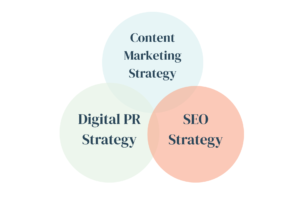
Not only does content marketing play an important part in building brand authority. It also serves as a key contributor to the other two pillars. For instance, quality onsite content is required to execute an effective digital PR campaign. In addition, good content should answer targeted questions that consumers are searching for (i.e., answer search intent). This improves the search engine optimization side of things and helps you rank better in Google SERPs.
From its leading role as an authority-builder to its support function for digital PR and SEO, your content and the strategy behind it can be a game-changer for your growth-oriented endeavors.
Types of content marketing
Content marketing can take many different forms. We’ve already mentioned a handful of these as we went along. But here is a more comprehensive list of each valuable content type for quick reference:
- Guest posts: This kind of off-site content refers to articles written for an industry publication or reputable news site to stoke top-of-the-funnel buzz and generate leads.
- Blog posts: A blog post is a piece of text-based content that can range from an op-ed or thought leader piece to a how-to for a product or service.
- White papers: These are similar to a blog post in concept but are long-form, information-heavy pieces of content meant to encourage those close to making a buying decision.
- Social media: This is any form of content designed for your team to post on social media, from a short Tweet to a TikTok video and everything in between.
- Email: Email marketing is a hyper-targeted form of content that creates a direct line of communication between your brand and an opt-in audience.
- Ads: These are often top-funnel pieces of pure promotional content that can be textual, audible, and visual in nature. This can include Google search ads, display ads, and more.
- Podcasts: This audible form of content can range from short, newsy clips to lengthy presentations, webinars, and round-table conversations designed to demonstrate thought leadership and teach consumers.
- Infographics: Infographics simplify textual information, reducing takeaways into single, flowing, visually appealing presentations.
- Case studies: When you have a particularly poignant success story with a customer, you can create a case study as a way to concisely summarize the positive takeaways as a testimonial for those considering patronizing your brand.
- Videos: Videos provide rapid-fire information in a flowing and entertaining format that has been one of the most effective forms of content for years now.
- Demos: A contained demonstration of your products or services at the end of the funnel can help spur potential buyers to make a purchase.
- UGC: User-generated content (UGC) includes things like testimonials, reviews, and other forms of public feedback that can spur word-of-mouth marketing.
Even this exhaustive list doesn’t have every option and nuance. For instance, a “blog post” refers to onsite content. However, it’s technically different from a sales page, which is also a form of onsite content.
The former is a piece of content that seeks to inform the consumer and guide them along the funnel (different pieces of content address top, middle, and lower sales funnel CTAs). The latter is at the end of the funnel and prioritizes promoting a product or service and closing a sale.
Similarly, infographics are a specific form of visual content. However, you can also create memes, photos, illustrations, and other forms of still media.
The point is that the above list isn’t an authoritative group of items that have to be included in a content strategy. Think bigger than something that is that formulaic. Content marketing should never be restricted to one or two of these options, and, at the same time (unless you’re a very large company with lots of resources), you shouldn’t try to utilize every one of them at once. If you do that, you’ll spread those resources too thin, and nothing will be effective.
Instead, you need to take the time to create a marketing strategy. (Big surprise, right?) A quality strategy will help you choose what forms of content you should use based on your audience, how you should make them, and, ultimately, how you should deploy them in your larger growth strategy.
The content marketing strategy framework
A content marketing strategy framework gives you a 10,000-foot perspective of your content marketing activity. It steps back and considers how you can take unspecific plans and strategic initiatives and put them into motion.
A good framework for content marketing takes all of your content-related marketing elements into account and keeps all of your content and its messages flowing in the same direction. On a big-picture scale, this includes your brand’s mission, values, and goals.
On a nitty-gritty level, it also includes the content marketing resources that you have available to execute that vision. What skills, tools, and techniques do you have at your disposal to turn your content marketing vision into a bona fide reality?
A content framework takes both the minute details and the sweeping generalities into account. It creates the structure within which your content strategy can thrive, not just with a single piece of content but across all of your related content marketing endeavors.
How does a framework fit into your larger content marketing strategy?
If a framework brings your vision and resources together, how does it fit into the larger content marketing strategy process? To fully grasp where a framework fits in, let’s consider why you want to create a content strategy in the first place.
Content marketing strategies are powerful ways to create synergy and purpose behind marketing efforts. However, without structure, they can quickly fall apart.
This is especially true in an era where marketers are cobbling together campaigns using highly fractionalized digital marketing channels, tools, and strategies. Without a framework in place, a content strategy can splinter into a confusion of disconnected marketing efforts, assets, and activities. When marketing becomes decentralized and disconnected like this, nothing moves you toward your goals in meaningful or measurable ways.
This is where a framework brings a much-needed degree of predictability and organization. It gives you a clear path to put your content creation into motion. At Relevance, we spend months on strategy before we write a single piece so everything is based in research and data. Then, every piece has to earn its place by mapping back to it. That’s the step most teams skip: if an idea drifts from the framework, we simply don’t create it. We either tie it back and know it supports the framework, or we drop it. A framework isn’t a document you write once and file away. It has to be the filter every piece of content has to pass through to be useful.
Of course, content marketing doesn’t stop with a good framework. This provides a blueprint to follow, but to build on those plans, you must create content strategy templates, as well. These are highly practical preset formulas that you can use to intimately guide your content creation.
You can create templates to inform your content for specific events, campaigns, and even seasons of your business activity. Whatever the specific reason, a template provides a repeatable and distinct way you can utilize your larger framework to translate your content strategy into a variety of marketing assets.
What are the five elements of a content marketing framework?
Okay, so a framework is worth it …but how do you create one? Here are the pieces you want to consider when pulling together a marketing framework for your content.
- Vision, values, mission, and goals: Always start with the high-level stuff. Review both your larger objectives and short-term goals as a company and keep them at the center of your framework. As you define those goals, use the SMART framework to keep them concrete and trackable rather than vague aspirations.
- Target audience: Who are you targeting? Make sure you’ve identified your primary audience. Should you focus on a specific segment of that group? What content type will help you reach potential customers? Use this information to create a clear buyer persona for your current content marketing strategy.
- Content marketing resources: You can’t turn plans into assets without the right tools, team members, and budget in place. What are the resources that you have available to create content right now? What pieces or people are missing for your strategy to be effective?
- Content ideas: What will your content be about? What will your content format look like? Are there general themes, topics, or keywords that you want to hit on a regular basis? Will you be repurposing existing content? Figure these out and add them to your framework.
- A solid schedule: You don’t have to predict when you’ll post every article, infographic, or social blurb. However, you do want to have a rough idea of the timeline and content calendar that your strategy will require. This is why building out a schedule for creating, posting, and following up on content distribution is essential.
The holistic nature of this collection of components is a great snapshot example of how important a framework is as a central repository for all of your content strategy needs.
What does a content marketing strategy framework look like?
A content framework is a documented and specific manifestation of your content marketing strategy. It should detail everything from your goals and audience to the platforms, topics, and kinds of content that you can use. When it comes to the goals piece, it’s worth getting specific. Many teams use OKRs (objectives and key results) to turn a broad goal into something concrete and trackable, so there’s no ambiguity about what success actually looks like or who’s accountable for it.
Frameworks should also dig into the specifics of how your strategy will play out. It should include your budget, your team members, and their roles.
You should also consider the promotion channels you can use as well as the publishing schedules and timelines you’re working with. It should include the stages of your marketing funnel. Do you have a system for creating and posting content? That should be in there, too.
You can present this as a visual table for quick and easy reference. This should be headlined by your brand goals alongside your mission and values. Below that, you can list each element of your framework in vertical columns, including:
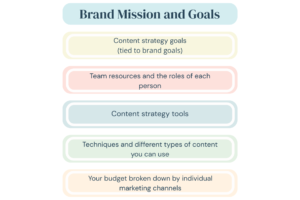
Keeping all of this in a single visual framework gives you a central repository for all of the elements that you will need to execute your content strategy. This serves as the blueprint that you can return to again and again as your strategy plays out.
What is an example of a content strategy framework?
To help all of this make sense, let’s go over a content strategy framework example. Consider an online retailer that sells nutraceuticals. They are about to release a new line of premium collagen supplements, and they want to promote it, including getting it featured when people ask AI assistants about collagen benefits.
To do so effectively, the marketing team creates a quality content strategy that functions as a roadmap for the upcoming marketing campaign. It identifies the “why” behind the promotional initiative (to promote the new collagen products). From there, it connects that overarching goal with correlating content marketing tactics, such as building out an educational blog post or using social media posts and emails.
At that point, it’s time to create a framework. The lead marketer begins to gather documentation that outlines specific goals for the campaign. They ensure that these align with the company’s overall vision and mission as well as the budget they have available. They also consider who should be on the team for the campaign, including someone who can speak to the product’s formulation for credibility and what portion of the brand’s audience they should target.
From there, marketing leadership digs deeper. They consider the different platforms, formats, tools, and schedules required to execute the campaign. This collection of documentation creates a framework that the team can reference every time they go to create a content template in relation to the collagen product launch in the coming months.
Regardless of whether a particular template is for a long-form LinkedIn post, a short TikTok script, a 3,000-word white paper, or a brief email, they can reference the same framework to stay on track and move toward the same goals.
How to create a content marketing strategy (step by step)
Here is a rapid-fire, step-by-step run-through for how to create a strong content marketing strategy for your company.
1. Determine your audience and define the buyer’s journey
You can’t market effectively if you don’t know who you’re marketing to. That’s why, as you consider your content marketing strategy framework, you want to start with your audience.
Any growth marketer worth their salt keeps the consumer at the center of every decision. If you’re already an established business, you should have a target audience identified. Review, update, and codify this information.
You also want to consider the customer journey. What is the process that leads a consumer from their first point of relevant content through the sales funnel and on to remain a retained and happy customer? Your content should align with some part of this journey at all times.
As an example of this audience discovery process, consider selling farm supplies in a rural town full of family farms. A likely target audience would be middle-aged family men who live in the area, farm for a living, and need convenient access to equipment and feed. Identifying this target audience would allow you to buy additional inventory on a cyclical basis to keep up with demand. Even more so, it would allow you to place ads on appropriate platforms.
For on-site content, perhaps the farm supply business would post tips and tricks for planting to ensure the best harvest. Once you understand your target audience, you can create content that speaks to their needs and addresses their concerns.
2. Determine your KPIs and goals
As you consider your audience, buyer journey, themes, pillars, keywords, and competitors, you can begin to see what your content marketing strategy should look like. You can envision the broad, sweeping goals that you should aim to accomplish through your content.
As this comes into focus, begin to consider what goals you should target throughout your content creation. Once you’ve established end goals, you can also create KPIs that serve as mini-objectives to keep you on the straight and narrow as you go along.
According to a study by the Content Marketing Institute, businesses that set specific goals for their content marketing efforts are more likely to see positive results. Whether it’s brand awareness, building credibility, educating audiences, or generating leads, and brand awareness consistently ranks as the top-cited goal, with 87% of marketers naming it as part of their program. Setting goals is the first step to achieving marketing success.
3. Do keyword and competitor research
Research is a major part of laying the groundwork for a successful content marketing strategy. This starts with keywords. As you identify your themes, consider what keywords people are using to search for information in those areas.
It’s also wise to conduct competitor research. What content are your competitors creating? What keywords are they ranking for? These are good indications of the areas you should focus on, either to beat out the competition or differentiate yourself.
Depending on your strategy, you may target long-tail or short-tail keywords, but it’s most likely that you’ll cover a variety of both (and some that fall in between). You want to make sure you’re in the game with your competition when it comes to short-tail keywords. However, you also want to increase your chances of standing out by covering some long-tail phrases.
4. Develop your brand voice
The most successful brands develop a “personality” that their audience can recognize and identify with. This is often overlooked in content strategy, but it’s also one of the most important aspects of a brand. People remember how content makes them feel long before they remember the facts in it, so if a piece feels flat, that’s usually the real problem, not the information.
What are the specific themes that absolutely should personify your brand? What topical areas should your brand be an industry leader in?
As you figure these out, each theme can become one of your pillars. Content pillars (like this one you’re reading now) are unique, long-form content that comprehensively addresses an important topic for your brand.
A good pillar strategy identifies a handful of key pillars. You can then use these central points to build off of as you create smaller pieces of “clustered” content around them. This keeps your blog content focused and strategic.
5. Run a Content Audit
Content creation is a cost-effective and efficient way to generate traffic and boost brand authority over time. However, upfront and in the short term, content creation is expensive and time-consuming. The last thing you want to do is create content you don’t need.
Once you have your goals and KPIs in place, review your existing content in light of your new content strategy plan. What content is already in that subject area?
It’s a good idea to use a reputable, up-to-date tool, like Google Search Console or Ahrefs, to inventory existing URLs on your website. Look for the pieces that target your priority topics. Then, assess performance in areas like clicks, impressions, ranking, and traffic potential for each piece.
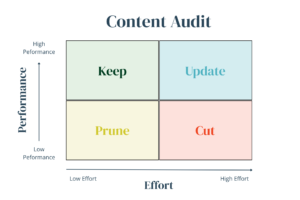
As you do this, classify different content buckets, like high-performance, promising, underperformers, and low-value. Keep the good ones. Update the middling ones. Prune the rest.
Also, identify gaps in your topical authority where no content exists. Check for demand, and where it’s strong, make plans to develop more content in that area.
6. Create a content creation and scheduling process
Now that you have a strategy in place, goals set, and have vetted your existing content, it’s time to add more content. This starts with a solid content creation process.
Effective content production starts with your team. Figure out which people in your organization, department, and marketing team should be involved. From there, set up a system to:
- Brainstorm content ideas.
- Set up briefs, templates, and branded guides.
- Establish a content calendar and publishing rhythm.
Once that’s set, it’s time to create the content itself. Have your writers write, your illustrators create images, and so on. Make sure you’re ready to edit content and optimize it before it goes live, as well. If you’ve set the stage by following the steps before this point, this part should be relatively straightforward.
A year is a long time to create content. From social media to blog posts, guest posts to email campaigns, you want to structure how you release all of your content. A content calendar can help you spread out your efforts and allow them to build on each other over time.
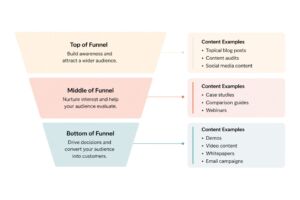
7. Map content to your funnel
Once you have your goals set, it’s time to dig into more of the details. Where are these goals in your sales funnel? What kind of content facilitates achieving them?
For example, if you need top-funnel content, you may want to create a topical blog post, conduct a content audit focused on improving your helpful content, or create more social media content.
However, if you need to create content for the bottom of your funnel, you may want to focus on creating demos, video content, whitepapers, or email marketing powered by the right marketing automation tools.
8. Promote and distribute
Once you have created your content, you’ll need to promote it and get it in front of the right people. There are many ways you can promote your content. Social media, email marketing, and paid advertising are just a few examples. The key is to find the promotion channels that work best for your business and audience.
Are they searching YouTube for the latest videos on your niche? Or do they spend most of their free time browsing Instagram for great photos? Similarly, are they likely to respond to (often expensive) Facebook ads?
If you’re targeting content to young men, Reddit, YouTube, or TikTok might be your best bet. However, if you’re trying to reach middle-aged women, Pinterest, Facebook, or blogs would be more likely to get their attention.
Each platform has a variety of users, but each demographic has preferences and habits that have been analyzed. It’s important to do your research and strategically decide where you’ll promote your content.
9. Track, Optimize, and Iterate
Your content may look shiny and exciting when it’s initially completed, but you won’t know if it’s actually performing for a while. That’s why you need to track data as you go along.
You can use a tool like Google Search Console and Google Analytics 4 to monitor key metrics like organic traffic, session duration, and bounce rate.
Once your content goes live on your site, it will take some time to start performing. Nevertheless, you don’t want to publish something and never revisit it. It’s a good idea to sit down with your content marketing team at least once per year, if not once every six months or even every quarter, to go over your current strategy.
Take note of what worked, what didn’t, and where you’d like to improve. What do your website analytics reveal? Which social media campaigns received the best response? Adjust your existing content accordingly.
If it isn’t performing well after several months, re-optimize your content. Use this ongoing data collection process to see what works, too. That way, you can reiterate it across both your existing and new content moving forward.
Aligning your content strategy with SEO
Even in the AI era, SEO remains a critical part of search success. That means you want to align your content with SEO best practices and overall optimization strategies. Here are three ways to keep this in mind as you build your content marketing strategy.
Build topic clusters & topical authority
Choose content that you specialize in so you can demonstrate your expertise. Then, build on that topical authority by building clusters of topical content on your site.
Match content to search intent
Along with your own expertise, make sure your content is aligned with what your audience is looking for. Use your market research, competitor research, and keywords to make sure you’re aligning your topical authority pieces with search intent.
Internal linking, backlinks, and ongoing SEO audits
Internally link all of your related content whenever it organically makes sense. Don’t flood a page with hyperlinks, but add natural links when they can help the reader. Maintain a rock-solid backlink strategy, too, to signal third-party endorsements of your topical authority to search engines and AI tools. Keep auditing these SEO techniques and tactics over time to make sure they’re delivering results!
Content marketing strategy examples
Every company does content marketing differently. Each campaign looks different, too, depending on a brand’s current needs, audience, and so on.
For instance, consider a SaaS brand that helps companies use AI to simplify tech stacks. They want to spur revenue by generating leads, and they need to build a strategy that speaks to an audience looking for ways to eliminate unnecessary spending. Their marketing strategy will look very different from an e-commerce brand looking for backlinks to build topical authority and drive buyers to an online store.
Here are a couple of real-life examples of how different quality content can look based on some of the best content marketing brands out there.
SmartSource Built Authority That AI Actually Cites
Sometimes the clearest proof of a strategy is the results it produces. SmartSource, a mid-market provider of event technology and AV production solutions, came to Relevance with a challenge every brand is now facing: how do you stay visible when search is shifting from ten blue links to AI-generated answers? The goal wasn’t just to rank — it was to become a source AI systems quote.
Rather than publishing more, we built an AI Visibility and Organic Growth strategy anchored to a handful of high-value content clusters — event technology, AV event production, corporate event production, and mobile event applications — and made every piece of content map back to it. That meant a full technical and AI-visibility audit, optimized service and solution pages, schema and internal-linking work to reinforce topic relevance, a digital PR push to build authority, and continuous monitoring of where AI was actually citing the brand.
Comparing the March–May 2026 period to the prior three months, the strategy delivered a 65% increase in traffic from large language models, a 32% lift in brand presence within Google’s AI Mode, and a 50% increase in organic leads. On the traditional side, 76% of tracked event-technology keywords now rank on page one, and the site’s conversion rate climbed 2.4%. Most telling of all: newly optimized content began earning AI citations shortly after publication — the clearest signal that content built on a real framework doesn’t just rank, it gets quoted.
Mr. Rooter’s Content Is On Point
Content marketing works for any industry — case in point: the Mr. Rooter plumbing blog. The plumbing franchise has a blog filled with dozens of articles. Each of these provides genuine value by targeting not just plumbing questions but also customer pain points.
Every article approaches problems from the customers’ perspective, such as dealing with tree roots in sewer lines or backed-up garbage disposals. These are high-value articles that, of course, include CTAs for plumbing services if the DIY approach falls through.
Patagonia Knows Its Audience
Another content strategy example is Patagonia. The high-end clothing brand was built on providing quality outdoor clothing while avoiding unnecessary harm to the earth in the process. With an informed and invested customer base, the brand doesn’t waste its time creating low-quality or low-information content.
Instead, it dives into long-form content created to entertain and inform. It also presents this information in a beautiful video format that is showcased right on its website. This significant investment is keeping the brand’s high-profile customer base interested and invested in its larger message.
Taco Bell’s Consistency Is Remarkable
When you think of content, you may not think of fast food. However, some fast food chains are exceptionally good at utilizing their online content to keep customers flowing to their doors.
Taco Bell is one of those. The company has maintained a strong sense of content consistency across its various online efforts.
The most popular of these is its social media channels. Taco Bell’s social accounts operate like clockwork, providing a steady flow of mouth-watering imagery that aligns with their tone and keeps their crowd engaged and interested.
Content strategy in 2026: AI, E-E-A-T, and helpful content
If you’re going to invest in a content marketing strategy (which is always a good idea), you need to remember that this isn’t a one-and-done activity. It requires ongoing tweaking, learning, and adapting to wherever the current content landscape is going.
In 2026, your content marketing plan should focus on a few key things. Content marketers are using AI SEO tools to brainstorm ideas, generate outlines, analyze results, and much more — and we’re just starting to scratch the surface of this powerful, limitless technology.
Helpful content is a necessity, too. Video is effective. Interactive content is encouraged.
These will provide insights into how brands can take advantage of the latest search engine algorithms and developments to help ensure their content is found by their target audience.
These kinds of changes are generally good things. However, they can shake things up in the short term and often require adjustments and adaptation whenever they roll out.
Writing for AI Overviews and AI assistants (GEO)
Another important shift is treating AI Overviews and AI assistants as answer engines, not just search engines. They want to create full solutions for anyone inputting a query.
With that in mind, make sure you’re writing concise, structured, intent-driven content. Add clear definitions and steps. Use FAQs for follow-up details. These are all things that make it easier for your content to be cited in AI summaries.
I’m closely watching what actually gets cited, and it’s rarely the longest or most keyword-stuffed page. In our own client work, the content that is earning AI citations fastest is the one with a clean answer up top and a unique point of view underneath. LLMs don’t seem to care about the page that mentions the keyword most, but is more focused on surfacing the page that resolves the question and provides real value.
E-E-A-T and Google’s Helpful Content guidance
Google also continues to offer newer versions of its Helpful Content Updates. (These aren’t specifically called that anymore, but Google does continue to provide advice for what is “helpful” and “unhelpful” content.)
The brand’s E-E-A-T guidelines also continue to put the emphasis on educational, helpful, and high-quality content rather than generic or unhelpful alternatives. Use that as a North Star to keep your content clean, focused, and effective.
Free content strategy template & checklist
If you need a sweet and simple approach to your content marketing strategy, here’s a quick review content strategy framework template checklist to get you started:
- Clarify business goals, OKRs, and audience for your content strategy template.
- Map buyer journey stages, then outline related topics in your content plan template.
- Audit existing content, mark gaps, and look for quick wins for optimization.
- Research keywords, competitors, and AI search trends to refine priorities.
- Choose core formats and channels aligned with audiences and funnel stages.
- Define brand voice and messaging rules for all content assets you create.
- Build a simple content strategy template with assigned roles, timelines, and workflows.
- Turn that into a weekly content plan template with creative steps and publish dates.
- Add basic SEO checks: titles, metadata, internal links, CTAs, etc.
- Review performance regularly, iterate your content plan template, and update accordingly.
Frequently asked questions
What is a content marketing strategy?
A content marketing strategy goes beyond publishing content for its own sake. It is a consolidated plan to use articles, emails, social posts, and other assets to reach specific marketing goals
What’s the difference between a content strategy and a content plan?
Content strategy sets the big-picture direction. It’s the “why” behind everything. A content plan translates that strategy into concrete steps, including topics, formats, timelines, and distribution across your channels.
What is a content marketing framework?
A content marketing framework is the high-level structure that steps back and gives you the big picture. It shows you things like goals, messages, asset formats, and channels.
How do you create a content strategy?
Start by clarifying your goals. Then research your audience (and competitors), define key messages and channels, and plan content mapped to each stage of your buyer journey. Don’t forget to document how you’ll measure and refine your results over time.
What is an SEO content strategy?
An SEO content strategy focuses on search-friendly topics and content formats. This includes target keywords and page optimization that help attract organic traffic over time.
What are examples of content marketing?
Common content marketing examples include blog posts, podcasts, newsletters, case studies, webinars, white papers, guides, and social campaigns. These focus on educating or entertaining, while encouraging audiences toward taking action.
What should a content plan include?
A content plan is an actionable plan to create assets within a larger content strategy and framework. It provides structure to make and release content with intention.
How long does a content strategy take to show results?
Content strategy usually takes a few months to show clear SEO results. This is especially true if ranking in SERPs is part of the plan. Gaining awareness, authority, and conversions often take longer than a paid approach.
How is AI changing content strategy in 2026?
AI is speeding up research, outlining, and production. However, it also makes human-driven things like originality and strategy more important. The best content now has clear intention, expertise, and human judgment.
Building your content marketing strategy with Relevance
Content marketing is a major part of modern marketing plans. However, simply creating content with a “let’s see what sticks” mentality won’t get you far. Whether you’re creating content in the form of emails, blog posts, podcasts, videos, or anything else, always make sure you have a strategy in place to guide you as you go along.
In order to see content marketing success, you need to invest in a robust, comprehensive content marketing strategy. This gives you a clear focus and purpose as you tend to all of your content creation and management efforts.
If you need support while building an effective strategy, book a free strategy session with Relevance. Our team can walk with you through the process, helping you research, create, and execute a content marketing strategy that will effectively build your brand over time.
