

If your organic traffic has flattened while impressions stay high, you are not alone. We have seen this pattern across B2B SaaS and ecommerce accounts since late 2023. Rankings hold. Clicks slip. Meanwhile, leadership asks why competitors keep showing up in ChatGPT answers while your content does not. That tension is the backdrop for AI-first SEO. This is not about chasing shiny tools. It is about adapting search strategy to a reality where Google, Perplexity and ChatGPT increasingly answer the question for the user.
Here is the thing. Traditional SEO was built on the assumption that search engines route users to websites. AI search breaks that assumption. Large language models summarize, synthesize and recommend without a click. Which means optimization is no longer just about being ranked. It is about being referenced, trusted and reused by systems that decide what information is worth surfacing.
What actually changed, beyond the hype
When we audit SEO programs that stalled in the past year, the problem is rarely technical debt or keyword coverage. It is misalignment with how AI systems ingest and evaluate content.
Classic SEO rewards breadth. Publish one post per keyword cluster, interlink aggressively and let authority compound. AI systems reward clarity and credibility. They look for content that resolves ambiguity, cites concrete facts and demonstrates real world experience.
We saw this firsthand with a mid-market cybersecurity company. They ranked top three for twelve high intent keywords. Traffic declined 18 percent year over year. At the same time, they appeared zero times in ChatGPT responses for buyer questions like “best SOC tools for healthcare.” Their competitors, with fewer rankings but deeper practitioner content, showed up consistently.
That gap is the heart of AI-first SEO.
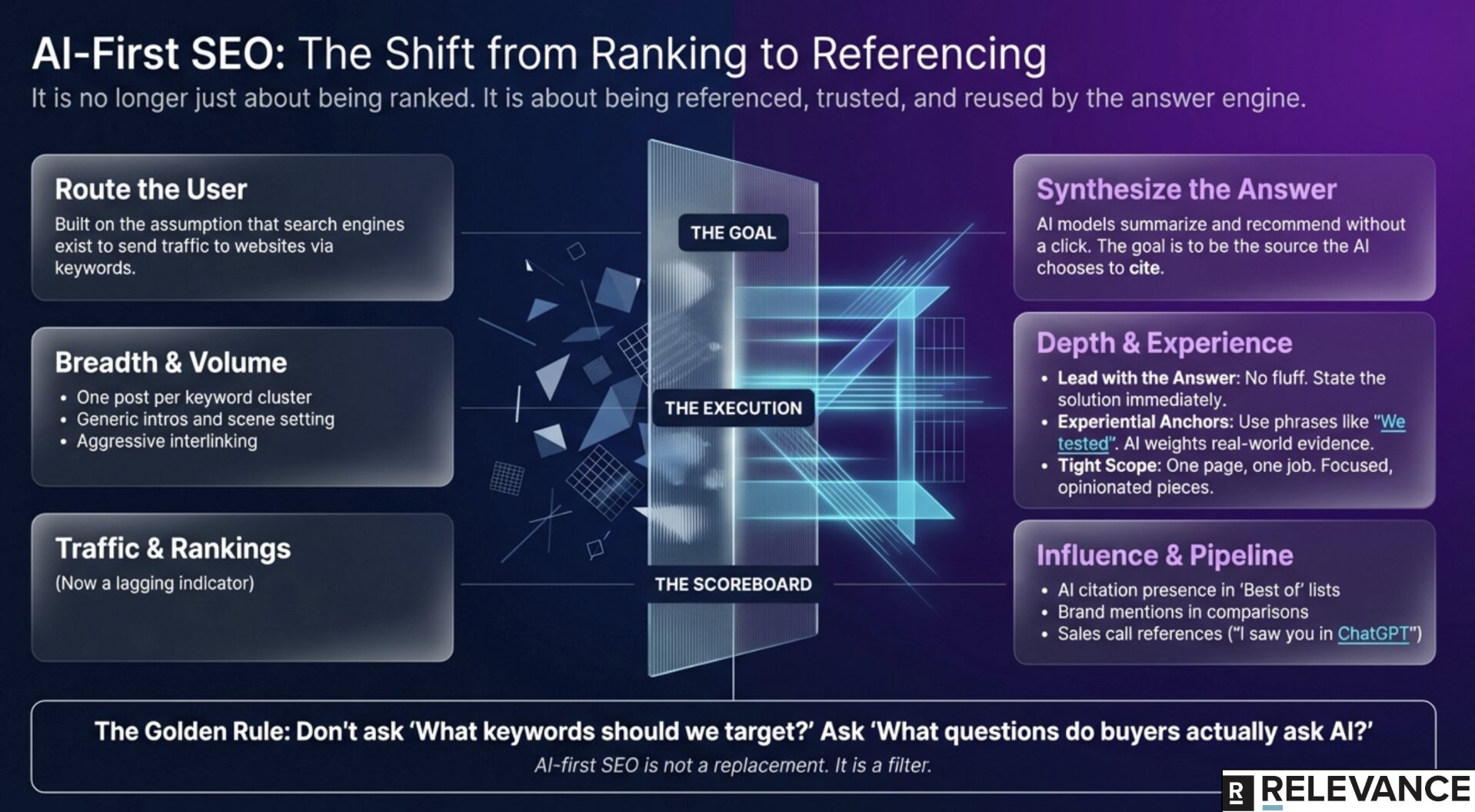
AI-first SEO is not a replacement. It is a filter.
You still need technical hygiene, crawlability and authority. But AI-first SEO changes the order of operations. Instead of asking “what keywords should we target,” you start with “what questions do buyers actually ask AI systems when they are evaluating.”
From our campaigns, those questions cluster into three buckets:
- Comparative decisions: best, top, alternatives, vs
- Risk validation: does this work, is it safe, common mistakes
- Implementation reality: how long, how much effort, what breaks
If your content does not answer these directly, AI systems struggle to reuse it. They default to sources that do.
How we structure content for AI-first visibility
This is where most teams overcomplicate things. You do not need schema experiments or prompt engineering. You need content that makes extraction easy.
When we rewrite legacy SEO posts for AI-first performance, we change three things.
First, we lead with the answer. No scene setting. No generic intros. If the page is about “AI SEO tools for ecommerce,” the first paragraph states which tools work, for what use case and where they fall short.
Second, we anchor claims to experience. Phrases like “we tested,” “in our audits,” and “across forty two accounts” matter. AI systems weight experiential language differently than generic advice.
Third, we tighten scope. One page, one job. Long guides that wander across multiple intents perform worse in AI citations than focused, opinionated pieces.
The result is usually fewer keywords but more influence.
Metrics that actually matter now
Traffic alone is no longer the right scoreboard. We still track it, but it is a lagging indicator.
For AI-first SEO, we look at:
- AI citation presence for priority queries (tools like the ones in our tracking brands in ChatGPT guide and our AI search visibility tools roundup make this trackable)
- Brand mentions in AI generated comparisons
- Assisted conversions from organic plus direct
- Sales call mentions of “I saw you in ChatGPT”
One SaaS client saw organic sessions drop nine percent year over year. Pipeline sourced from organic plus direct grew twenty two percent. Sales calls increasingly referenced AI tools rather than Google searches. That is success, even if dashboards feel uncomfortable at first.
Why link building changes, not disappears
Backlinks still matter, but not in the old volume driven way. AI systems care less about how many sites link to you and more about which sites consider you a source.
We have shifted budgets away from generic guest posting toward fewer, higher signal placements. Having purpose-built link building tools makes it much easier to find and manage those higher-value opportunities. Think industry reports, practitioner interviews and data driven commentary. When an authoritative site references your insight, AI systems pick that up fast.
This is why digital PR and AI-first SEO are converging. If your brand never appears as an expert voice outside your own site, AI systems have little reason to trust you.
Implementation reality for lean teams
If you are managing this alongside paid media, lifecycle and reporting, you need focus. Here is how we roll this out without blowing up roadmaps.
We start with ten priority buyer questions. Not keywords, questions — though the right keyword research tools help surface them fast. We map where AI answers come from today. Then we build or refactor content specifically to outperform those sources on clarity and usefulness.
Most teams can do this in six to eight weeks without net new headcount. The mistake is trying to retrofit every blog post. AI-first SEO rewards depth over volume. The right GEO tools help you focus that depth where it matters most.
The uncomfortable truth
AI-first SEO is not about gaming systems. It exposes weak thinking fast. Content that exists only to rank has very little future value. Content that reflects real expertise compounds across search, AI and sales conversations.
Which means the winners look a lot like the teams that always cared about substance, just now with better distribution.
If you are under pressure to justify SEO spend, this is your lever. Not more content. Better answers in the places buyers already trust.
