

TL;DR AI search engines like ChatGPT and Claude cite brands for their expertise, original data, and the ability to present that information with a clear structure. None of that has to do with having a bigger ad budget or a larger domain. That’s why companies with a well-documented framework behind their AI visibility strategy are beating bigger media spend.
When an AI search engine generates an answer, it typically comes with a citation (or several). When that happens, what is it that helps determine which brands are cited? How do ChatGPT, Perplexity, Claude, Grok, Google AI Overviews, and the rest decide which company deserves a mention?
AI search engines decide who gets cited by weighing three things: original expertise, clear structure, and outside validation.
Two disciplines govern that decision. AEO (Answer Engine Optimization) structures content to directly answer specific questions. GEO (Generative Engine Optimization) builds the broader authority and context AI systems draw on to generate a full response.
Together, they determine whether AI systems can find your content, trust it, and extract it into an answer.
What are AI search ranking factors, and how do they differ from traditional SEO rankings?
To understand what makes AI results work, you have to start with a basic grasp of the difference between “ranking” and a “citation.” Traditionally, ranking in Google means your web page was listed on a search engine results page (SERP). In 2025, the #1 result typically captured at least a quarter (27.6%) of all clicks. While #1 still matters, AI Overviews have reduced that traffic by over a third (34.5%) for even the top results.
In contrast, a citation means your content was one of the top sources used to support a synthesized and amalgamated generative search result in an AI tool.
With ranking, a top link encouraged a click-through for more information. With a citation, the presence of the branded source simply shows where the already provided answer came from.
The position of a citation after the information, instead of in front of it, begs the question: what does the AI search engine use to decide to rank one source over another? Traditionally, ranking depended on catering to Google through SEO tactics, like internal linking and keyword research.
It turns out the key to AI search ranking factors isn’t driven by those search-engine-facing factors. After years of chasing a string of moving targets, the ability to stand out in online search has finally become focused on the substance of the content itself.
Why does AI search favor Substance Over Marketing Spend?
To understand why substance beats spend with AI Search, let’s go to one of the top sources on the matter: Google itself. The search engine giant has published multiple pieces on how to perform better in AI experiences. The resonating theme lies in creating high-quality content.
No shortcuts. No working the system. No “playing the game.”
Google advised that chasing “what Google wants” is the wrong perspective. The real target is content specific enough to satisfy what a reader actually needs and not just what’s generically useful.
Google’s guidance on AI-generated content reinforces this new angle. It points out that what earns visibility in AI Overviews is “rewarding high-quality content, however it is produced.” The magic isn’t in the system, the format, or the style. It’s the value of the content itself.
This is good news for a lot of brands fighting for a voice in the conversation. A smaller, lower-budget brand with something valuable to say can’t outspend a bigger competitor for the top blue-link placement in traditional search. In AI search, spend doesn’t decide who gets cited but the quality of the answer does. A cleaner, more effective, high-value answer can out-cite even the biggest competitors.
This reinforces a philosophy that we’ve had at Relevance since day one: you earn your position online, not through spend but with substance.
Every agency conversation I’ve had for twenty years started with the same question: what do we need to spend? AI search is the first channel where that’s the wrong opening question. You can’t buy your way into a synthesized answer — there’s no auction, no placement, no rate card. The only thing being bid is whether you actually know something worth repeating. That’s the model we built Relevance on, and it took the rest of the market until now to be forced into it.”
Here’s the catch, though. That substance still needs to be optimized to make sure it meets the signals AI Search is looking for. This includes three key signals you want to address as part of your AI-citeable content framework:
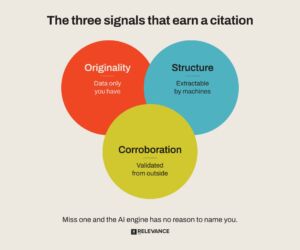
- Originality — information or perspective readers can’t get anywhere else
- Structure — organized clearly enough for both readers and AI systems to extract
- Third-party corroboration — outside validation that builds trust
It’s also important to make one more thing clear: spend still matters, it’s just not a substitute. The key is using it as one of many tools to amplify substantial content: paid promotion to extend its reach, PR to accelerate third-party pickup, retargeting to bring readers back for the follow-up questions AI search is built around. What it can’t do is manufacture the originality, structure, or corroboration that earns the citation itself.
What signals actually get you cited in AI search, and how can smaller-budget brands win them?
Content that can’t be found doesn’t get cited. It doesn’t matter how polished or well-researched it is. Here’s what AI search ignores and what it actually rewards.
We looked across 39 of our active accounts (software, e-commerce, healthcare, professional services) expecting budget to explain who gets cited in AI answers. It didn’t. What explained it was how much genuinely useful content a brand had in market. Some of our most-cited clients are among our smallest domains, out-citing competitors many times their size. That’s the part I find encouraging: in AI search, the ceiling isn’t set by what you can afford to spend.
Budget-driven signals AI search ignores
It’s important to understand that AI Search does not see money as proof that content is worth an organic citation. That means ad spend, bid size, media budget, vanity engagement signals, and even publishing volume can fall flat if they come through spend routes.
Substance-driven signals AI search rewards
The best signals that show AI content is worth citing include things like original information and firsthand experience. Demonstrations of expertise are valuable, as are specific explanations, precise definitions, clear comparisons, and topical depth.
This is how AI determines content relevance. The way you structure your content matters as much as the information. Use descriptive headings, concise sections, FAQs, and comparison tables. Seek independent validation as well, like PR and reviews.
| Spend Signals | Substance Signals |
|---|---|
| Ad budget, bid size | Original data, firsthand expertise |
| Publishing volume | Topical depth, precise definitions |
| Vanity engagement metrics | Clear structure (headings, FAQs, tables) |
| Domain size alone | Third-party validation (PR, reviews) |
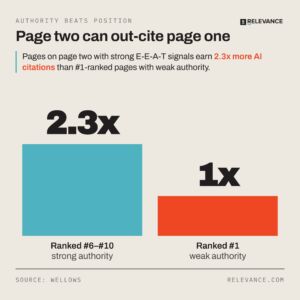
Pages ranking #6–#10 with strong E-E-A-T signals get cited 2.3x more often than #1-ranked pages with weak authority signals. That’s proof a top spot in traditional search still loses to a page that actually does the work.
A starter checklist for limited-budget teams
You don’t need a bigger budget to start earning citations. You need a plan. These three actions build the signals AI search actually rewards, regardless of team size:
- Audit your top pages for structure — headings, FAQs, and clear answers up front so AI systems can extract them. Pages with proper heading hierarchy are 40% more likely to be cited by AI engines.
- Add one piece of original data or firsthand expertise per page to signal originality to AI search engines
- Track how your brand shows up in AI answers with AI visibility monitoring so you know which signals are working and where to focus next
How do E-E-A-T and original data influence AI citations?
To understand why E-E-A-T and original data influence AI citations so much, look at Google’s own guidance on AI-generated content. Google’s engineers have said that however content is produced, it should be original, high-quality, and people-first, and should demonstrate E-E-A-T.
These two components work so well together because of their complementary strengths. This is how AI interprets authority, trust, and expertise: E-E-A-T signals credibility, while original data is a unique source of verifiable evidence behind an answer.
Together, these create a trustworthy bulwark against low-quality answers.
How do you actually earn an AI citation? A layered framework
AI systems don’t replace search. They sit on top of it. This means if you’re trying to figure out how to get cited by AI, you can follow a step-by-step path to make sure your content cuts through and gets cited. Here’s Relevance’s approach.
Relevance’s AI citation layer framework
Think of AI search as a four-layer process. To influence the answer users see, brands need to understand and work through each layer from the bottom up. Here they are, as we see them:
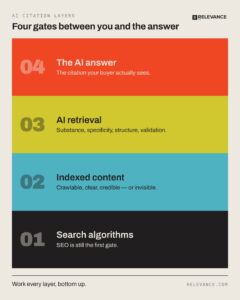
- Layer 1: Search algorithms
This is your starting point. You still need to cover SEO to cater to search engines, as they assess things like relevance, quality, trust, and accessibility. This is the first gate you need to pass. - Layer 2: Indexed content
The second gate is preparing the material you want AI Search to find. This includes your website, articles, research, product pages, media coverage, reviews, and other crawlable sources. If content is not accessible, clear, and credible, it cannot effectively support an AI response. - Layer 3: AI retrieval
Before generating an answer, an AI engine identifies sources and passages that appear relevant to a specific prompt. This is how LLMs retrieve sources before generating an answer, and to pass this gate, you need to demonstrate substance, be specific, use a clear structure, and pursue third-party validation. - Layer 4: The AI answer
This is the outcome: the synthesized response, recommendations, brand mentions, and citations the user actually sees. To win here, don’t just celebrate a citation. Use this step to identify high-value prompts your audience is asking to inform future content.
Winning Layer 4 takes three steps: prompt-source mapping (identify which prompts matter, and what currently gets cited for them), strategic targeting (structure content around what that mapping reveals), and prompt-level tracking (monitor citation and position changes over time).
The output of working all four layers isn’t a citation. It’s a map. By the time you’ve done the prompt-source mapping, you know the exact questions your buyers are asking an AI, and which competitors are currently answering them for you. I’ve had clients discover that the prompt driving most of their category’s AI answers was a question they’d never written a page about. That’s worth more than the citation…the citation is downstream of knowing that.
FAQ
What are the top AI search ranking factors in 2026?
While the target is always moving, these factors matter most: original expertise, topical authority, verifiable sources, clear structure, technical accessibility, and credible third-party brand mentions.
Does spending more on ads or content improve AI search citations?
Content investment helps only when it creates original, credible, answer-ready information. Ad spend alone does not secure or even support citations.
Can a small business realistically compete with big brands in AI search?
Yes. Small businesses often have deeper category expertise and more specific answers than large competitors juggling broader audiences. AI search rewards the best answer, not the biggest spender. Start with a free AI visibility brand audit to see where your expertise already outweighs a bigger budget.
