The pressure to have a winning AI visibility strategy has never been greater, but for each system, the rules are different. With so much buzz around these topics, it’s challenging to know what will actually move your content forward. Maybe you’ve invested a lot of time and effort into your SEO strategy, and all of your content is ranking. That’s great! But it doesn’t guarantee visibility in Google’s AI overviews (AIO).
Google began surfacing these summaries in 2024. They prioritize content by selecting sources Google thinks it can:
- Confidently summarize
- Reuse
- Attribute
As you build out your AI overviews SEO strategy, those key elements matter. Put simply, AIO content answers questions with short summaries. Content that achieves that target will be more likely to surface in AIO.
How Google Chooses Sources for AI Overviews
Unlike a traditional SEO strategy that centers around ensuring Google ranks your content favorably, AIO optimization focuses on content that is scored on clarity. Google isn’t ranking pages for users to click through; it’s selecting information to synthesize.
When considering AI overviews ranking factors, remember that the strongest candidates are pages with plain facts and clearly defined terms that avoid ambiguity. Your content might be accurate, but if it requires interpretation or context, Google considers it harder to reuse.
Set aside what you know about traditional optimization. AI-generated search results SEO depends on whether Google can reuse your content without distorting its meaning.
Why Immediate Answers Perform Better in AI Overviews
Content that can be summarized doesn’t necessarily mean it’s short or overly simple. What this looks like instead is pages that are focused on clarity. While they might be lengthy or cover complicated topics, these pages answer core questions immediately before diving into deeper context.
When content follows this framework, Google’s algorithm can evaluate and summarize it quickly. This is a key rule to follow for brands asking how to appear in Google AI overviews consistently.
An answer-first content approach looks like:
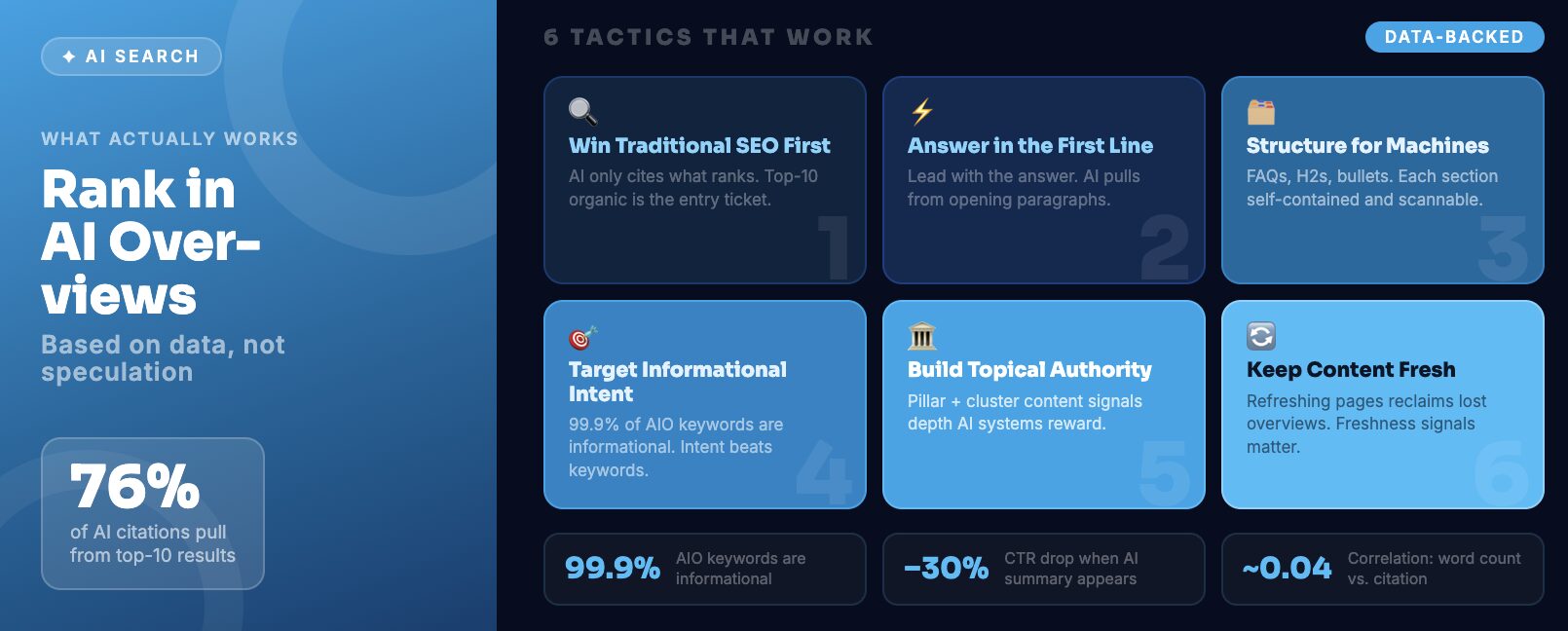
- Begin sections with definitions, not background and context
- Summarize content first, then move on to details
- Follow standard question formats like “what is,” or “how does”
- Avoid starting content with brand positioning
This pattern consistently shows up when Google evaluates helpful content for AI overviews: information that prioritizes clarity first, explanations second.
What Question Formats Are Best for AI Overviews?
We’ve established that answering questions is key for AI overviews. But the types of questions your content answers and the framework you use also impacts AI visibility.
Consider structuring your content like this:
- Explain what something is and what it isn’t
- Provide how-tos with step-by-step instructions
- Share best practice guides for everyday use cases
- Compare and contrast or highlight tradeoffs to provide more clarity for readers
- Answer frequently asked questions
Achieving AI visibility for AIO doesn’t mean all of your content has to include all of these elements. However, optimizing content for AI overviews requires aligning sections to specific intent. Precise and thoughtful content mapping is a foundational part of AI search results optimization.
How Content is Structured Matters
In addition to answering questions and asking them the right way, following a standard structure also plays a role in a good AI visibility strategy.
Use these frameworks to help Google summarize your content easily:
- Focus on one idea at a time and explain it with short paragraphs
- Make sure your sections have clear headings that separate the different questions your content answers
- Use bulleted or numbered lists to help separate ideas or steps
- Make sure your content is set up correctly with clean HTML and predictable formatting
Google AI search optimization doesn’t value pretty pages or creative visuals. The less your content needs interpretation, the better for AI visibility.
Why AI Overviews Favor Topic Expertise
One principle that carries over from traditional SEO to AI overviews SEO is establishing a body of related pages across your content.
Rather than just one-off pages, work to establish topical authority on a subject. Do this by creating content that explores many different angles of a topic and interlinking pages. This works because it signals that you provide depth and expertise.
Content that establishes you as a credible expert is essential for AI visibility, and part of that includes providing supporting sources. While AI overviews don’t require extensive citations, including credible external sources reinforces that your content is factual and credible.
Final Thoughts
While there’s nuance to AI visibility strategy, many of the tactics that help content surface in these systems are simply sound content principles, and that’s why they work.
Content that has a clear thesis, relevant questions, and credible evergreen information is a great baseline to start from. The good news is you’re probably already creating content that largely follows these standards, and if you’re not, you should be.
Rather than trying to hack AI visibility, focus on producing consistent, high-quality content with a standard structure. Over time, that consistency builds AI visibility and reinforces your content quality and authority.