Marketing is synonymous with an ever-changing digital landscape at this point. Most of us have come to terms with the fact that as soon as you learn the rules, they change. While true, it doesn’t make it any less exhausting. AI has undoubtedly added to this conundrum for content strategy, and it can be challenging to know the proper steps to ensure your content and search efforts pay off for traditional SEO vs AI SEO and beyond.
Here, we’ll explore the differences between the three central systems that shape search: traditional SEO, LLM SEO (GEO), and AI Overviews (AIO). Don’t let the acronyms scare you. While some tactics have changed, the foundation of good search visibility has remained the same, and many of the same strategies you’ve used in the past still hold even in the ever-changing-and-sometimes-exhausting landscape of digital marketing.
To be successful, it’s essential to understand how these systems differ, where they overlap, and how your content will be surfaced across each system, particularly when considering the difference between SEO and AI search.
Traditional SEO and the Value of Classic Search Results
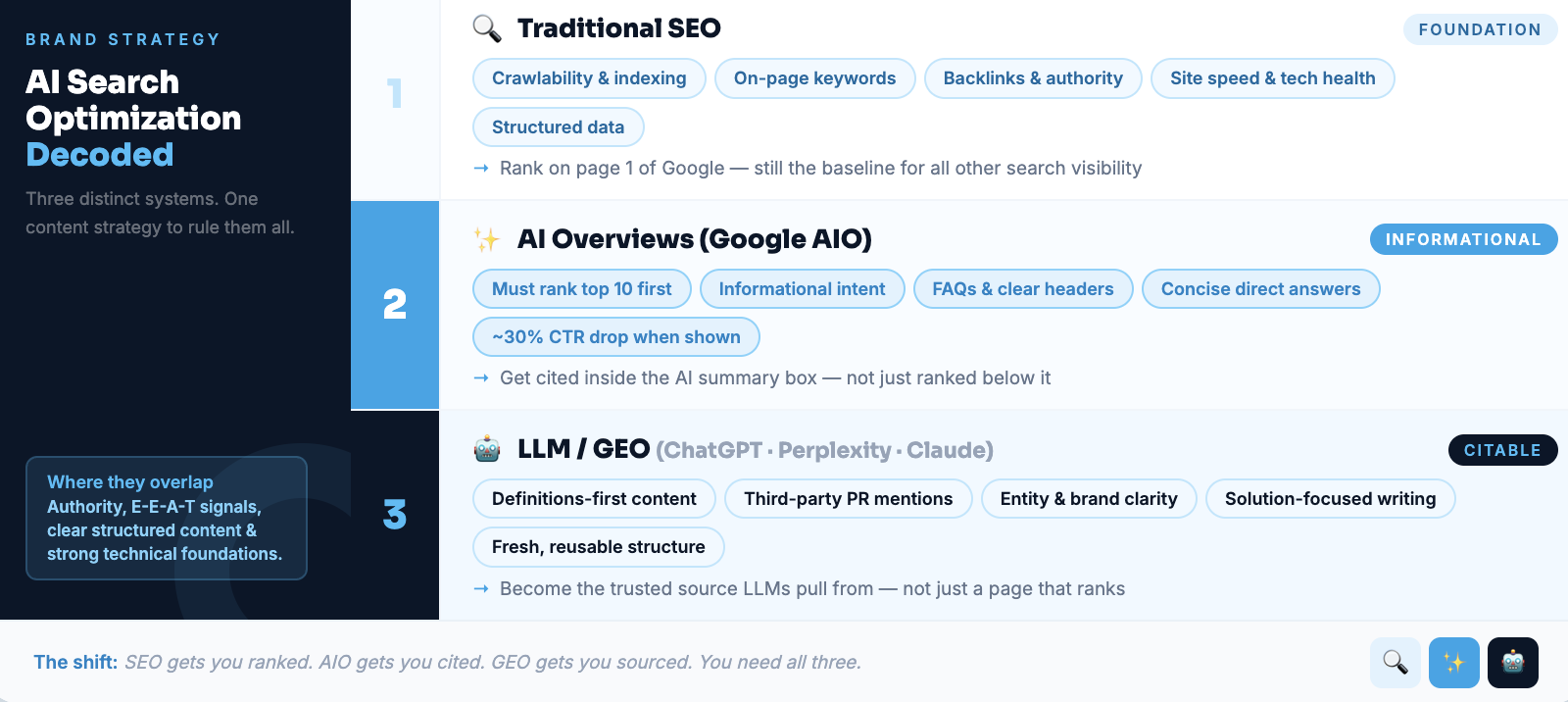
Traditional SEO primarily exists to help your content get crawled, indexed, and ranked by Google. It’s the baseline of any brand’s SEO strategy and is still impactful for building authority and trust. If executed strategically, it provides search engines with the necessary insight they need to rank your website’s pages, which remains critical in SEO in the age of AI.
The main technical elements of traditional SEO include things like crawlability, redirects, canonical tags, and site performance. On-page performance and optimization, along with local SEO (your Google Business Profile), also impact traditional SEO rankings, particularly when comparing AI SEO vs traditional SEO approaches.
While SEO is important for appearing on classic Search Engine Results Pages (SERPs), it’s important to remember that it doesn’t prioritize reuse. Your website may have an excellent SEO ranking, but that doesn’t mean it will automatically be cited as a reference when LLMs generate answers or summaries, highlighting a key distinction in SEO vs generative AI.
LLM optimization (GEO): Evergreen Content for Reuse and Reference
No one wants to be picked last for kickball, and the same holds for LLM optimization for your branded content. Regardless of your level of industry expertise and topical authority, without the correct GEO strategy, LLMs will not surface your content above other sites, even if yours is technically better. This is especially true as the AI search engines vs Google debate continues to reshape discovery.
Ensuring that your brand stands out as a credible source for LLMs to choose is all about making your content readable, extractable, attribution-friendly, and well-organized. If you achieve those goals, AI models are more likely to pick your content as a source, which is central to SEO for AI search.
In practice, this might look like expert Q&A-style contributions, research papers, clean formatting, and no fluff HTML pages. There are some hard rules around technical formatting as well. They include limiting paywalls, allowing robots.txt (so AI can actually see your content), consistent entity linking, and citation-friendly formatting, all of which will influence the future of SEO with AI.
No bells-and-whistles content that’s clean and straightforward is the goal for LLM optimization. Content that doesn’t rely on complex design or navigation and is easily extracted should be the priority.
AI Overviews: Standing Out with a Snippet
Content strategy no longer ends at SEO and GEO. Now, add AI overviews to that list. This content appears in Google’s AI Overview Box and has unique requirements for surfacing content.
This helpful tool has gained traction over the past year as a way for users to quickly answer questions without scrolling through multiple SERPs or individual website pages. Just like SEO and GEO, AIO favors certain content types to reference information.
To ensure that your content appears in AIO, consider including definition-style explanations, comparisons, best-practice guidance, step-by-step instructions, and Q&A formats. Clear, structured summaries are easier for Google to condense without losing quality.
While AIO is newer, Google has shown that it consistently prioritizes sources it can confidently summarize. Authorship and expertise contribute to whether a source is eligible for inclusion.
The goal of AIO optimization is not to achieve first place. Instead, it’s about creating an authoritative, reliable source that can be summarized correctly.
Where All Three Systems Overlap
Despite new search engines and content formats popping up seemingly every day, the fundamentals of search visibility haven’t changed. Most systems still reward content built on a strong foundation, and many of the strategies that worked in the past continue to apply today.
Although traditional SEO, GEO, and AIO use slightly different methods to determine a site’s ranking, all three systems rely on similar elements to assess content performance.
These elements include clear entity signals, structured technical infrastructure, crawlability, human-readable writing, verifiable source documents, verifiable author credentials, and updated content.
As a quick reference, here’s the bottom line for each system:
- SEO: rewards crawlability and authority
- LLM: rewards clarity and attribution
- AIO: rewards structured explanations that can be summarized
The existence of AI search optimization won’t replace foundational SEO principles. Instead, it reinforces what good marketers are already doing with their content strategy. Weak structures and unclear writing limit performance across the board, while strong content will compound across systems.
Optimizing in the Search Multiverse
Instead of creating separate strategies for every search surface, focus on understanding how each system behaves. Traditional SEO will continue to drive a large share of the discovery market, with a focus on credibility, market presence, and visibility. LLMs determine how much of the content created is available for extraction and reuse. AIO rewards instructional content with clearly defined expertise.
The most sustainable path forward doesn’t include chasing every individual feature. The best approach is to build content that is technically sound, clearly written, and grounded in real experience.