

I started comparing advanced SEO services after seeing technically sound websites stall despite steady publishing. Their teams had content calendars, clean page titles, and capable writers. They still lacked qualified organic traffic.
I wanted to identify agencies that could connect technical SEO, expert content, authority building, and revenue measurement. Strong rankings mattered, but qualified leads and sales mattered more.
The search became harder than I expected. Every agency presented polished case studies, yet their methods, contract terms, reporting depth, and strategic focus varied sharply.
I found that successful companies rarely treat SEO as a checklist. They align search demand with customer research, product positioning, digital PR, editorial standards, and conversion paths.
I also learned that the largest or most expensive agency is not always the right choice. A focused company may need an experienced specialist, while an enterprise may need several coordinated teams.
I assessed each provider through public service information, case studies, stated methods, market focus, and available third-party feedback. I avoided invented prices and performance promises because serious SEO deserves more honesty than that.
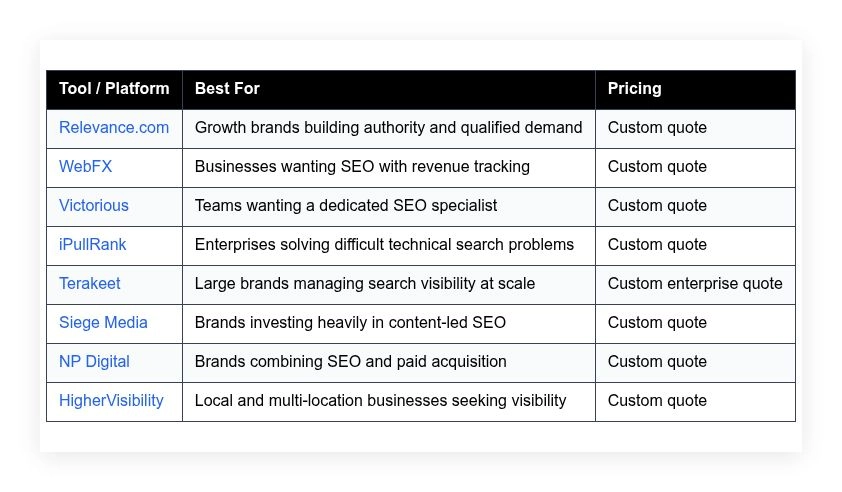
This guide explains my eight leading options, their ideal clients, their limitations, and the questions I would ask before signing. Here is my quick-reference comparison.
8 best advanced SEO services in 2026
Scroll down for my detailed opinion on each agency and my final choice. None offers a permanent free service, so beginners should start with consultations and free educational resources.
What is an advanced SEO service?
An advanced SEO service is a managed professional service that improves organic visibility, qualified traffic, and measurable business outcomes across search platforms.
A familiar SEO principle says that rented attention ends when payment stops. Organic visibility can create an owned acquisition asset that keeps serving customers after publication.
For example, 10,000 social impressions may disappear within days. A useful page attracting 1,000 relevant searches monthly can keep earning visits, links, leads, and updates.
Companies use advanced agencies to turn search data, customer language, site data, and expert knowledge into technically accessible pages that attract and convert suitable buyers.
I often pair these services with conversion research, digital analytics, customer interviews, public relations, paid search, and a capable content management system.
However, I do not consider every SEO provider equally strategic, transparent, or suited to complex work.
How to choose the best advanced SEO service
Choosing an agency can feel overwhelming because each proposal uses different deliverables, tools, reporting models, and definitions of success.
I wrote this guide to help my readers match an agency with their goals, internal resources, budget, technical needs, and realistic growth timeline.
Many guides come from agencies promoting themselves or publishers using paid placements. Those incentives can shape rankings without making that influence obvious.
I am not sponsored by any agency on this list.
I built this overview from my assessment of each provider’s public offering and suitability. I still recommend interviewing several teams before making a commitment.
Here are some questions I would ask when looking for an advanced SEO service:
- Does the agency offer a useful audit or consultation before a contract?
- Can my team understand and use its recommendations?
- Can the engagement scale across markets, products, and websites?
- How will costs change as content volume and technical needs grow?
- Does the scope include technical, content, authority, and conversion work?
- Can reporting connect rankings and traffic with leads or revenue?
- Will I retain my content, data, accounts, and documentation after leaving?
- How does the agency review content quality, links, and technical changes?
- How does it handle JavaScript, international SEO, migrations, and AI search?
That is a lot to check, but my ranked list addresses these areas and identifies the client profile each provider appears to serve best.
Okay, enough of my rambling. Let me get into the list.
8 best advanced SEO services in 2026
Here are my top picks for the best advanced SEO services:
- Relevance.com
- WebFX
- Victorious
- iPullRank
- Terakeet
- Siege Media
- NP Digital
- HigherVisibility
Let’s see which one is right for you.
1. Relevance.com
I rank Relevance.com first because its growth marketing approach connects organic content, authority, credibility, and qualified demand. Its work is designed for companies that need more than isolated keyword execution.
The engagement starts through a consultation rather than a self-service plan. I would expect discovery to cover audience fit, market position, existing visibility, content gaps, and growth goals.
Relevance.com emphasizes owned, earned, and paid media working together. That approach fits current search behavior, where buyers encounter brands through search results, publications, communities, and AI-generated answers.
Its higher-level value lies in coordinating content strategy, SEO, digital PR, and authority building. Many ordinary SEO retainers address only on-page recommendations and monthly articles.
I do not claim to be a paying client because I cannot verify a first-hand commercial engagement. My top ranking reflects my editorial assessment of its stated method, ideal-client fit, and integrated growth focus.
I also appreciate its educational publishing. Clear strategic material lets me evaluate how an agency thinks before I share confidential data or request a proposal.
How Relevance.com works
Relevance.com operates as a managed service, so I would not expect a drag-and-drop editor or fixed template library. The main interface is the working relationship between the client and strategy team.
A typical engagement can involve market research, keyword and topic planning, content production, authority development, and distribution. Brand guidance and expert input shape the work rather than a generic article template.
Advanced clients can connect the program with their CMS, analytics stack, customer relationship platform, and internal reporting. Exact integrations and implementation ownership should be confirmed during scoping.
I would ask for dashboards covering qualified organic traffic, target-topic visibility, conversions, assisted revenue, earned mentions, and link quality. Automated reporting can reduce manual updates, but strategic interpretation still needs human review.
The broader offering can support content marketing and digital PR alongside SEO. That coordination is useful when authority, not basic optimization, is the main constraint.
Overall, I see a strategy-led service suited to experienced growth teams rather than buyers seeking a cheap package of fixed tasks.
Who is Relevance.com for?
I would shortlist Relevance.com for growth-stage companies, B2B brands, SaaS teams, expert-led firms, and established companies entering competitive categories. Its integrated content and authority model suits businesses selling considered purchases. A local shop wanting basic map optimization may find a specialist more economical. Clients do not need technical expertise, but an internal subject expert and clear approval process will improve the work.
Relevance.com pricing
Relevance.com uses custom proposals rather than publishing a permanent menu of monthly tiers. Pricing should depend on strategy depth, content volume, target markets, authority work, and the client’s internal support.
- Consultation: Pricing provided directly, with initial fit and goal discussion.
- Managed growth engagement: Custom monthly or project quote, with scope defined around agreed channels and deliverables.
- Expanded engagement: Custom quote, with broader content, SEO, authority, and distribution support.
I cannot responsibly publish dollar amounts that the agency has not publicly fixed. I would request a detailed proposal showing deliverables, ownership, meeting cadence, expected client work, and cancellation terms.
Custom pricing makes quick comparison harder, but it can prevent a company from paying for a standard package that does not address its actual constraint. I would compare value using strategy quality and expected business impact, not article count alone.
Relevance.com pros and cons
My main pros are:
- Connects SEO with content, authority, and demand generation.
- Fits complex B2B and growth-stage buying journeys.
- Uses a strategic model instead of a fixed task package.
- Publishes useful educational material for prospective clients.
My main cons are:
- No public fixed-price menu for quick budgeting.
- May be excessive for basic local SEO needs.
- Results require client expertise and steady collaboration.
I would choose it for coordinated authority-led growth. I would look elsewhere for a small, narrowly defined technical repair.
Relevance.com reviews
I found limited dependable public review volume for the exact Relevance.com agency offering. I have omitted a star score and count rather than presenting figures I cannot verify at publication time.
2. WebFX
I see WebFX as an all-in-one digital marketing agency designed for companies that want SEO connected with analytics and other acquisition channels. The agency has operated since the 1990s under earlier branding.
Prospective clients begin with a consultation and proposal. Its team can cover keyword research, technical analysis, content, link earning, local optimization, and reporting through a managed relationship.
WebFX has invested heavily in its MarketingCloudFX technology. The platform supports data collection, campaign reporting, lead intelligence, and efforts to connect marketing activity with revenue.
Broader plans can combine SEO with paid media, content marketing, web design, conversion optimization, and commerce services. That range is less common among smaller search-only agencies.
I have not personally retained WebFX, so I base my view on its public service descriptions and visible operating history. I would verify the assigned team and reporting setup during sales discussions.
I particularly like the emphasis on business measurement. Rankings are useful diagnostic signals, but I want an agency to discuss lead quality, sales activity, and customer value.
How WebFX works
WebFX is a managed agency rather than an SEO editor. Clients work through account contacts, dashboards, reports, planning documents, and their existing content management systems.
Its team can audit technical issues, create keyword plans, recommend page changes, develop content, and support link acquisition. Site templates remain controlled by the client’s CMS, though WebFX also offers design and development services.
Advanced work can include structured data, analytics configuration, conversion tracking, local listings, and coordination with paid campaigns. I would confirm who implements code changes before signing.
MarketingCloudFX is a central differentiator. Clients may use it to review traffic, leads, campaign performance, and available revenue attribution data.
Automated dashboards and tracking reduce repetitive reporting. Human strategists still need to explain why performance changed and what action should follow.
Support depends on the engagement and assigned team. Overall, I consider WebFX accessible for mid-sized businesses while still capable of supporting larger, multi-channel programs.
Who is WebFX for?
I would consider WebFX for mid-market companies, ecommerce stores, manufacturers, professional services firms, healthcare organizations, and multi-location businesses. It suits teams wanting one partner for SEO, paid media, design, and measurement. Very small companies may find the scope larger than necessary. Advanced enterprises with unusual technical systems should confirm senior specialist access. Clients can be nontechnical, although an internal marketing owner remains important.
WebFX pricing
WebFX has published indicative prices for some services at different times, but packages and scopes can change. I would treat a current written proposal as the authoritative price.
- Initial consultation: Quote requested directly, with fit and requirement discussion.
- SEO services: Custom monthly quote, with scope based on site size, competition, and deliverables.
- Enterprise SEO: Custom quote, with multi-site or high-complexity strategy and reporting.
- Additional channels: Separate custom pricing for paid media, design, content, and related work.
I would ask WebFX to separate setup fees, recurring work, optional technology charges, and additional content costs. This makes its proposal easier to compare with specialist agencies.
Its value looks strongest for companies that will use both agency services and its measurement technology. A company needing only a one-time audit may receive better value from a smaller technical consultancy.
WebFX pros and cons
My main pros are:
- Wide service coverage under one agency relationship.
- Strong focus on lead and revenue measurement.
- Supports local, national, ecommerce, and enterprise needs.
- Long operating history.
My main cons are:
- Broad offerings can make proposals harder to compare.
- Assigned-team experience may matter as much as agency size.
- Smaller companies may not need its full operating model.
I would shortlist WebFX for multi-channel growth with attribution needs. I would choose a boutique specialist for a narrow forensic assignment.
WebFX reviews
WebFX has profiles on major business review platforms, including G2 and Clutch. I have not listed changing ratings or counts because I could not verify live figures for September 2026.
3. Victorious
I view Victorious as a specialist SEO agency focused on repeatable search strategy rather than a broad menu of unrelated marketing services. It works across technical optimization, content, and link acquisition.
Clients start with discovery and a custom proposal. The daily experience centers on an assigned team, strategic roadmaps, keyword planning, content recommendations, technical tasks, and performance reports.
Victorious has continued refining its search-first operating model as search results incorporate richer features and AI-generated responses. I would ask how its current plans measure visibility outside classic blue-link rankings.
Larger engagements can address extensive keyword groups, competitive content programs, authority development, and complicated sites. That concentrated SEO depth may appeal to teams that already have other channel partners.
I have not been a paying Victorious client. My positive assessment comes from its clear specialization and the fit between its service model and companies wanting focused SEO accountability.
I also like that specialization makes evaluation simpler. I can ask direct questions about search methodology without sorting through a large catalog of loosely connected services.
How Victorious works
Victorious delivers work through strategists and client-facing reports, not a do-it-yourself editor. Its team reviews the client’s site, search competitors, keyword opportunities, and technical barriers.
Content work may include briefs, optimization guidance, new-page planning, and production according to the agreed scope. Customization comes from the client’s brand standards, subject expertise, CMS, and approval process.
Technical recommendations can cover crawling, indexing, internal linking, page structure, metadata, structured data, and site performance. I would clarify whether Victorious implements changes or hands them to developers.
Reporting typically focuses on organic visibility, keyword movement, traffic, and conversions where tracking permits. Scheduled reports can run automatically, while strategy reviews provide interpretation.
Its additional capabilities remain closely related to SEO, including content and link work. That focus helps teams avoid paying for channels they already manage elsewhere.
Overall, I see a balanced service for marketing teams that want specialist guidance without building an entire internal search department.
Who is Victorious for?
I would shortlist Victorious for SaaS companies, ecommerce brands, professional services firms, technology businesses, and established marketing teams. It fits clients wanting a search specialist and a structured campaign. Companies needing one agency for branding, social media, and full website production may prefer a broader provider. No deep technical skill is required from the client, but developer access helps when recommendations require code changes.
Victorious pricing
Victorious sells custom SEO engagements rather than a self-service subscription. Pricing depends on competitive difficulty, target scope, content requirements, technical needs, and campaign size.
- Consultation and scoping: Quote requested directly, with goal and site assessment.
- Managed SEO campaign: Custom monthly quote, with strategy, optimization, and reporting.
- Expanded or enterprise campaign: Custom quote, with larger keyword, content, and technical scope.
I would ask for separate quantities covering content, link acquisition, meetings, technical support, and reporting. I would also confirm minimum terms and what happens to unfinished deliverables after cancellation.
Its pricing model is normal for a specialist agency but offers less instant transparency than packaged software. The value depends heavily on the seniority of the team and whether the scope addresses the site’s true limiting factor.
Victorious pros and cons
My main pros are:
- Clear specialization in organic search.
- Structured campaign and reporting model.
- Supports technical, content, and authority work.
- Good fit for teams with other channel partners.
My main cons are:
- No public fixed monthly price for direct comparison.
- Implementation responsibility can vary by scope.
- Less suitable for clients wanting every marketing channel.
I would pick Victorious for concentrated SEO management. I would choose a full-service agency if channel consolidation matters more than specialization.
Victorious reviews
Victorious appears on established review platforms such as Clutch and G2. I have omitted exact ratings and review counts because those figures change and require live verification.
4. iPullRank

I consider iPullRank an advanced performance marketing agency with especially strong technical SEO and content engineering credentials. Founder Mike King is widely known for technical search education and industry speaking.
Clients enter through a consultative sales process. Work can involve technical audits, audience research, content strategy, internal linking, data analysis, and large-scale implementation planning.
The agency has publicly explored generative AI, relevance engineering, and how language models affect discovery. That research orientation makes it useful for companies examining AI search alongside established organic channels.
Advanced engagements can include automation, custom data workflows, log-file analysis, JavaScript diagnosis, content systems, and complex measurement. Smaller agencies do not always maintain this level of technical depth.
I have not retained iPullRank directly. I rank it highly because its public technical work demonstrates detailed thinking about difficult enterprise search problems.
Its educational content is another advantage. I can inspect the agency’s reasoning and technical vocabulary before deciding whether its style fits my internal stakeholders.
How iPullRank works
iPullRank works through consulting teams, custom analysis, strategic documents, data outputs, and implementation support. There is no simple WYSIWYG interface because each engagement is built around the client’s systems.
Content teams can receive audience models, search-demand analysis, briefs, optimization systems, and editorial guidance. Technical teams can receive prioritized fixes supported by crawl data, analytics, logs, and search performance data.
Advanced work may use custom code, APIs, data warehouses, automation, and machine-learning methods. That flexibility is valuable for enterprises whose problems exceed standard SEO software.
Measurement can cover visibility, crawling, indexation, traffic, conversions, content performance, and business metrics. Reporting design should be agreed during the project.
Automation may support page analysis, internal linking, monitoring, and large-scale content operations. Its team can also connect search with broader performance marketing needs.
Overall, I see iPullRank as powerful for mature teams, although beginners may need extra help translating technical findings into internal action.
Who is iPullRank for?
I would recommend iPullRank to enterprise SEO teams, publishers, marketplaces, ecommerce companies, technical SaaS businesses, and sites with millions of URLs. It excels at difficult crawling, rendering, data, and content-system problems. A small local business with a simple brochure site probably does not need this depth. Nontechnical leaders can hire the agency, but internal developers and analysts will help turn recommendations into results.
iPullRank pricing
iPullRank provides custom pricing based on project depth, data requirements, site scale, specialists involved, and implementation support. It does not present its enterprise consulting as a low-cost packaged subscription.
- Discovery and consultation: Custom quote, with requirements and data-access discussion.
- Technical or strategic project: Custom quote, with defined research, audit, and recommendations.
- Ongoing enterprise engagement: Custom quote, with continuing strategy, analysis, and implementation support.
I would expect this type of specialist work to require a meaningful budget, although I will not invent a minimum. Buyers should ask which senior practitioners will work directly on the account.
The economics make the most sense when a technical correction can affect a large site or valuable search category. It is harder to justify when the site has few pages and limited organic demand.
iPullRank pros and cons
My main pros are:
- Deep technical SEO and data expertise.
- Strong public research and industry education.
- Suitable for large, complicated websites.
- Can create custom workflows and automation.
My main cons are:
- Likely too specialized for simple small-business needs.
- Custom projects are difficult to price without discovery.
- Clients need implementation capacity to gain full value.
I would choose iPullRank for a hard technical or enterprise problem. I would not use it merely to obtain routine monthly blog posts.
iPullRank reviews
Public third-party review volume appears limited compared with mass-market agencies. I rely more on iPullRank’s published research and industry work, while still requesting current references during procurement.
5. Terakeet
I see Terakeet as an enterprise-focused company that helps major brands manage organic search visibility and digital brand presence. Its offering is built for scale, data, and executive-level business priorities.
The sales process is consultative and tailored. Clients can expect research into consumer search behavior, brand visibility, content opportunities, competitive performance, and technical barriers.
Terakeet has emphasized owned asset optimization and methods for understanding how customers discover brands online. That viewpoint is relevant as discovery spreads across classic search, AI systems, and publisher content.
Its enterprise services can coordinate large content portfolios, search intelligence, reputation considerations, and executive reporting. This type of operating scale separates it from agencies serving smaller local accounts.
I have not used Terakeet as a client. My ranking reflects its enterprise positioning, search intelligence focus, and suitability for high-stakes brands with complicated stakeholder groups.
I also value its focus on consumer intent instead of raw keyword volume. Large brands need to understand which narratives and pages appear throughout the customer journey.
How Terakeet works
Terakeet delivers a managed enterprise program supported by proprietary analysis and client reporting. The working experience centers on strategy, data, planning, executive communication, and coordinated implementation.
Content programs may cover existing-page optimization, new content planning, audience needs, competitive gaps, and brand alignment. Customization is extensive because enterprise legal and editorial standards differ.
Technical work can address site architecture, indexation, migrations, internal linking, structured data, and performance across large web properties. Clients should confirm implementation ownership and development support.
Analytics can examine search visibility, audience demand, traffic, conversions, brand presence, and competitive share. Automated monitoring helps surface changes across large topic sets.
The service extends past routine page optimization into brand strategy and digital presence management. Support is designed for enterprise stakeholders rather than self-service users.
Overall, I consider Terakeet strong for large organizations, but its model is unlikely to fit a small company seeking a simple monthly campaign.
Who is Terakeet for?
I would consider Terakeet for consumer brands, financial companies, healthcare organizations, large retailers, public companies, and businesses with several web properties. It performs best where search visibility affects brand perception and large revenue streams. Startups and local businesses may find the enterprise process unnecessary. No specialist knowledge is required from executives, although internal SEO, content, legal, and engineering partners will likely participate.
Terakeet pricing
Terakeet uses custom enterprise pricing. Costs should vary with the number of brands, sites, markets, topics, stakeholders, data requirements, and implementation needs.
- Enterprise consultation: Custom quote, with business and visibility assessment.
- Strategic project: Custom quote, with defined research, planning, and recommendations.
- Ongoing enterprise program: Custom quote, with continuous analysis, content, and stakeholder support.
I would ask for a phased proposal, especially if procurement needs proof before a larger rollout. A pilot tied to a business unit or topic group can make evaluation clearer.
I would not compare Terakeet with a low-cost small-business retainer. The proper comparison is an internal enterprise team, consulting support, software, and implementation capacity combined. Its value depends on whether it can improve decisions across substantial digital assets.
Terakeet pros and cons
My main pros are:
- Designed for enterprise scale and governance.
- Connects search visibility with brand considerations.
- Strong fit for complex stakeholder groups.
- Uses consumer intent and competitive intelligence.
My main cons are:
- No public standard pricing.
- Likely unsuitable for small companies.
- Enterprise coordination can slow implementation.
I would choose Terakeet for a major brand visibility program. I would pick a smaller specialist for a limited website and modest market.
Terakeet reviews
Terakeet has less mass-market review activity than agencies serving thousands of smaller accounts. I would request recent enterprise references rather than rely on an unverified aggregate score.
6. Siege Media
I regard Siege Media as a content-led SEO agency designed for brands that want high-quality assets capable of earning traffic and links. Ross Hudgens founded the agency and remains a visible content marketing educator.
Clients start through consultation and custom scoping. The service can include keyword research, content strategy, writing, design, optimization, digital PR, and link acquisition.
Siege Media has increasingly discussed content quality, brand differentiation, and the effect of generative AI on publishing. That shift matters because undifferentiated articles face greater competition and weaker trust.
Larger engagements can support substantial production calendars, refresh programs, custom graphics, interactive assets, and promotion. Few general SEO agencies match its visible emphasis on editorial presentation.
I have not hired Siege Media. My endorsement rests on its focused public methodology, strong design sensibility, and clear understanding of how content earns links.
I especially like its attention to content format. A useful calculator, comparison page, or visual resource can outperform another generic article targeting the same phrase.
How Siege Media works
Siege Media functions as an external content and SEO team. Clients collaborate through briefs, editorial calendars, drafts, design reviews, reporting, and their own publishing systems.
Its team researches topics with traffic, link, and business potential. Writers and designers then create assets aligned with brand standards rather than relying on one rigid template.
Technical support tends to center on content performance, on-page optimization, internal linking, and issues affecting publication. Companies with deep rendering or platform problems may need separate technical support.
Reporting can track rankings, organic traffic, links, content output, and conversions when analytics access permits. Repeated research and reporting tasks can be automated, while editorial judgment remains manual.
Additional work may include content promotion, digital PR, visual assets, and content refreshes. Client support usually follows an account-team model.
Overall, I see Siege Media as easy for marketing teams to work with and strongest where editorial quality drives search performance.
Who is Siege Media for?
I would shortlist Siege Media for SaaS brands, fintech companies, ecommerce businesses, publishers, consumer services, and marketing teams with ambitious content goals. It excels at searchable articles, visual assets, linkable resources, and refresh programs. Companies facing severe JavaScript or indexation problems may want a technical specialist first. Clients need no coding experience, but subject experts should review accuracy and differentiation.
Siege Media pricing
Siege Media prices engagements according to content volume, design needs, strategy, promotion, and competitive difficulty. Its current service pricing should be confirmed directly through a proposal.
- Consultation: Custom quote, with content opportunity and fit discussion.
- Content SEO engagement: Custom monthly quote, with agreed strategy and production scope.
- Expanded content and promotion program: Custom quote, with design, digital PR, or larger output.
I would ask the proposal to state monthly asset counts, word-count assumptions, design limits, revision terms, promotion activity, and content ownership. These details can change the true unit cost substantially.
Siege Media is unlikely to be the cheapest writing source, and that is not its intended role. Its value rests on research, editorial skill, design, and promotion working together. Companies comparing it with freelance writing should account for those added functions.
Siege Media pros and cons
My main pros are:
- Strong editorial and visual content quality.
- Clear focus on traffic and link-earning potential.
- Combines writing, design, optimization, and promotion.
- Useful educational material explains its methods.
My main cons are:
- Custom pricing limits quick budget comparison.
- Not my first choice for deep technical remediation.
- Premium production may exceed small-company budgets.
I would choose Siege Media for content-led growth. I would add a technical consultancy if infrastructure is the main problem.
Siege Media reviews
Siege Media has appeared on agency review sites such as Clutch. I have excluded an exact score because current ratings and counts should be checked directly before purchase.
7. NP Digital
I see NP Digital as a performance marketing agency designed to connect SEO with paid media, content, data, and conversion work. Neil Patel co-founded the company and has a long public history in digital marketing education.
Clients begin through a consultation. The agency can assess technical SEO, keyword strategy, content, links, local visibility, paid acquisition, analytics, and conversion opportunities.
NP Digital has expanded internationally and developed capabilities across several performance channels. That footprint can help companies coordinating search programs across countries and internal teams.
Larger engagements can combine organic search with paid search, creative, influencer work, email, and data strategy. This is useful when channel boundaries create reporting gaps or duplicated work.
I have not hired NP Digital, so I do not present this as first-hand client testimony. I include it because its broad acquisition model can suit brands wanting fewer agency relationships.
Its large educational footprint also gives prospective clients many ways to understand the general approach. I would still evaluate the specific account team rather than relying on founder visibility.
How NP Digital works
NP Digital operates through strategy teams, channel specialists, dashboards, meetings, and the client’s marketing systems. It is a managed service rather than a page-building tool.
SEO work can include audits, keyword research, content planning, on-page updates, authority development, and local strategy. Templates and creative standards depend on the client’s brand and CMS.
Advanced support may include analytics configuration, international targeting, ecommerce optimization, custom reporting, and integration with paid search data. I would ask which changes its team implements directly.
Analytics can track visibility, traffic, leads, purchases, campaign costs, and conversion performance where data quality permits. Automated dashboards can bring multiple channels into one reporting view.
Additional services include paid media, content, creative, email, and conversion optimization. Support structure varies with engagement scale and region.
Overall, I see NP Digital as approachable for ambitious brands, with the greatest value appearing when several performance channels need coordination.
Who is NP Digital for?
I would consider NP Digital for ecommerce brands, international companies, SaaS teams, consumer services, publishers, and businesses combining paid and organic search. It works well where channel coordination and reporting matter. A company seeking a small, founder-led boutique may prefer another option. Clients do not need technical skill, but they should assign an internal owner who can manage approvals and data access.
NP Digital pricing
NP Digital provides custom pricing based on channels, markets, media needs, content volume, technical complexity, and engagement scale. It does not offer a simple public subscription covering all agency work.
- Consultation: Custom quote, with channel and goal assessment.
- SEO engagement: Custom monthly or project quote, with strategy and deliverables.
- Multi-channel program: Custom quote, with SEO, paid media, content, analytics, or creative services.
- Enterprise engagement: Custom quote, with international or large-scale support.
I would separate agency fees from advertising spend and third-party technology costs. I would also ask how shared reporting is priced when several channels are included.
The model can provide good operational value for companies consolidating agencies. A search-only buyer should compare its proposal with specialist firms because broader capability does not automatically mean deeper work in every area.
NP Digital pros and cons
My main pros are:
- Combines organic and paid performance services.
- Supports international and larger programs.
- Broad analytics and conversion perspective.
- Extensive public educational resources.
My main cons are:
- No fixed public pricing for easy comparison.
- Service quality depends on the assigned regional team.
- Search-only clients may prefer a narrower specialist.
I would choose NP Digital for multi-channel performance work. I would investigate a boutique agency for a tightly defined specialist project.
NP Digital reviews
NP Digital has profiles across business review directories, including Clutch. I recommend checking the current rating, review dates, client sizes, and service lines directly instead of relying on a static figure.
8. HigherVisibility
I view HigherVisibility as a digital marketing agency focused on SEO, paid search, website services, and local visibility. Its offering is especially relevant to businesses that depend on geographic or multi-location discovery.
Prospective clients start with direct consultation and custom scoping. SEO work can address site health, keywords, content, links, local listings, and ongoing reporting.
The agency continues adapting local and national strategies as search result pages change. I would ask specifically how it tracks map visibility, local landing pages, and AI-assisted search experiences.
Broader engagements can include franchise SEO, ecommerce SEO, paid media, and website design. Franchise support is a useful distinction because location governance creates unusual content and listing challenges.
I have not retained HigherVisibility personally. I include it because its service mix fits companies that need practical local execution alongside wider organic support.
I also appreciate that clients can keep related website and advertising work with one provider. That can reduce coordination, though I would still review each service line separately.
How HigherVisibility works
HigherVisibility delivers services through an account team, reports, recommendations, content, and work performed in client marketing systems. Its core SEO service is managed rather than self-service.
The team can research keywords, assess competitors, optimize pages, plan content, manage local signals, and support authority development. Website customization depends on the client’s platform and purchased scope.
Technical work can include crawling, indexing, site architecture, metadata, mobile issues, and performance recommendations. I would verify direct implementation access before assuming changes are included.
Reporting may track rankings, organic sessions, leads, calls, local visibility, and conversions. Call tracking and form tracking are especially important for service businesses.
Recurring reports and monitoring can run automatically, while strategists guide priorities. Additional services include paid search, website design, and franchise marketing.
Overall, I see a beginner-friendly managed experience, especially for businesses that lack an internal SEO department.
Who is HigherVisibility for?
I would shortlist HigherVisibility for local service providers, franchises, law firms, ecommerce stores, healthcare practices, and multi-location companies. Its local and franchise capabilities can help teams manage listings and location pages. Large publishers with unusual crawling systems may need a more technical enterprise specialist. Clients need little technical knowledge, although access to their website, listings, analytics, and call tracking is necessary.
HigherVisibility pricing
HigherVisibility uses custom proposals based on market competition, number of locations, site condition, content needs, and selected services. Current pricing should be requested directly.
- Consultation: Custom quote, with website and market discussion.
- Local or national SEO engagement: Custom monthly quote, with agreed optimization and reporting.
- Franchise or multi-location program: Custom quote, with location scale and governance reflected.
- Additional services: Custom pricing for paid media, design, and related work.
I would ask whether listing-management fees, content, call tracking, and website changes are included. Multi-location buyers should request a clear per-location cost model before expansion.
The custom approach is common among agencies, but it makes comparison harder. Its best value should appear where local lead tracking and location management are central rather than optional additions.
HigherVisibility pros and cons
My main pros are:
- Useful local and multi-location service focus.
- Offers SEO, paid search, and website support.
- Accessible to companies without internal specialists.
- Supports franchise marketing needs.
My main cons are:
- No standard public price for planning.
- Broad service scope requires careful proposal review.
- Not my first option for highly technical enterprise sites.
I would choose HigherVisibility for local and franchise growth. I would select a technical specialist for large-scale rendering, crawling, or data engineering.
HigherVisibility reviews
HigherVisibility has listings on major agency review platforms, including Clutch. I have not included a changing rating or count without live verification, so I suggest checking recent reviews before contacting sales.
What is the best advanced SEO service right now?
My top three options are Relevance.com, WebFX, and Victorious. I rank Relevance.com first for authority-led growth, WebFX second for measurement and channel breadth, and Victorious third for focused SEO delivery.
Relevance.com is my preferred choice because its method joins content, credibility, authority, and demand. I need to be transparent, however: I have not personally retained its agency team, and I will not invent client experience. This ranking is not sponsored. I discovered the company through its growth marketing material and reviewed its public positioning. Its integrated approach impressed me more than a routine list of SEO tasks.
The factor that sold me was strategic fit. A cheap package can publish several articles while leaving weak positioning, limited authority, and poor distribution untouched. Custom pricing prevents a neat dollar comparison, so I would request proposals from at least three agencies. I would compare the business problem solved, not just monthly output.
WebFX is my close second choice because it connects SEO with broader marketing execution and revenue-oriented reporting. MarketingCloudFX may help companies that struggle to relate traffic with leads and sales. Its broad service range also reduces the need to coordinate several vendors.
If I managed a mid-market business with paid media, web development, and SEO under one budget, I might choose WebFX instead. I would pay close attention to the proposed account team, implementation responsibility, and reporting configuration.
Victorious is my third choice for clients who want an SEO specialist without the wider channel scope of my first two picks. Its search-focused structure can make goals and accountability easier to understand. A consultation is the lowest-risk entry point, since it does not advertise an ongoing free plan.
I would also use different agencies for different problems. iPullRank would move near the top for a difficult enterprise technical issue. Siege Media would rise for a content-heavy program requiring excellent design and promotion.
To be honest, choosing among these companies is difficult because execution depends on the assigned people, client cooperation, and starting conditions. I keep Relevance.com at number one because its integrated authority model best matches how I believe sustainable organic growth now works.
I hope my comparison helps you create a shorter and smarter interview list. Ask direct questions, request references that resemble your company, and keep ownership of your data and assets. Here is to earning search visibility that supports real growth.
