

You have probably noticed the weird new content KPI: “Did an LLM quote us?”
That is not vanity. If your buyer is asking ChatGPT “What is usage based pricing?” or “How do I set up GA4 events for Shopify?” and your site is not the source, you are losing demand before the first click. Which means your SEO, paid and outbound teams end up fighting uphill for attention that used to be free.
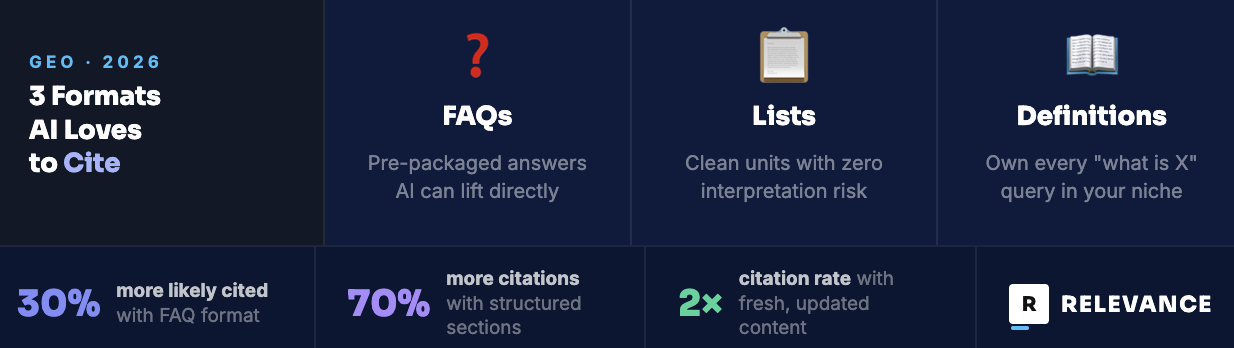
Here is the thing: AI models do not “prefer” your brand. They prefer content they can confidently reuse. FAQs, lists and definitions are basically the three easiest shapes for an AI system to chunk, understand and cite. When we write for growth teams under quarterly pressure, we obsess over those shapes because they scale with limited time and limited budget.
The simple reason these formats win in AI answers
Most AI search experiences work like this: they retrieve a handful of relevant passages, then synthesize an answer. Retrieval loves clean structure. Synthesis loves unambiguous language.
FAQs, lists and definitions do two important jobs at once:
- They reduce interpretation risk. The model does not have to guess what you meant.
- They create quotable units. A definition paragraph or a three step list is easy to lift.
If your page is a flowing narrative with no anchors, the AI has to work harder. In practice, that usually means it quotes somebody else.
Definitions are how you become the canonical “what is X” source
Definitions are your best shot at owning the top of funnel question that keeps showing up in sales calls. You want one clean definition that is short enough to quote but specific enough to trust.
A definition that works for AI typically has four parts in this order:
- The category: “X is a type of Y”
- The job: “It helps you do Z”
- The context: “Most common in B2B SaaS or ecommerce when…”
- The boundary: “It is not the same as…”
That boundary line is where most marketers get lazy, and it is where you win. If you define “lead scoring” but never clarify how it differs from “qualification,” you are begging the model to blend concepts.
Where to put it: near the top of the page, after a short hook, in its own subhead. Do not hide it halfway down because you want to “build suspense.” AI does not reward suspense.
Lists are how AI learns your process
LLMs are constantly trying to answer “how do I” questions. Lists are the most compact, least ambiguous way to communicate a process.
In growth work, the list patterns that show up in AI answers tend to be:
- Steps (setup, implementation, rollout)
- Checklists (launch readiness, audit items)
- Components (pricing elements, tracking requirements)
- Comparisons (pros and cons, when to use what)
The trap is writing lists that look structured but are actually fluffy. “Align stakeholders” is not a step. “Get sales and marketing to agree on what a PQL is, then document it in the CRM” is a step.
If you want lists to perform in AI, write them like you are handing them to a junior marketer at 5 p.m. on a Friday who still needs to ship.
FAQs are how you cover messy intent without writing 20 blog posts
FAQs are not just “people also ask” bait. They are an intent coverage tool.
In practice, a strong FAQ section does three things:
- Captures variant phrasing your audience uses in Slack and sales calls
- Clarifies objections that block conversion
- Creates short answer blocks that AI can reuse
You do not need 40 questions. You need the right eight to 12 questions, and the first sentence of each answer needs to stand alone.
A good internal rule: if you copied only the first sentence into a chat response, would it still be accurate?
How to structure all three on the same page without making it a mess
Think of this as packaging, not padding. Your goal is to make the page easy for scanners, easy for search and easy for AI retrieval.
Here is the cleanest layout we keep coming back to:
- A short hook that names the problem in plain language
- A definition box
- A “how it works” section with one tight list
- FAQs that handle edge cases and objections
If you do that, you can keep the page mostly prose and still give the model what it needs. That “mostly prose, bullets sparingly” approach is how we keep content readable for practitioners while still making it machine friendly.
Quick comparison table
| Format | What it gives AI | Where it belongs | Common mistake |
| Definition | A quotable canonical answer | Top of page | Vague, buzzword heavy wording |
| List | A reusable procedure | Middle of page | Steps that are not actionable |
| FAQ | Intent coverage and objections | Bottom third | Long answers with buried ledes |
A realistic two-week implementation plan
If you want this to actually ship, do not start with your whole site. Pick one money page or one category hub.
- Day 1 to 2: Pull questions from sales, support and onsite search.
- Day 3 to 5: Write one definition and one process list.
- Day 6 to 8: Draft eight to 12 FAQs with one sentence ledes.
- Day 9 to 10: Add basic schema and internal links.
- Day 11 to 14: Watch Search Console and iterate.
That is it. No “AI content transformation initiative.” Just a sprint that produces structured, reusable answers.
How to measure if it is working
Classic SEO metrics still matter, but you want to add two AI era signals.
First, look for query expansion in Google Search Console. When definitions and FAQs land, you often start ranking for longer, weirder queries that never showed up before.
Second, track referral traffic from AI tools in Google Analytics 4. Create a custom channel group for known AI referrers and monitor engaged sessions and assisted conversions. It will not be perfect, but it gives you a directional read without pretending attribution is solved.
And yes, you should still care about conversion rate. If your FAQ section answers objections well, you usually see fewer “pricing page pogo sticks” in behavior flows. That is not an AI metric, but it is the real win.
The uncomfortable truth
AI is not rewarding content volume. It is rewarding clarity.
If your content team is churning out posts but your site still does not have crisp definitions, skimmable processes and tight FAQs, you are leaving the easiest wins on the table. We would rather publish one page that becomes the answer than five pages that become background noise. That is the mindset we push in our own editorial standards.
Methodology
The insights in this article come from Relevance’s direct work with growth-focused B2B and ecommerce companies. We’ve run the campaigns, analyzed the data and tracked results across channels. We supplement our firsthand experience by researching what other top practitioners are seeing and sharing. Every piece we publish represents significant effort in research, writing and editing. We verify data, pressure-test recommendations against what we are seeing, and refine until the advice is specific enough to actually act on.
