

If you’re asking “How much does SEO cost in 2026?” you’re probably not trying to price out “SEO.” You’re trying to price out momentum. The kind where organic starts carrying real weight in your pipeline or ecommerce revenue so you’re not refreshing Meta CPMs and Google CPCs like it’s your job.
Want something to share to your team? Download our full 2026 SEO & Authority Engineering Investment Report
In 2026, the market has gotten more honest about what it takes. Good SEO is not a couple of blog posts and some title tag tweaks. It’s a production system: technical fixes, content that actually deserves to rank and link and ongoing iteration based on what the SERP is doing this month.
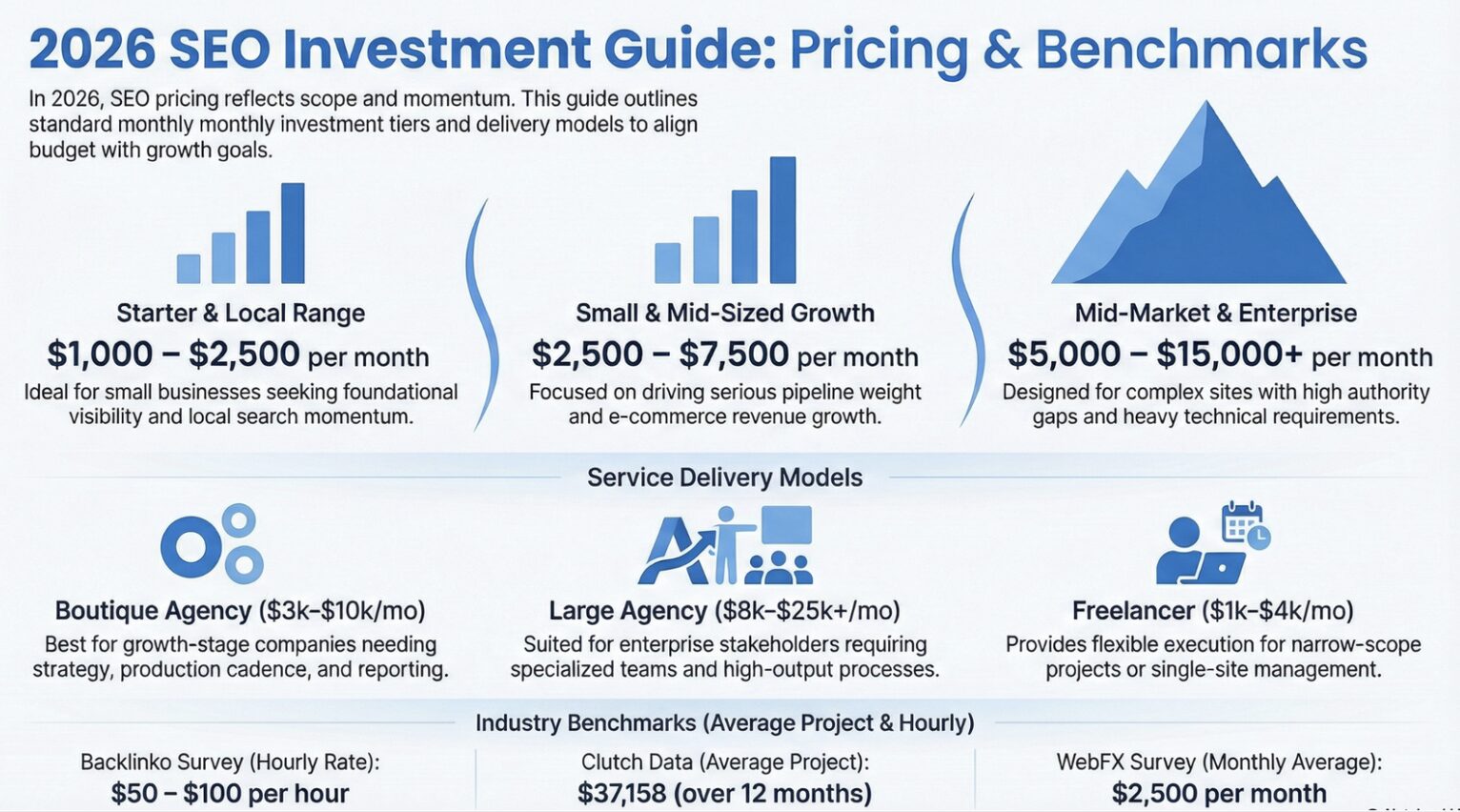
Here are the ranges we see most often, backed by current surveys and pricing benchmarks.
The real-world SEO cost ranges in 2026
Most businesses paying for ongoing SEO land in one of three bands:
-
Starter and local: $1,000 to $2,500 per month f
-
Serious small and mid-sized growth: $2,500 to $7,500 per month
-
Mid-market and enterprise: $5,000 to $15,000 per month
If you want a single “average,” you can find a few.
- Backlinko’s 2026 survey highlights $1,000 to $2,500 per month as a typical monthly spend range and $50 to $100 per hour as a common hourly range.
- Clutch’s January 2026 pricing data, based on reviewed projects, pegs an average SEO project at about $37,158 over roughly 12 months, or about $3,199 per month when you normalize it.
- WebFX reports an average of $2,500 per month from its survey of U.S. businesses.
Those can all be “true,” because SEO pricing is really a proxy for scope.
What you’re buying at each pricing level
| Model | Typical 2026 spend | Best fit | What you actually get |
|---|---|---|---|
| DIY + tools | $100 to $800 per month | Founder-led, early stage | Tools, your time, slower iteration |
| Freelancer | $1,000 to $4,000 per month | Narrow scope, one site | Flexible execution, limited coverage |
| Boutique agency | $3,000 to $10,000 per month | Growth-stage B2B or ecommerce | Strategy + production cadence + reporting |
| Larger agency | $8,000 to $25,000+ per month | Complex sites, multiple stakeholders | Specialists, process, heavier overhead |
| In-house hire | $90,000 to $160,000+ per year | Long-term SEO as a core channel | Full focus, still needs tools + content help |
That last row is the one teams forget. “We’ll just hire someone” is not cheaper if you actually need output. One strong in-house SEO still needs dev time, design bandwidth, writers, tools, and often PR support. This is especially true in specialized verticals like healthcare SEO, where compliance and E-E-A-T add complexity.
What drives SEO cost in 2026
You can usually predict the price by looking at three variables: how competitive your SERP is, how fast you need results, and how much your site fights you.
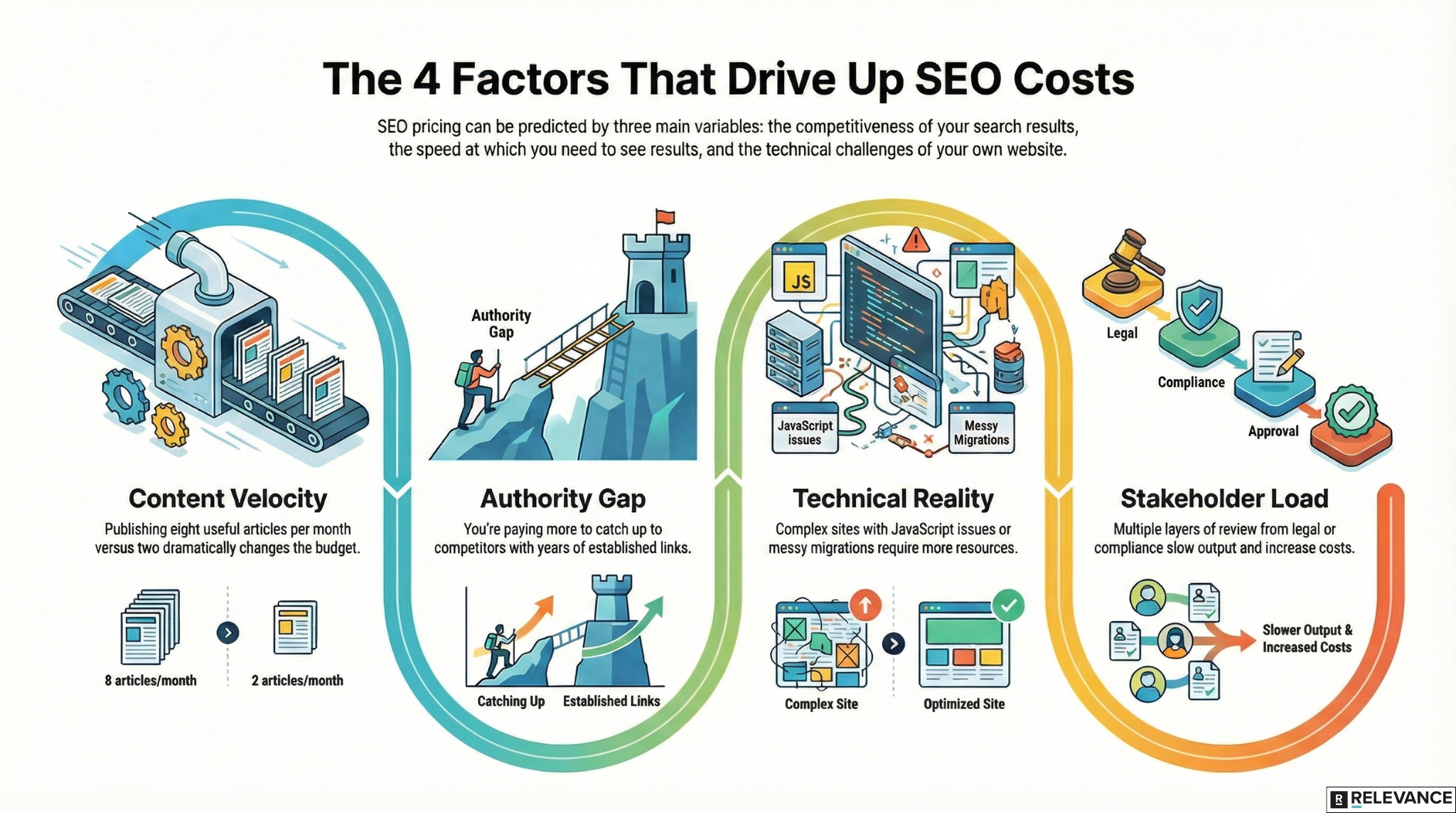
Here are the cost multipliers we see hit budgets hardest:
-
Content velocity: publishing two useful pieces a month vs. eight changes everything.
-
Authority gap: if competitors have years of links and brand search, you’re paying to catch up.
-
Technical reality: headless builds, JavaScript rendering issues, faceted navigation, messy migrations.
-
Stakeholder load: approvals, compliance, legal review, and “five people in the doc” slow output.
Notice what’s not on that list: “AI.” AI can cut drafting time, sure. But the expensive part is still deciding what to publish, making it materially better than what’s ranking and getting it distributed or cited.
Want something to share to your team? Download our full 2026 SEO & Authority Engineering Investment Report
What We Charge at Relevance (and why)
If you’re shopping SEO based purely on “monthly retainer,” we’re probably not the cheapest option, and that’s intentional.
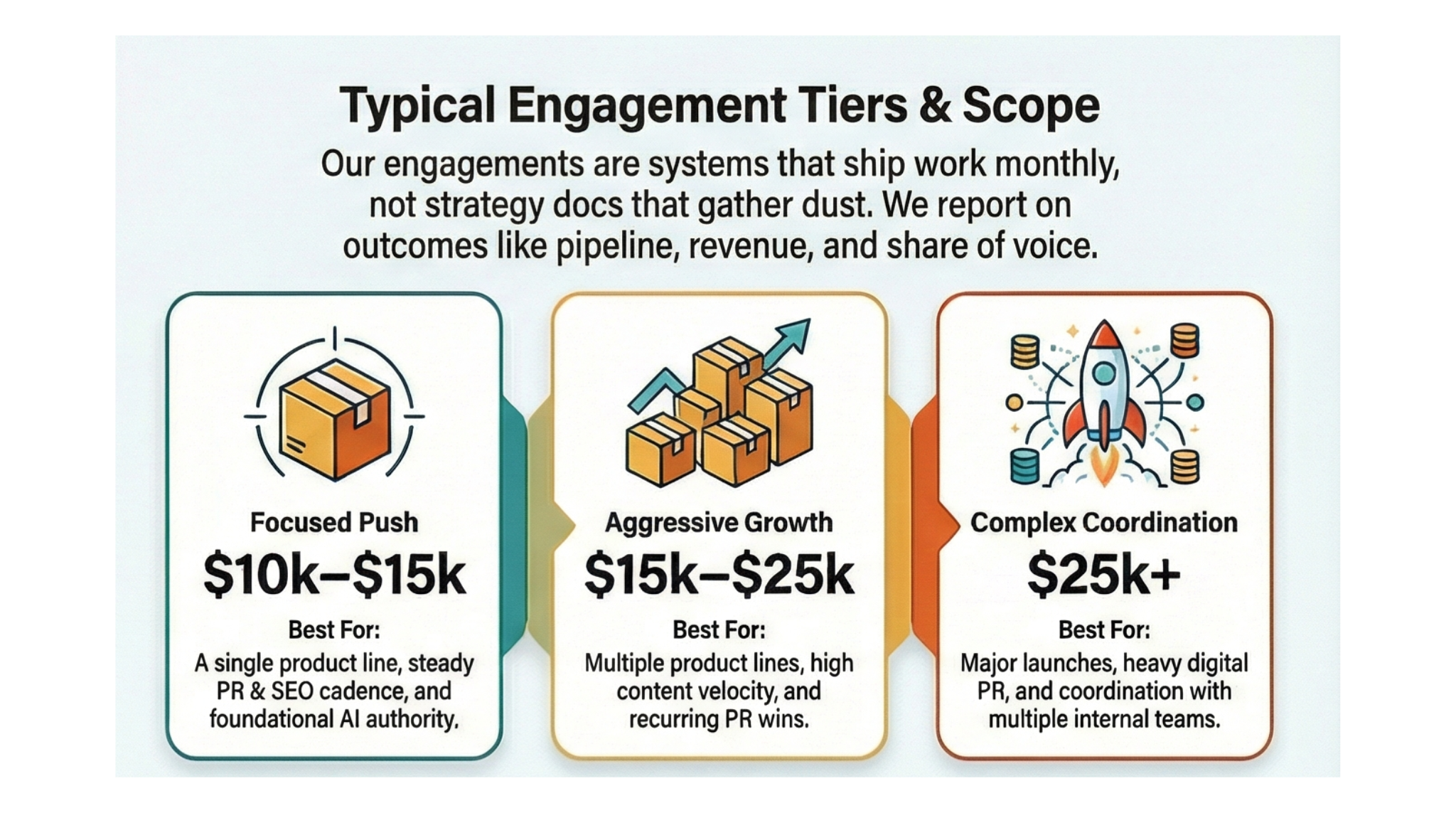
Relevance lives in the premium $5k to $25k+/month range because we’re not selling only “content” or only “technical SEO.”
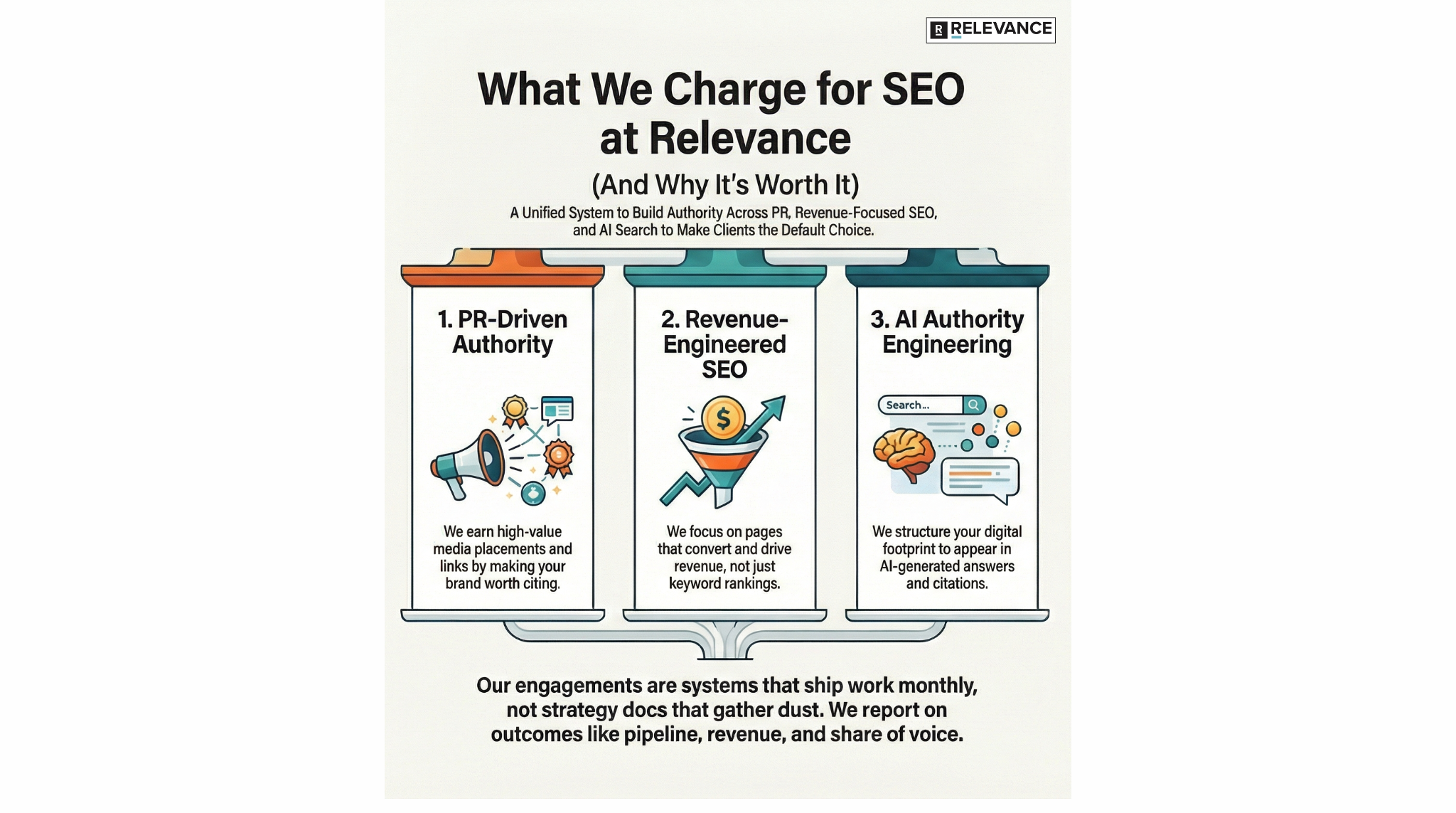
We’re building authority across three systems that now overlap more than most teams realize:
1) PR-driven authority (earned media + narratives)
Links still matter, but in 2026 the best links come from being worth citing. We run PR like a growth channel: angle development, newsjacking when it makes sense, data-led pitches, founder visibility, and placements that actually move perceived credibility. That authority compounds in organic search and in AI answers.
2) SEO that’s engineered to win pages, not just keywords
We focus on the pages that change revenue—category pages, solution pages, BOFU comparisons, integration pages, and “why us” assets that convert. That means content + on-page + internal linking + technical cleanup + conversion improvements working together, not as separate checklists.
3) AI Authority Engineering (LLM visibility + citation gravity)
This is the part most SEO retainers still hand-wave. We deliberately structure your brand’s digital footprint so you’re more likely to appear in AI-generated answers (and not just on your own site). Practically, that means entity clarity, consistent narratives across trusted sources, and a citation strategy that increases the probability your brand becomes a default reference.
What that usually includes:
You’re paying for a system that ships every month, not a strategy doc that gathers dust:
-
PR + earned media execution (not “we’ll build backlinks”)
-
Revenue-aligned SEO roadmap + technical work that actually gets implemented
-
Content that earns rankings and citations (not filler)
-
Authority distribution: getting your story repeated in the places algorithms trust
-
Reporting tied to outcomes: pipeline, revenue, assisted conversions, share of voice—plus LLM visibility signals where measurable
Who this is for and who it’s not:
This tier makes sense when:
-
Organic is already meaningful, or you need it to become meaningful fast,
-
You’re in a category where trust/credibility is half the buying decision,
-
Leadership is asking, “Why are our competitors showing up everywhere, including AI answers?”
If you just need basic on-page cleanup and a couple of blogs a month, you can absolutely spend less and be fine.
But if you’re trying to become the brand that gets cited by Google, by journalists, and by AI systems, then this is where budgets usually land.
Want something to share to your team? Download our full 2026 SEO & Authority Engineering Investment Report
What “cheap SEO” usually looks like (and why it’s expensive)
When someone offers SEO for $500 per month, they almost always have to do one of these:
They automate everything and send reports that look busy.
They outsource the work to the lowest bidder, and you get content that never earns links.
They focus on vanity metrics like “keywords tracked” instead of revenue, pipeline, or assisted conversions.
You’ll still spend money, you’ll still burn internal time, and six months later you’ll be explaining to leadership why nothing moved.
How to evaluate an SEO quote without getting played
The fastest way to spot a good provider is whether they talk about outputs or outcomes. Outputs are deliverables. Outcomes are what change in the business.
When you’re comparing proposals, ask for four things:
-
A 90-day plan with specific shipping dates
-
A content strategy tied to search intent and revenue
-
How they earn links or citations, not “we build backlinks”
-
Reporting that connects to conversions, pipeline or revenue
If they can’t show you what gets shipped in month one, don’t expect month six to be magic.
The overlooked line item: tools and data
Even if you hire an agency, you’ll probably still pay for some tooling internally. Common stacks include Google Search Console, GA4, a crawler like Screaming Frog, and a primary SEO suite. For example, Ahrefs pricing starts around $99 per month and scales up for larger teams.
Tools won’t replace execution, but they do affect how quickly you can diagnose problems and prove impact.
The bottom line
Today, most companies that take SEO seriously spend $2,500 to $7,500 per month all-in for an ongoing program, with smaller businesses often closer to $1,000 to $2,500 and competitive categories pushing $8,000+ fast.
The better question to take to your CFO is not “what does SEO cost?” It’s “what does it cost to keep renting every customer through paid, forever?”
Want something to share to your team? Download our full 2026 SEO & Authority Engineering Investment Report
Methodology
The insights in this article come from Relevance’s direct work with growth-focused B2B and ecommerce companies. We’ve run the campaigns, analyzed the data, and tracked results across channels. We supplement our firsthand experience by researching what other top practitioners are seeing and sharing. Every piece we publish represents significant effort in research, writing and editing.
We verify data, pressure-test recommendations against what we are seeing, and refine until the advice is specific enough to actually act on.
