In the last decade of running SEO, PR, and content programs at Relevance, we’ve watched “gated content” swing like a pendulum.
A few years ago, gating was a thoughtful debate. Now it’s often a reflex: ship another PDF, slap on a form, call it lead gen. And, to be fair, sometimes it works. But most of the time, it quietly trades trust for a tiny spike in MQLs, then leaves your team wondering why pipeline didn’t move.
The bigger issue is that your audience isn’t comparing your asset to “nothing.” They’re comparing it to the 12 other guides open in tabs, the LinkedIn post that already summarized the topic, and the competitor who’s giving away something similar with zero friction.
Our rule of thumb is that gating should be a value exchange decision. If you haven’t earned the “ask,” the form becomes the conversion killer, not the conversion lever.
While blanket statements like “never gate content” and “gate all of your content” are rarely accurate and advisable for all businesses, a good deal of thought should be put into the decision to gate any piece of content. Here are four questions to ask yourself before doing so:
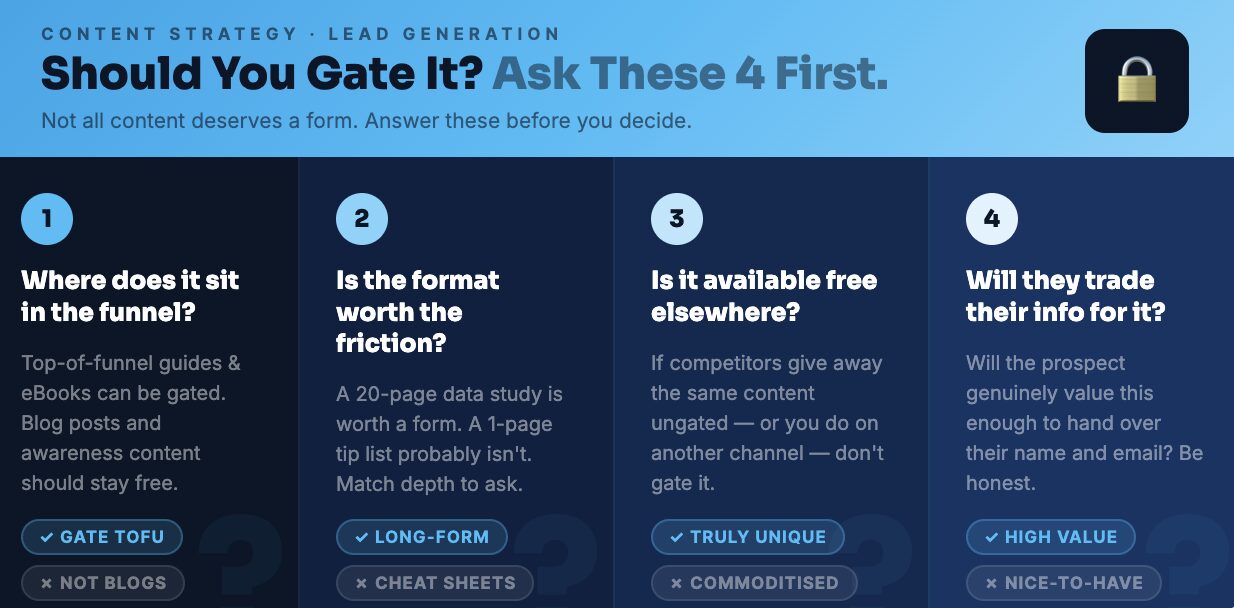
1. “Is this content significant enough to warrant a form?”
It’s common to gate top-of-the-funnel content like guides and eBooks that are purely educational and not directly tied to your products and services. However, a mistake that many businesses make is gating TOFU content that is simply not significant enough to warrant a registration form.
It’s somewhat problematic to quantify value based solely on the length of a document or by how much time was put into its creation. For example, infographics take hours to complete and provide a ton of information, but are never gated. One-page cheat sheets and guides are short and concise, but are frequently gated.
At the same time, a one-page document entitled “10 tips for (something in your industry)” may be more appropriate as a blog post rather than a downloadable, whereas a 20-page data study is probably worth giving up a name and email address to access.
Perhaps a better question is “Will the prospect value the content enough in this format to warrant giving their contact information away?” Taking a customer-centric view with regards to the packaging and substance of the content will help you make the best decision.
The following three questions may shed further light on this abstract issue.
2. “What stage of the sales funnel is the content aimed at?”
Every piece of content should be created with a specific stage of the sales funnel in mind. TOFU content like on-page copy and blog posts most likely won’t get gated, but a white paper might. As you move more towards the bottom of the funnel, it becomes more appropriate to gate content – like case studies or spec sheets – since the prospect appears interested in retaining your services. If you can infer intent from a download, and that intent signifies an interested and qualified prospect, gate that content!
3. “What are we going to do with this contact information?”
If you do decide to gate top-of-the-funnel content, you should have a robust lead nurturing program in place in order to take advantage of that lead data. In fact, the volume of gated TOFU content on your website should be directly proportional to the sophistication of your lead nurturing. If your TOFU content varies by topic, it’s prudent to define and map segments to appropriate personas to move leads quickly and effectively through the sales funnel.
4. “Is this contact available elsewhere without a form?”
A great way to alienate potential leads is to present them with a gated piece of content only to discover that they have either seen this information elsewhere or discovered it later on without having to fill out a form. Research the content of your competitors to make sure they aren’t giving away the same content without a form, or worse, if you’re gating content on one of your own channels while making it available without a form on another owned channel.
Whatever decision you make for your downloadable, it’s important to ask yourself these questions during the content creation process itself in order to ensure that the final product gets created for the exact purpose it was intended. Go forth and gate with confidence (or not)!