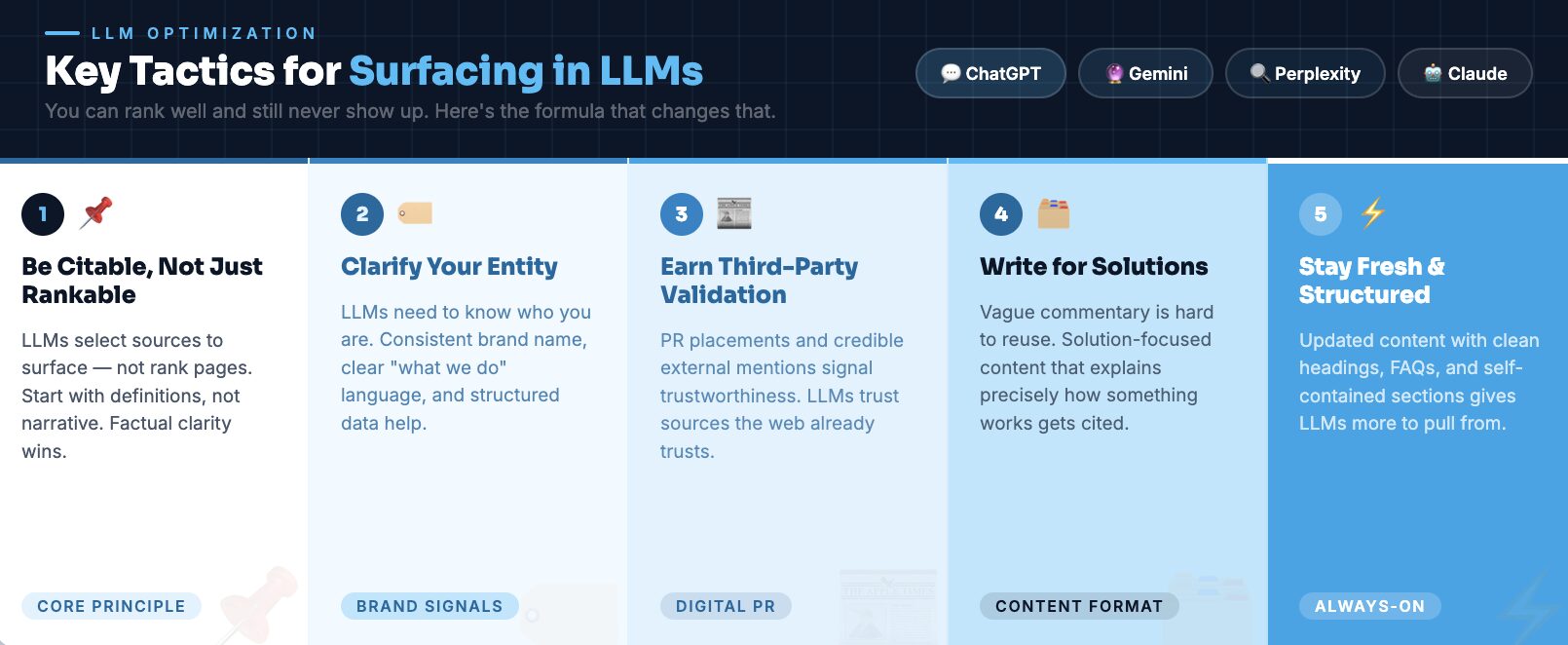
You can rank well and still never show up in LLMs. And yes, that is as frustrating as it sounds.
Even if you do everything “right” and your end-to-end SEO content strategy is best practice, it doesn’t mean that you’ll show up in ChatGPT. If it feels like the rules have changed again, it’s because they have.
Knowing how to make your content count now means understanding not just how search engines rank pages, but how large language models (LLMs) decide what to surface.
There’s no LLM SEO hack you’re missing. However, there is a formula and a clear set of principles to ensure your content consistently shows up where it should.
Be citable, not just rankable
We’re in LLM school today, and please repeat (or reuse) after me: LLMs prioritize content that can be reused and referenced. That starts with clear content. LLMs aren’t ranking pages; they’re selecting the “best” sources to surface to their end users.
Practically speaking, this looks like pages that begin with definitions and not narrative descriptions. I know, hard to hear as marketers, we’re storytellers after all. While good content will stand the test of time, it’s important to remember that LLMs prioritize definitions and factual explanations, so start there and build from that foundation.
Vague commentary is harder for LLMs to reuse. Focusing on solution-based content that explains precisely how something works is helpful. This first tactic is a core principle for AI-powered search optimization. By aligning your content to this rule, you’ll start to see success.
Optimize for entities, not keywords
Entity-based SEO is essential for visibility in LLMs. This looks like building content around specific entities (conditions, treatments, tools, concepts). The good news is you’re probably already doing this, but it’s not just a good content-organization strategy; it’s a critical tactic for successful generative engine optimization (GEO).
This principle, also sometimes called semantic SEO for AI, works because LLMs don’t match text strings. They identify entities and then map the relationships among them. If an entity is clearly defined and consistent across your content, LLMs will recognize this pattern.
Optimized content for ChatGPT and other LLMs should:
- Use the same definitions across all related content
- Use clear, specific definitions and avoid vague explanations
- Reinforce concepts with an internal linking strategy and authoritative references
Rethink Q&A content
Optimize content for ChatGPT and other LLMs by answering the right questions, the right way. LLMs reflect how questions are commonly phrased. Content that mirrors those questions is more likely to be surfaced. This tactic is an easy way to integrate LLM optimization strategies into how you’re already building your content.
Content sections that answer basic questions like “what is,” “how does,” or “when should,” are a great place to start employing this tactic. Best practice is to keep answers clean, informative, and free of promotional language.
Lean into your experts. Not only is it essential to consider what questions are being asked, but answering them with clear, authoritative answers helps ensure success.
Publish research-grade, shareable assets
LLMs favor original, authoritative source material.
White papers, studies, and data-backed research papers may seem overly technical for your audience, but LLMs reward this content for its credibility. Building credibility for LLM content optimization isn’t about publishing more. The key is to provide content that offers detail and expertise, and can be reused and referenced. Structured instructional resources, documentation, and explainer pieces often surface more reliably because they’re designed to be reused rather than skimmed.
How to show up in ChatGPT results with authority:
- Provide clear authorship and visible publication dates
- Always make content open access without logins or paywalls
- Publish formats that machines can read and extract content from easily
Make content machine-readable
Strong content can still fail if it’s difficult for LLMs to extract information from.
Excellent SEO for AI search engines can still break down because pages rely too heavily on scripts, rendering layers, or image-only explanations. While good content is key, accessibility is just as essential for being surfaced in LLMs.
LLMs work best with structurally predictable content:
- Plain HTML for core information
- Clear headers that establish hierarchy
- Tables where relationships or comparisons matter
- Text explanations that do not depend on visuals
This isn’t a new technical requirement. It overlaps directly with long-standing SEO foundations that you’re probably already familiar with. The difference is that extraction now matters as much as indexing.
Access still matters
Some sites block AI systems without realizing it.
Content hidden behind logins or cookie walls is sometimes inaccessible. Overly restrictive crawl rules can also prevent LLMs from reaching content entirely.
As AI systems rely more on live retrieval, open access is more than just a nice-to-have. Allowing systems to read what you publish is now a baseline visibility requirement.
Trust signals must be legible to machines
LLMs assess trust structurally, not emotionally.
They look for clear author attribution, consistent topical focus, and transparent organizational identity. Author bios, external profiles, and visible expertise signals help establish credibility in ways machines can interpret. This reflects standard E-E-A-T principles, but without the emotional layer. Machines require explicit proof.
Consistent content is more visible
LLMs will always choose to surface content that appears current and actively maintained.
Pages with visible update dates, refined terminology, and corrected data signal reliability. In some cases, expanding and improving existing content has more impact than publishing something new. Long-term AI visibility means prioritizing fresh, maintained content. If you want your content to show up, keeping it updated shouldn’t be a pesky task that always lands at the bottom of the to-do list. Instead, it’s a reasonably low lift practice to increase your AI visibility.
Final thoughts
LLM SEO does not replace traditional SEO. It builds on it.
The sources that surface most consistently are not chasing new tactics. They’re publishing content that is clear, structured, open, and reusable. Visibility becomes a byproduct of how sound knowledge is organized.
As search continues to evolve, selection will favor sources that make their expertise easy to understand and trust.