
Your SEO dashboard is flat, your paid CAC keeps creeping up, and your CEO just forwarded a competitor’s feature in a tier-one publication with a single line: “Can we do this?” You ask your team about “digital PR” and get three different answers: press releases, link building, or “relationship stuff.” Here’s what it actually is, why it moves rankings in a way most content calendars never will, and how to run it without turning your brand into a desperate pitch machine.
We’ll define digital PR, then walk through the specific tactics and a step-by-step playbook to use digital PR to boost search visibility, with realistic timelines, metrics, and common failure modes.
What is digital PR?
Digital PR is creating something genuinely publishable (data, expert insight, a sharp angle, a useful tool, a timely point of view), then pitching it to online publications and creators who already have your audience’s attention. If it lands, you get third-party coverage. If it’s done well, you also earn editorial links and brand mentions that strengthen your search presence over time.
That “something publishable” is the part most teams skip. They treat digital PR like outreach. Real digital PR is closer to product marketing: you’re packaging an insight so a journalist can turn it into a story in under ten minutes.
Here’s what it looks like in the real world:
- A data story: Asana’s State of Work Innovation research (a large survey-based report) is a classic example of a PR-ready asset. It gives journalists quotable stats and multiple angles to write about.
- A linkable “source of truth” page: Ahrefs built a stats page, then ran targeted outreach. They documented sending 515 emails and earning dozens of backlinks from linking websites, and the page ultimately ranked #1 for “SEO stats.” That is digital PR thinking applied with SEO measurement discipline.
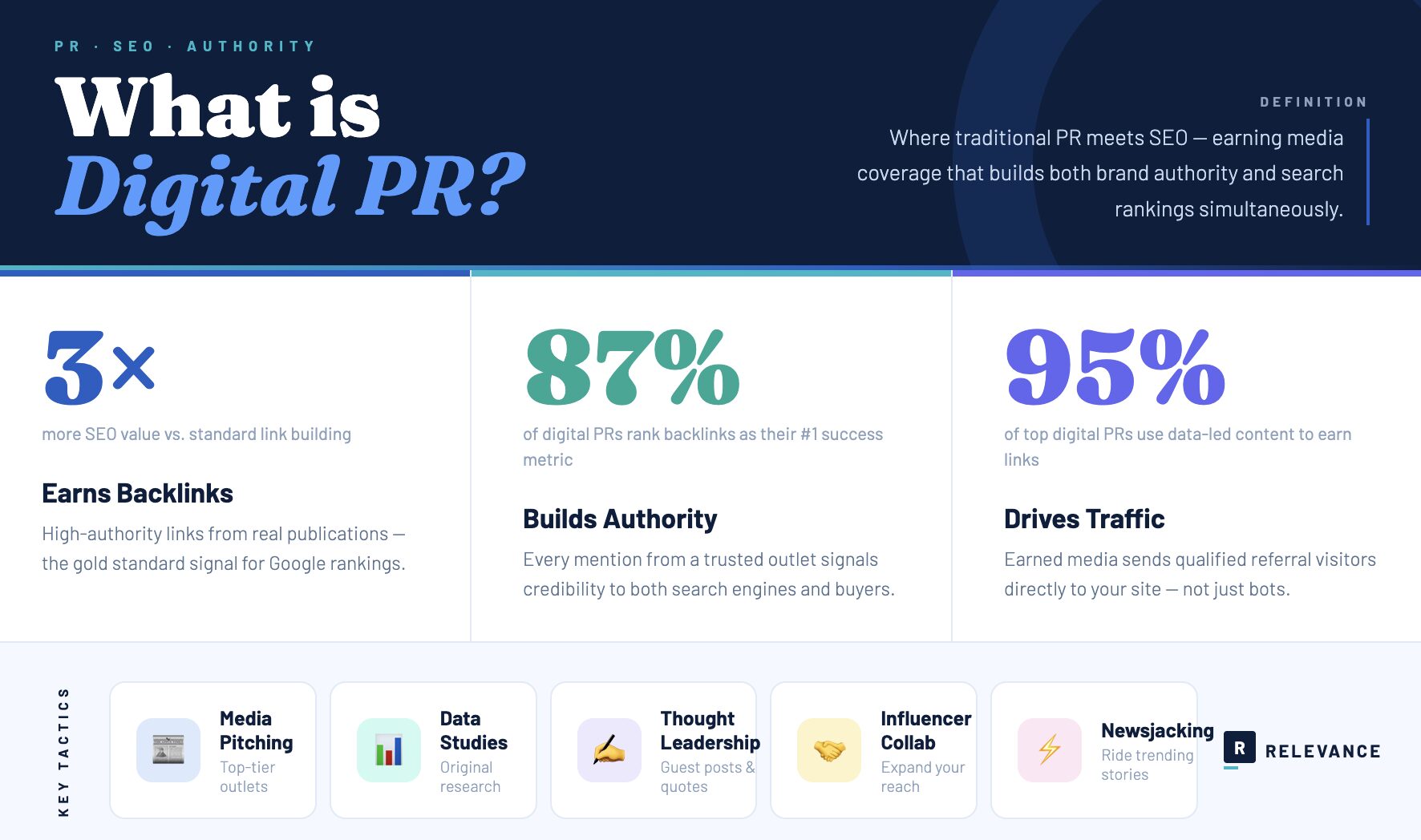
The point is not “get press.” The point is to earn credible third-party validation that search engines and humans both respond to: editorial links, citations, and brand familiarity.
How digital PR differs from related concepts
Digital PR vs. link building
Link building is usually page-first: “We need links to this URL to move this keyword.” Digital PR is story-first: “We have a story that deserves coverage, and the links are one byproduct.”
That difference sounds subtle until you watch it play out. A link building team might write a guest post and negotiate an anchor text. A digital PR team might publish an original dataset or a sharp industry analysis, then earn citations from journalists who are writing their own stories. Same outcome (links), different why, different quality, different compounding.
Even industry guides that are link-building oriented call out that digital PR is broader than classic link building because it’s built around coverage, credibility, and relationships, not just acquisition.
Digital PR vs. traditional PR
Traditional PR can be about offline reach (print, TV, radio) and reputation. Digital PR keeps the reputation part, but the distribution and measurement are native to the internet: online publishers, newsletters, podcasts, YouTube, social, search demand, referral traffic, and backlinks.
In practice, the biggest difference is feedback loops. In digital PR, you can tie coverage to what happened next: branded search lift, referral spikes, new referring domains, and ranking movement.
Digital PR vs. content marketing
Content marketing is usually owned media: you publish on your site and promote it. Digital PR is earned media: someone else publishes the story (or references your asset) because it’s useful for their audience.
Great teams combine them. The digital PR asset becomes the content hub. The earned coverage becomes distribution. The SEO team gets durable backlinks and topical authority signals. The growth team gets a story they can run through paid and lifecycle.
Benefits of digital PR for search visibility (what actually moves)
You’ll see a lot of fluff like “build awareness” and “increase authority.” Here’s what that means in consequences and metrics.
Digital PR tends to matter most when you’re competing in a SERP where everybody has “good content.” In those SERPs, authority and familiarity decide who gets the click and who gets buried.
1) You earn higher-trust links than most scalable link tactics.
Editorial links are hard to fake at scale, and they usually come from sites that already have authority. Industry guidance consistently frames digital PR as a way to earn high-quality backlinks and build authority for SEO.
2) It helps you compete in SERPs where backlinks are still a differentiator.
Large correlation studies continue to show that top-ranking results tend to have stronger link profiles. Backlinko’s large analysis of Google results is one of the most cited examples in the SEO world.
Ahrefs has also published research showing a relationship between referring domains and organic traffic, and explains the “vicious circle” where top results keep earning more links over time.
3) You get branded search lift, which makes SEO easier downstream.
Here’s the thing: once people know your name, your whole SEO program gets cheaper. Your content gets clicked more. Your outreach gets warmer. Your sales team stops fighting “who are you?” objections. Digital PR’s coverage creates those brand touchpoints in a way that blog posts rarely do.
4) You build assets journalists keep citing.
A good digital PR asset can pay you back for years, because writers keep needing the stat, the chart, or the definition. That’s the quiet win. One placement is nice. Becoming the “source” is the real game.
Digital PR tactics that reliably boost search visibility
1) Data-led stories that journalists can quote in one sentence
If you’ve ever been on the receiving end of a journalist’s deadline, you know the truth: they’re not looking for your “thought leadership.” They’re looking for a clean number and a credible source.
Asana’s big research report example is useful because it’s not just “we surveyed people.” It’s structured to produce quotable insights and multiple editorial angles.
Where teams mess this up is they publish a PDF that hides the data behind a form. Journalists will still cover it sometimes, but you’re making it harder than it needs to be. If search visibility is your goal, build a crawlable on-site hub with key charts and callouts, then offer the full report as optional.
2) “Stats pages” and evergreen source hubs (SEO’s sleeper PR play)
Ahrefs’ “SEO statistics” case study is a great blueprint because it’s not sexy, it’s just effective. They created a page built to attract links, ran outreach, documented the campaign volume (515 emails), earned backlinks, and the page went on to rank.
The move here is positioning: you’re not pitching “our company.” You’re pitching “the internet’s most useful page on this topic.” That’s a digital PR angle wearing an SEO hat.
3) Expert commentary programs (but built like a system, not a scramble)
If you only do reactive PR when someone pings you, you’ll miss most opportunities. The win is building a system: clear spokespeople, a handful of tight talking points, proof points (numbers, customer examples), and a repeatable way to respond fast.
One caution from the last year: if your commentary program relied heavily on HARO/Connectively, you probably felt the disruption. Prezly’s overview notes that HARO (after being rebranded as Connectively) shut down on December 9, 2024, then later reopened in April 2025. That volatility is exactly why we like to diversify into direct journalist lists, niche newsletters, and platforms like Qwoted rather than betting everything on one inbox feed.
4) Newsjacking that actually earns links (not just social impressions)
Newsjacking works when you bring something to the story that the journalist can’t get elsewhere: proprietary data, a credible expert, or a unique angle that’s grounded in reality.
A lot of guides talk about “react fast.” Sure. But the real constraint is “react with substance.” If your comment is generic, it’s not getting picked up. If your angle includes a real stat from your own dataset, now you’re interesting.
5) Product-led PR moments (only when it’s truly news)
Press releases for “we shipped a button” won’t move search visibility. A meaningful launch can. The Semrush guide frames product news as a valid digital PR lane when it’s actually newsworthy and tied to what journalists are already covering.
This is where SEO teams can add leverage: build a launch page that targets the non-branded query cluster, then use PR coverage to send authority signals to that page, not just to your homepage.
When digital PR makes sense (and when it doesn’t)
Digital PR makes sense when you have (1) something worth saying, (2) at least a quarter to let compounding kick in, and (3) a SERP where authority is the differentiator.
If you’re a B2B SaaS company trying to rank for competitive category terms, digital PR is often the difference between “we publish content forever” and “we actually crack page one.” The link and brand effects compound, and they make every other channel perform better.
On the flip side, if you need pipeline next month and you can’t invest in an asset that’s genuinely publishable, you’re going to hate this channel. You’ll do a rushed campaign, get ignored, and conclude “PR doesn’t work.” In that situation, you’re usually better off putting the next 30 days into demand capture (paid search, retargeting, outbound) while you build the raw material (data, customer stories, POV) that makes PR doable later.
What our research team is seeing today – March, 2026
Across current digital PR work, the teams getting the biggest SEO lift aren’t doing “one big splash” and calling it a quarter. They’re building a drumbeat: one substantial asset every 8 to 12 weeks (data, a benchmark report, an interactive), plus weekly or biweekly expert commentary that keeps the brand showing up in the conversation.
We’re also seeing measurement expectations mature. Instead of promising “rankings in 30 days,” strong teams set two time horizons: early indicators (placements, referring domains, referral traffic, branded search trend) in the first 30 to 60 days, and SEO movement (ranking lifts on the linked-to hub and adjacent cluster pages) in the 90 to 180 day window. That lines up with the broader SEO reality that links and authority effects compound over time, not overnight.
One more pattern that’s hard to ignore in 2025: digital PR is increasingly pulling double duty for AI-driven discovery. Earned mentions across credible sites are becoming part of how brands show up, not just in classic blue links, but in the overall “who gets referenced” layer of the web. Search Engine Land has been covering this convergence of earned media and modern search visibility.
What top experts are saying
You don’t have to take “PR matters for SEO” on faith. Even Google’s John Mueller has publicly praised digital PR, noting it’s a shame it’s often lumped in with spammy link building and saying it can be as important as technical SEO, or more, in many cases.
Rand Fishkin has been banging a different drum that ends up in the same place: clicks and attribution are getting messier, and marketers need to invest in influence and demand creation rather than assuming rankings alone will do the job. His writing on the decline of clean attribution is basically a warning label for anyone who thinks “just publish more content” is a growth strategy.
And if you want the practitioner data, BuzzStream’s 2025 State of Digital PR report is a useful snapshot of what digital PR pros are actually doing and wrestling with right now, based on interviews conducted in late 2024.
How to use digital PR to boost search visibility (a practical playbook)
1) Start with a search visibility goal, not a “press” goal
If the goal is “get coverage,” you’ll optimize for logos and vanity wins. If the goal is “increase search visibility,” you’ll make different choices: which page you want links to hit, which topics you want to build authority around, and which publications actually influence your market.
Pick one primary outcome for the next 90 to 180 days. Examples that are concrete enough to manage:
- Improve rankings for a specific non-branded topic cluster (the pages you want to lift should already exist or be in progress).
- Increase branded search demand (especially if you’re losing clicks to bigger brands).
- Grow referring domains to your domain and to one priority hub page.
Now the campaign can be designed like a growth experiment, not a vibes project.
2) Build an asset that is easy to cite
This is the part that separates “we tried PR” from “we have a PR engine.”
A good digital PR asset has three properties:
It’s specific (a tight claim with proof), scannable (a journalist can grab it fast), and credible (methodology, sourcing, or clear firsthand data).
If you’re doing research, show your methodology in plain English. If you’re using internal data, explain the sample and caveats. If you’re creating a “stats page,” make it ridiculously well-organized.
Then make it crawlable. A PDF can exist, but the source hub should live on your site where links help the page that needs to rank.
3) Decide where links should go before you pitch a single inbox
Most digital PR campaigns accidentally point authority to the homepage. It feels safe. It’s also a waste if you’re trying to win non-branded search.
Pick one of these link targets:
- The data hub (best when you want that page to rank and earn more organic links).
- A category page (best when you’re in a competitive market and need authority on the money page).
- A supporting guide that connects the PR angle to a broader cluster.
Once you choose, make sure the page is technically ready: fast, indexable, internally linked from relevant pages, and not buried in your navigation.
4) Build a media list like a performance marketer builds audiences
Stop thinking in terms of “top tier” versus “not top tier.” Think in terms of relevance and distribution.
We like three buckets:
A handful of high-authority publications that shape the conversation, a larger set of niche trades where your buyers actually pay attention, and a list of newsletters and creators who can amplify quickly.
Most campaigns fail because the list is lazy. It’s scraped. It’s not aligned to the story.
5) Pitch with receipts, not adjectives
Journalists don’t care that your report is “groundbreaking.” They care that it gives them a clean angle and a credible stat.
A pitch that works usually has:
A one-sentence headline, a 2 to 3 sentence story angle, 2 to 3 bullet-proof data points, and a line about why it matters right now.
Keep it short. If you have to explain it for five paragraphs, it’s not ready.
6) Follow up like a human, then turn coverage into SEO leverage
Once coverage lands, the campaign isn’t done. This is where search visibility gets amplified.
Make sure your own site is using the moment: internal links to the hub, a short update on your blog that points to the coverage (no need to spam it), and distribution through your owned channels.
If a publication mentions you without a link, consider a gentle link request, but only when it’s truly additive. Digital PR is a long game. Don’t burn relationships for a single URL.
7) Measure what matters (and keep the timeline honest)
Digital PR measurement is where stakeholder trust gets won or lost.
Track leading indicators quickly (placements, referral traffic, new referring domains), but evaluate SEO impact over a longer window. Ahrefs’ research on backlink growth and rankings is a useful reminder that authority effects compound and tend to show up over time, not instantly.
Here’s the metric set we use most often:
- Referring domains to the campaign hub
- Branded search trend (Google Search Console impressions for brand queries)
- Rankings for the target cluster (not just the one keyword)
- Referral traffic quality (engagement, assisted conversions)
- New links earned without outreach (the “second-order” effect)
That list is enough to prove value without drowning in dashboards.
Common challenges (and how to avoid the usual faceplants)
The most common failure is building an asset that’s secretly an ad. Journalists can smell it. If your “study” only exists to validate your product category, it won’t earn coverage, and even if it does, it won’t earn the kind of citations that compound.
The second failure is impatience. Teams expect SEO movement in weeks, don’t see it, and stop. That’s how you end up with a graveyard of “campaign pages” that never got a second wave of distribution. Plan for 90 to 180 days of measurement from day one, and you’ll make smarter calls.
The third is over-reliance on one channel for commentary opportunities. The HARO/Connectively shutdown and later reopening is a perfect reminder that platforms change. Build direct relationships and diversify where you source opportunities.
Our research process
At Relevance, we sit in the messy middle where SEO meets PR meets growth. We’ve helped teams build digital PR programs that are designed to do two things at the same time: earn real coverage people actually read, and earn the kinds of editorial links and brand mentions that make search visibility compound over quarters.
When we write about digital PR, we’re not treating it like a “links tactic” you bolt onto SEO at the end. We’re looking at how the story, the asset, the pitch list, and the measurement plan fit together, because that’s where most campaigns fall apart. One team will spend a month on a “data study,” then send a generic blast to 300 inboxes and wonder why nothing lands. Another will win coverage, but point every link to the homepage and learn nothing about what actually drove rankings.
To sanity-check our POV, we also reviewed current practitioner guidance and industry data on what’s working right now, including how SEO teams are rating digital PR versus other link building tactics, plus current realities in source platforms (the HARO to Connectively saga being a recent case study in “don’t build your whole program on one channel”).
How we research articles at Relevance.com
Our articles start with how we see tactics work in real growth programs: what teams do, what they measure, what actually compounds, and where campaigns break under stakeholder pressure. We aim to write like practitioners because that’s who this is for.
Then we validate with external sources that document mechanisms and current realities. For this article, we consulted:
- Search Engine Land’s 2025 guide to digital PR for SEO (definition, mechanics, and how PR intersects with E-E-A-T and links). (Search Engine Land)
- Semrush’s guide to digital PR and campaign structure (tactics and examples like research studies and expert commentary). (Semrush)
- Ahrefs’ documented link-building case study and backlink research (practical results and link-to-ranking dynamics). (Ahrefs)
- BuzzStream’s 2025 State of Digital PR report and link-building statistics coverage (industry trends and practitioner sentiment). (BuzzStream)
- Prezly’s summary of the HARO/Connectively timeline (platform volatility and why diversification matters). (Prezly.com)
- Backlinko’s large-scale ranking factors analysis (commonly referenced correlation benchmarks around links and rankings). (Backlinko)