

We’ve been on both sides of the press release equation for a decade: writing them, pitching them, getting them rejected, and watching a few land way bigger than they “deserved.” If you’ve ever hit publish on a release and heard nothing but the sound of your own Slack notifications, you’re not alone.
The hard truth is that most press releases are written like compliance documents. They’re technically correct, painfully safe, and completely ignorable. Meanwhile, editors and reporters are triaging inboxes at warp speed, looking for a reason to say “yes” without doing extra work.
The good news is that getting noticed is more about being clear than gimmicky. It’s about making your release easier to understand, easier to trust, and easier to turn into a story.
Below are the five moves we lean on when a release actually needs to break through.
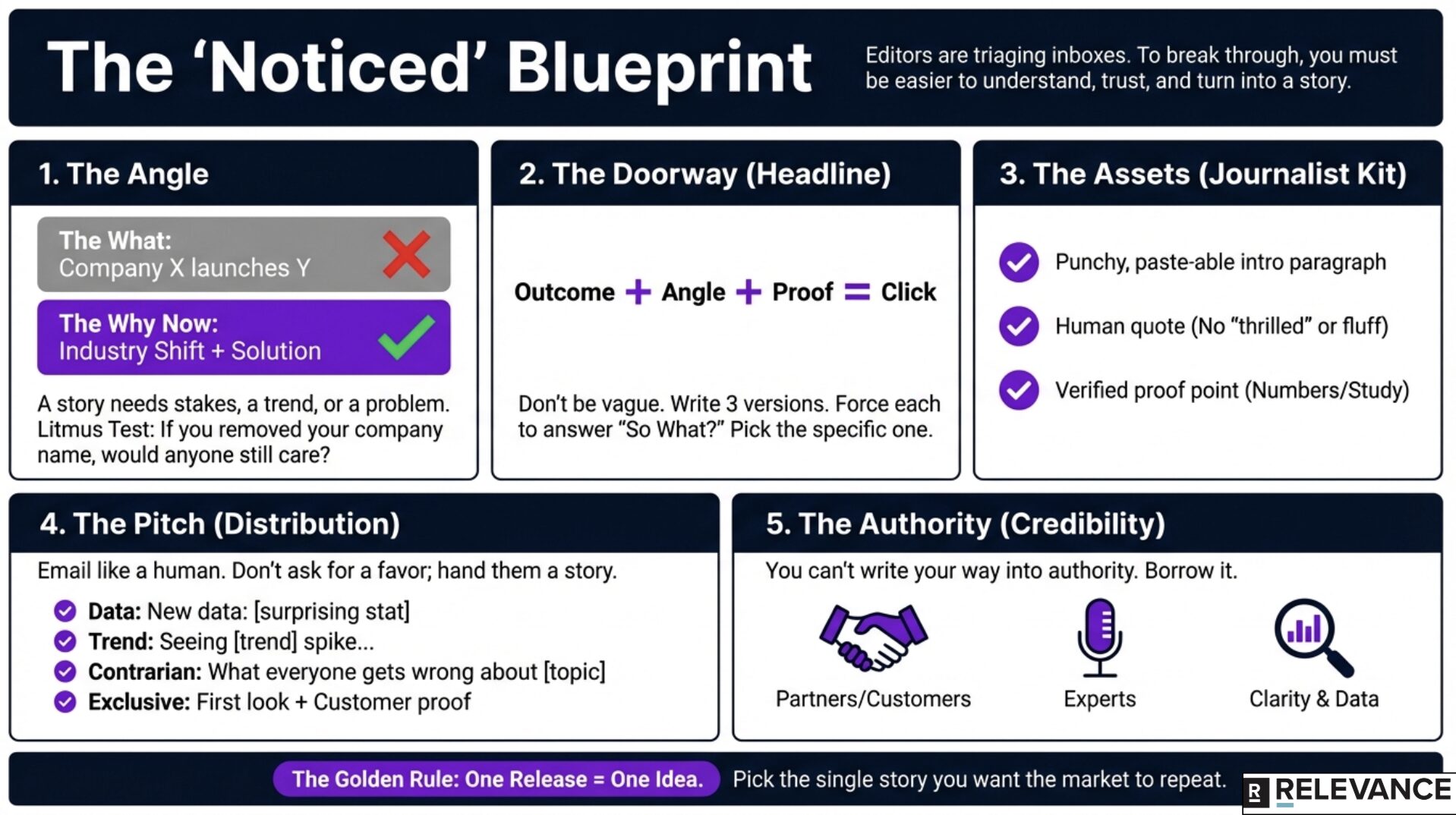
1) Lead with the “why now,” not the “what”
Most releases open with a company announcing something. That’s not a story. A story has stakes, a trend, or a problem that just reached a tipping point.
Instead of: “Company X launches Feature Y,” try: “As [industry shift] accelerates, Company X launches Feature Y to solve [pain].” You’re not adding fluff. You’re giving the journalist the headline scaffolding they already need.
A quick way to test this is to ask: if you removed your company name from the first paragraph, would anyone still care? If the answer is “no,” the release is starting in the wrong place.
2) Make the headline do actual work
Reporters don’t read releases top to bottom. They scan. Your headline and subhead are the doorway—most releases never earn the click because the doorway is vague.
A noticed headline usually does at least two of these:
- Names the outcome (what changes for the reader/market)
- Includes the specific angle (category, audience, or constraint)
- Hints at proof (data point, traction, partners, first/only)
If you’re stuck, write three versions and force each one to answer “So what?” Then pick the one that feels slightly uncomfortable because it’s specific. Specific is what gets remembered.
3) Give them the story assets inside the release
A press release that gets picked up quickly is one that removes friction. That means you’re packaging a story in the easiest way to pick up;.
Think of it like you’re building a “journalist kit” without calling it that:
- A clean, punchy first paragraph that can be pasted directly
- One quote that sounds like a human (not a brochure)
- One proof point that demonstrates this is real (numbers, customers, adoption, study, etc.)
- A line that clearly explains who this matters to (and why)
We’ve seen releases die because the quote is empty (“thrilled,” “excited,” “game-changer”) and the proof is missing. Even if the news is legit, the release doesn’t feel legit until it carries something verifiable.
4) Pitch the release like a human, not a distribution service
Distribution can help with footprint, but “noticed” usually comes from the pitch—the first message that lands in someone’s inbox.
The trap is writing a pitch that sounds like you’re requesting a favor. The better approach is writing a pitch that sounds like you’re handing them a story they can run fast.
Here are five subject line patterns we’ve used (and seen work) when the angle is strong:
- Data: “New data: [surprising stat] in [industry]”
- Trend: “Seeing [trend] spike—here’s what we’re launching because of it”
- Local/vertical: “[City/vertical] angle: [what changed]”
- Contrarian: “The thing everyone gets wrong about [topic]”
- Exclusive: “Offering you first look: [what’s new] + customer proof”
Then, keep the email short. Two tight paragraphs beats six fluffy ones. Your goal isn’t to “explain everything.” Your goal is to make them curious enough to open the release and confident enough to reply.
5) Borrow credibility instead of trying to “sound credible”
This is the part founders and marketers hate hearing: you can’t write your way into authority if you haven’t built any external proof.
The releases that get traction tend to have at least one credibility anchor:
- A recognizable publication angle (timely, relevant, specific)
- A credible partner, customer, or expert voice
- A proof point that shows momentum
- A positioning that’s clearly differentiated (not “we’re also doing AI”)
One of our favorite examples of this is a book launch campaign we supported for Michael Bungay Stanier. The goal wasn’t just “get coverage,” but to position him as the go-to expert for workplace relationships—not another generic leadership voice. That meant targeting premium business outlets and placing him in contexts that signal authority (like expert lists), so the credibility compounds long after launch.
That same idea applies to product releases. If you can’t borrow credibility from a partner or major customer yet, borrow it from clarity and proof: the sharpest angle, the cleanest explanation, and one real metric that signals “this is happening.”
One release, one idea
If you try to announce three things, you’ll get coverage for none. Pick the single story you want the market to repeat, then make every paragraph reinforce it.
