Last quarter you shipped content, ran paid, maybe even landed a decent press mention… and somehow you’re still not showing up where buyers decide. You’re not in the top 3 for the category terms. You’re not the brand AI tools recommend. Your competitor’s “comparison page” is outranking your product page. And you’re getting the same question from leadership in five different forms: “Why aren’t we more visible?”
Growth marketing is what you build when you’re done playing channel whack-a-mole and you want a system that compounds.
How Relevance approaches this in 2026
At Relevance, we’re not interested in “doing SEO” or “doing PR” as separate checkboxes.
Our goal is a compounding visibility engine: SEO + digital PR + content + PPC, now layered with AI visibility (earning mentions/citations in AI answers and search overviews).
This article is based on what we’ve executed across dozens of campaigns, and I’ll anchor the examples in three published case studies our team ran end-to-end:
- Gabb Wireless: monthly recurring revenue grew from $12,233 to $46,477 in 10 months, alongside major organic ranking gains. (Relevance)
- Nurx: organic search grew from 4.8% to 28.7% of acquisition (a structural shift away from paid dependency). (Relevance)
- Spoonful of Comfort: in six months we produced 45 pieces of original content designed to rank and convert, supported by authority-building distribution. (Relevance)
Then we pressure-tested the framework against what’s changed in discovery: Google expanding AI Overviews globally, and the continued rise of zero-click behavior that reduces “rank = traffic” certainty.
What is growth marketing?
Growth marketing is the practice of building a repeatable system to acquire customers and then improving that system continuously.
Not “run ads.” Not “publish blogs.” Not “get press.”
A growth marketer asks: Where does demand come from, what converts it, and what makes it compound instead of resetting every month?
That’s why growth marketing usually looks cross-channel in real life. Because buyers don’t experience you in channels — they experience you as a brand showing up (or not) across a messy path:
- they Google something
- they skim a comparison list
- they ask ChatGPT/Perplexity
- they click one or two sites (maybe)
- they get retargeted
- they ask their team for a recommendation
- they finally fill out a form… or they don’t
Your job is to make that path tilt in your favor.
Growth marketing vs. performance marketing
Performance marketing is typically optimized for efficiency inside paid platforms: CAC, ROAS, payback period. Good teams do it well. But it’s still rented distribution.
Growth marketing zooms out and adds a second mandate: reduce fragility by building owned visibility that compounds.
In our Nurx campaign, organic search didn’t just “grow.” It became a meaningfully larger acquisition channel — from 4.8% to 28.7% of acquisition. That’s the kind of shift that changes budget conversations because you’re not held hostage by auction dynamics anymore.
Growth marketing vs. growth hacking
“Growth hacking” got turned into internet lore: tricks, virality, gimmicks. Real growth work is quieter. It’s systems thinking and disciplined iteration.
The modern version is basically: build loops, measure what matters, and keep tightening the machine.
Why growth marketing matters more in 2025 than it did a few years ago
This is the uncomfortable truth most teams are bumping into: visibility and traffic are decoupling.
- Google’s own rollout of AI Overviews means more queries are answered before a click, and the feature is now available in 200+ countries and territories and 40+ languages. (blog.google)
- Clickstream research from SparkToro/Datos shows that in the U.S., for every 1,000 Google searches, only 360 clicks go to the open web.
Which means: even if your SEO team “wins” rankings, you can still lose attention. Growth marketing adapts by designing for presence (being cited, mentioned, compared, recommended) — not just pageviews.
The Relevance Framework
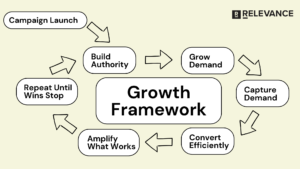
If you want the simplest version of our framework, it’s this:
Build authority. Grow demand. Capture demand. Convert efficiently. Amplify what works. Repeat.
And the channels aren’t separate lanes — they’re parts of one flywheel.
1) SEO for revenue capture, not traffic
The trap: publishing content because “SEO needs content.”
The fix: treating SEO like a revenue channel where each page has a job — capture high-intent demand, support conversion, or earn links/mentions that raise the whole domain.
Our work with Gabb Wireless is a clear example of what happens when you align keyword strategy to real purchase intent: within 10 months, SEO moved from negligible to a primary acquisition driver, with outcomes tied directly to revenue growth.
2) Digital PR as an authority engine (not a logo collage)
PR that only chases “coverage” is hard to defend. PR that produces authority pays rent across the whole strategy:
- stronger rankings (links + relevance signals)
- higher conversion rates (third-party trust)
- more AI visibility (models tend to cite recognized sources and consistently mentioned brands)
This is where a lot of teams miss the compounding part: one placement is nice; a repeatable PR production line changes your category position.
3) Content strategy that converts and earns references
Most content programs fail because they’re built on cadence, not outcomes. If the plan is “two blogs a week,” you’ll produce a lot of words and still feel invisible.
We build content around clusters that map to buyer intent, then we make sure the pieces are actually distributable (PR angles, data hooks, strong opinions, useful tools).
In our with Spoonful of Comfort, the content wasn’t just informational — it was engineered to answer real “I need to help someone” moments and guide the next step, and we produced 45 pieces in six months with that conversion path in mind.
4) AI visibility as the new layer above search
AI visibility isn’t a buzzword — it’s a new set of surfaces where your buyers are forming opinions.
The shift we’ve seen: brands don’t just need to rank; they need to be the one the model feels confident naming.
Practically, that means:
- your site needs clear, structured, citeable answers
- your brand needs consistent entity signals across the web
- you need third-party validation in places AI systems trust
Search Engine Land’s analysis of thousands of AI citations aligns with what we see in campaigns: different models lean on different source types, but “being citeable” and “having authority signals beyond your own site” matter.
5) PPC as an accelerator (and a safety net)
Paid has two jobs in a growth system:
- Learning fast: test messaging, offers, and landing pages without waiting months for SEO feedback.
- Amplifying winners: when a topic, page, or PR narrative works, paid extends its reach and captures more demand while organic compounds.
If PPC is your only engine, you’re on a treadmill. In growth marketing, PPC is the turbo — not the chassis.
How to create an effective growth marketing strategy
Step 1: diagnose the constraint (stop starting with channels)
Most plans start with “we should do SEO, PR, content, paid.” That’s a list.
Start with the constraint:
- If traffic is fine but conversions are weak, your strategy is conversion + positioning + landing pages.
- If conversions are strong but demand is thin, your strategy is visibility + authority.
- If demand exists but CAC is rising, your strategy is shifting acquisition mix toward compounding channels (SEO/PR/content) — like the Nurx shift where organic became a much larger share of acquisition. (Relevance)
Step 2: pick one “wedge” to win first
Trying to launch everything at once is how momentum dies.
Pick the wedge that unlocks the rest. In practice, it’s usually one of these:
- high-intent SEO cluster (category + comparison + alternatives)
- digital PR engine (authority acceleration)
- a flagship asset (data/story/tool) designed to earn links and mentions
Step 3: build the flywheel (make channels feed each other)
Here’s a realistic build order we use when teams want compounding visibility without chaos:
- Capture demand: build/upgrade bottom-funnel pages (category, product, comparison).
- Create proof: publish 2–3 pieces that answer “why you” better than anyone else.
- Distribute: run digital PR around those assets and angles.
- Amplify: use PPC to defend brand terms + retarget engaged visitors.
That’s it. Not 37 initiatives. Four moves that reinforce each other.
Step 4: measure like a growth team (not like five separate teams)
If your dashboards are siloed, your decisions will be siloed.
A growth marketing scorecard should include:
- demand capture: rankings on high-intent terms, organic signups/leads, assisted conversions
- authority: quality backlinks/mentions, branded search lift, referral traffic from placements
- AI visibility: share of voice in AI answers, citation frequency, sentiment/positioning
- efficiency: blended CAC and payback, not just platform ROAS
What our team is seeing today
A few patterns are getting loud across accounts:
Discovery is fragmenting. Your buyer might encounter you in Google, an AI Overview, a “best of” list, a Reddit thread, a Perplexity answer, and a coworker’s Slack message — all before they ever hit your homepage.
That’s why the “compounding visibility” approach wins. When SEO, PR, content, and paid are feeding each other, you don’t need every single click to go your way. You need your brand to be the one that keeps showing up with the right framing.
And yes: the teams that treat AI visibility as measurable (not mystical) are moving faster. They’re auditing where they show up, tightening citeable pages, and investing in authority signals that travel across engines.