
Search engine optimization (SEO) is essential for healthcare providers. It strengthens brand awareness, increases online visibility, improves local search presence, and attracts quality search engine traffic.
While an important part of healthcare marketing, though, SEO & GEO in the healthcare industry isn’t easy.
In fact, it can be downright challenging — and limited, too.
Most business sites need to take a long-term approach to begin ranking well in the SERPs. Even then, they typically won’t outperform industry-leading publications, such as .org sites like Mayo Clinic and Cleveland Clinic, or .gov sites like the CDC.
And, our team has LIVED EXPERIENCES & CASE STUDIES with this difficult challenge.
Our hope is by the end of this article, you will have a better idea of what it will take to pull of a healthcare SEO / GEO campaign.
Healthcare-first content standards
If you’ve ever published a “What is X?” condition page and watched it get outranked by Mayo/CDC/WebMD anyway, this is usually why: the page reads like a generic explainer, not a piece of medical content written by a real organization with real clinicians and real care pathways.
If your content looks like it could’ve been written for any clinic in any city, Google will treat it that way — and AI engines will, too.
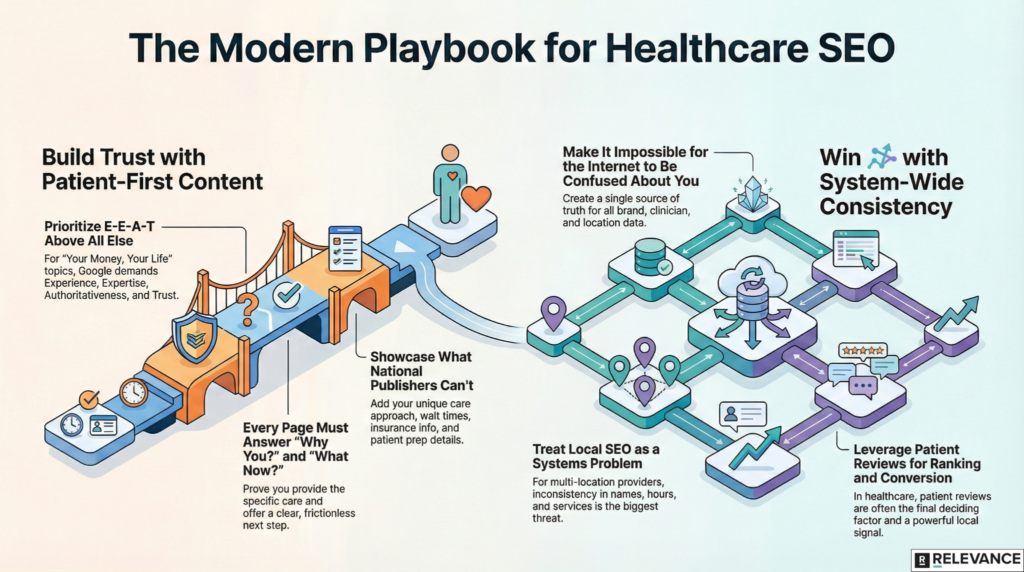
Every core page should prove three things quickly: (1) you’re qualified to talk about this, (2) you actually provide this care, and (3) the patient can take a next step without friction.
Start with architecture. For most healthcare orgs, the cleanest structure is:
-
Service Line Hub (the “authority page” for the specialty)
-
Condition + Symptom pages (diagnosis and decision-making content)
-
Treatment pages (procedures, therapies, medications, programs)
-
Provider pages (credibility + conversion)
-
Location pages (local intent + conversion)
From there, we enforce page-level standards that prevent “thin medical content traps”:
Service line hubs should read like a front door, not a blog post. Lead with who it’s for, what you treat, what you offer, and how to get care. Then layer in decision-support content (common symptoms, treatment options, when to seek care, insurance notes). If you’re a multi-location org, the hub should route cleanly into locations and provider teams.
Condition content has to be more than definitions. Patients don’t search “what is sciatica” because they’re curious; they search because they’re worried. Your condition pages should include symptoms, causes/risk factors, when it’s urgent, how diagnosis works, what treatment looks like at your organization, and what to expect next.
Provider pages are not optional “bio pages.” They’re credibility assets. Every provider page should connect credentials → specialties → conditions treated → locations → appointment path. If a provider treats a condition, make that relationship explicit (and link both ways). This is one of the fastest ways we improve both E-E-A-T signals and conversions.
One practical rule we use: if a page can’t answer “Why you?” and “What now?” it isn’t done.
A few non-negotiables we push:
-
Put “who wrote/reviewed this” above the fold, not buried in the footer. Credentials, role, and last reviewed date.
-
Don’t publish condition content unless you can connect it to next steps: treatments you offer, related services, and clear CTAs (book, call, find a location).
-
Avoid “thin” traps by adding what big publishers can’t: your care approach, wait times, insurance notes, patient prep, what to expect at the visit, and outcomes proof.
That’s the difference between “informational content” and content that actually earns trust signals.
Entity and authority signals for AI answers
AI engines don’t “feel” your brand. They infer your identity from consistency. If your clinician credentials are formatted six different ways across bios, directories, and listings, the model will treat your data as fuzzy, which is how you end up with wrong specialties, wrong locations, and zero attribution.
This section of the playbook is about turning your org into a clean, machine-readable set of entities:
Brand entity: One canonical name, one canonical description, one set of services/specialties you’re known for. This needs to be consistent on-site, in your GBPs, in directories, and in PR mentions.
Clinician entity: Provider name, credentials, specialty taxonomy, locations, education, certifications, and “what they treat.” Then lock it. The most common failure we see is providers drifting over time (“Interventional Pain” in one place, “Pain Management” in another, “Spine Specialist” somewhere else). Pick your taxonomy and keep it consistent.
Location entity: Name + address + phone + hours + categories + services available at that location. A hospital system can’t treat “locations” as interchangeable. Models and map algorithms absolutely don’t.
Operationally, the playbook approach is: create a single source of truth (spreadsheet or CMS fields) that powers bios, location pages, schema, and directory submissions. Then implement reinforcement loops: internal linking, structured data, and off-site citations that all reflect the same relationships (provider ↔ specialty ↔ conditions ↔ location).
If you do nothing else in this section, do this: make it impossible for the internet to be confused about who you are.
Local + multi-location systems
Local SEO in healthcare isn’t “optimize one Google Business Profile and call it a day.” It’s a systems problem. If you have 10, 30, 200 locations, the enemy is inconsistency—different phone numbers, mismatched names, duplicate listings, outdated hours, random categories, and location pages that are basically templated shells.
The orgs that win have a system for keeping 10–500 locations accurate, unique, and conversion-ready — and they treat every drift as a revenue leak.
We see local as three layers:
Layer 1: Listings integrity (baseline control).
You can’t scale rankings if you can’t scale accuracy. This means eliminating duplicates, standardizing naming conventions, fixing category chaos, aligning hours, and cleaning up NAP across the ecosystem. Most multi-location healthcare brands have more listing issues than they think, and those issues are silent killers in the Map Pack.
Layer 2: Location pages that earn relevance.
Templated pages are the fastest way to get ignored. A location page should prove what’s true for that facility: the providers there, the services available there, the insurance realities, parking/directions, and the appointment path. If the patient has to hunt for “how to get seen,” you’ve already lost them.
Layer 3: Reputation as a ranking and conversion lever.
Reviews aren’t just “nice.” In healthcare, they’re often the deciding factor. The playbook doesn’t just say “get more reviews.” It spells out a compliant workflow: when you ask, who asks, how you respond, and how you route patterns back into on-site content and service messaging.
A simple principle we use: your best local SEO is a location that feels unquestionably real. Algorithms reward that. Patients do too.
The exact operating model we use to scale without losing control:
-
Standardize NAP and taxonomy first (names, specialties, services, categories)
-
Build location pages that are actually unique (providers at that location, services, directions/parking, insurance notes, appointment flows)
-
Use review generation and review response as a ranking lever and a conversion lever (especially for urgent care, dental, med spa, PT)
One of the most common wins we see: cleaning up duplicates and standardizing categories across GBPs will move Map Pack visibility faster than “writing more blogs” ever will. Not glamorous, but it prints.
Technical foundations that actually move the needle
Healthcare sites tend to accumulate technical debt like it’s their job—multiple service lines, multiple stakeholders, lots of compliance layers, and usually at least one legacy CMS decision everyone regrets.
So we look at the technical work that actually changes outcomes, not a 200-item audit checklist no one will finish.
The priorities we push:
-
Crawlability + indexation control: making sure the pages you want indexed are getting crawled frequently, and the junk (filters, thin variants, internal search results) is not wasting crawl budget.
-
Internal linking that mirrors care journeys: service line → condition → treatment → provider → location. That pathway isn’t just good UX—it’s how you distribute authority to the pages that convert.
-
Structured data where it matters: medical org/local business basics, provider pages, FAQs when appropriate, and anything that reinforces who you are + where you operate + what you treat.
-
Speed on mobile: because in healthcare, a huge chunk of visits are high-intent, high-stress, and happening on phones.
If your site “looks fine” but performance is flat, it’s usually because these fundamentals aren’t aligned.
Tips for healthcare companies doing SEO & GEO
With so little wiggle room, healthcare companies have to excel at medical SEO to boost their brand in the digital landscape. Here are seven tips to help you do just that.
1. Get a thorough understanding of your goals
SEO takes time. You often won’t see results for months. The last thing you want to do is get those results and find that all this time they didn’t align with your mission or current marketing initiatives.
What are your goals at the moment, especially as they relate to SEO? Do you need more visibility online? Are you trying to drive more traffic to your site? Do you need to increase conversions? Does your brand need greater credibility in the eyes of consumers?
“Today, it’s not about ‘get the traffic’ — it’s about ‘get the targeted and relevant traffic.”
– Adam Audette,
Clarify your mission and objectives first. Then use that information to guide each step you take as you create and execute a healthcare SEO strategy.
2. Invest in E-E-A-T Content
Winning the SEO battle is never easy. In the healthcare industry, it is especially difficult. Why? Because you’re talking about YMYL (your money, your life) content, which Google is extra careful to analyze when ranking.
As a healthcare provider, you want to clearly demonstrate your credibility through E-E-A-T content. The acronym stands for Experience, Expertise, Authoritativeness, and Trustworthiness.
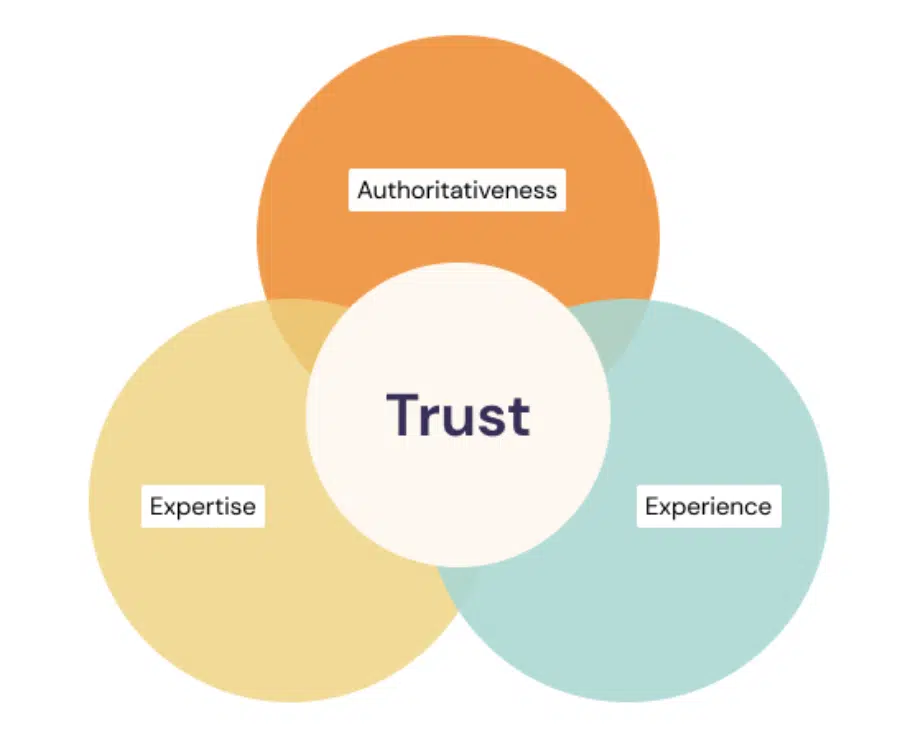
Put yourself in your audience’s shoes. If you have a medical concern or question, you want to go to a company that you can trust, right? By creating helpful, educational content, you establish your company as that trusted brand.
In the case of healthcare, you should go even further by backing each piece with accredited professionals. Optimally, you would have them author the piece, infusing their first-hand clinical experiences (there’s your first “E”) into the narrative. Each piece they byline should link to their bio on the site listing their credentials and explaining why they are a trusted expert (there’s your second “E”) on the subject.
If you can’t find a provider willing to write a piece of content, don’t fret—there are alternative options that can still help build your authority. For example, a telehealth client I worked with didn’t have providers that would byline content, but a medical professional would review each piece for factual and clinical accuracy. However, this review process wasn’t noted on their site. I asked them to include a tag that said “medically reviewed by [provider name]” and the date it was most recently reviewed to help support E-E-A-T efforts. Doing so helped build trust with their audience and contributed to ranking improvements.

3. Hone in on your topical authority
There are many aspects and nuances to every field, including healthcare. Where do you have unique health information and insights that you can offer?
As you create your SEO-optimized content marketing strategy, make sure you stay focused on the areas and healthcare services that you want to be known for. Don’t stray too far from the formula.
“My rule of thumb is to build a site for a user, not a spider.”
– Dave Naylor
Google’s SEO document leak in early 2024 shows that sitewide topical relevance matters. If you use generic messaging, your brand will never stand out. Stay focused on what you’re good at.
With that same telehealth client, I even saw that ranking in the SERPs was easier in other health-related topical authority areas once we owned one healthcare-specific area. You should be able to rank quicker in other related areas if you dedicate the time and resources to building topical authority in one core area first.
4. Gather multiple perspectives
Healthcare content marketing is more than a professional sharing advice with patients. You want to hear from multiple perspectives. (That’s why we have the classic “let me get a second opinion” line in so many medical situations, right?)
In the case of medical SEO, you can seek out multiple professional opinions, but in many cases, some of the best content can come directly from your patients.
Look for stories that reinforce your company’s success and what you’re able to offer your clientele or patients. Use things like reviews to build trust, make your brand more relatable, and turn your site into a trusted source in the online healthcare community.
5. User experience matters with SEO
Good website optimization goes beyond well-crafted content. Healthcare content needs to be practical. It is the last place you want to bury a lede or drag things down with sluggish load speed or complex navigation. It also includes things like interactions, mobile friendliness, and site architecture.
“Good SEO is paying attention to all the details that most bloggers ignore.”
– Ryan Biddulph,
If you want your healthcare website to attract organic traffic, you need to maintain a quality user experience (UX). This starts with technical SEO elements like page speed, load times, and image sizes.
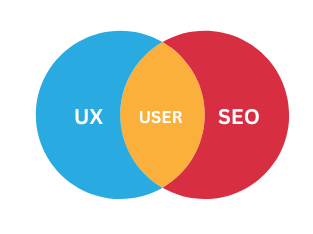
Good calls to action (CTAs) are also important for engagement. Provide intuitive navigation, easy-to-find information, and accessible-friendly options so that everyone who finds your content through the SERPs has a positive and insightful experience.
6. Optimize local SEO
Many healthcare operations are local. Hospitals serve geographic regions. So do doctor’s offices, dental practices, and urgent care clinics.
If you have a local aspect to your healthcare organization, you want to make sure it’s optimized to help potential patients closest to you find you. An urgent care center in Oakland, California won’t be able to help much if it’s the top result for someone with a medical emergency searching for local support in Miami.
You can improve your local SEO by including geographic information (like an address) across your website. You can also use Google Map Pack to ensure you show up in the local listings by geographic location, too. Claim your Google My Business listing, as well, and then fill in your information to encourage the search giant to target local search results to your site.
7. Invest in quality backlinks
As you build your healthcare website’s SEO through educational, high-quality on-site content, you also want to consider backlinks. These happen when a third-party site links to a piece of your content.
Good backlinks are best when they are on important keywords (called anchor text) and link to content that closely matches search intent. For instance, you could link to a CPR instruction page on the words “CPR manual” or something similar. “Sadly, much of the content being published is simply not worth linking to. 75% of it is getting zero inbound links. So forget the ‘more is better’ approach to content if you want links. Go with quality instead. Your content will generate links only if it is truly remarkable, as Seth Godin would say.”
– Brian Sutter
For the healthcare client I mentioned above, backlinks were a way for us to support the visibility goals for some important keywords. However, we weren’t just expecting backlinks alone to move the needle—we were most successful and saw the most significant increases in ranking overall when we executed a comprehensive onsite content strategy in tandem.
Once you have great content, look for digital PR opportunities to get your business mentioned and linked to on quality industry websites and publications. Getting backlinks from respectable healthcare websites boosts your credibility and can make sure you’re getting the most out of your SEO efforts.
What top experts are saying on top healthcare SEO techniques in 2026
Blake Davis
Blake Davis calls out out a major shift in healthcare SEO: if your content isn’t clear, structured, and trustworthy enough for AI systems to confidently reference, you’re already falling behind. For mental health clinics especially, authority and clarity now matter as much as rankings themselves.
Ruth Adeyemi
Ruth Adeyemi reinforces that the best healthcare SEO starts with patient psychology, not keyword tools. She’s pointing to a strategy built around symptoms, fears, and real questions—because that’s how patients actually search when they need care.
Damon Burton
Damon Burton’s work post is a reminder that SEO fundamentals still win, even in complex industries like healthcare. His results underline that consistent execution, technical discipline, and data-backed decisions outperform shortcuts every time.
SEO/GEO measurement for 2026
If you’re still measuring healthcare SEO with only rankings and sessions, you’re going to undercount wins—and miss problems early.
Our team looks at measurement model that reflects how discovery works now: part traditional search, part local, part AI answers, and part “zero click.”
We recommend tracking in layers:
-
Visibility layer: rankings for priority intents + Map Pack share of voice + branded search demand
-
Engagement layer: calls, form fills, direction requests, online bookings, click-to-call rate on mobile
-
Outcome layer: appointment completions (when you can), lead quality, service-line mix, CAC vs paid
-
AI layer: where you show up in generative results, what sources get cited, and whether the summary is accurate (locations, specialties, claims)
In practice, the teams that win treat measurement like a feedback loop. If AI answers are citing the wrong page, you fix the entity signals. If a location ranks but doesn’t convert, you fix the page experience and appointment path. If a service line is slipping, you look at topical coverage and internal linking—not “publish 10 more posts.”
That’s how you keep SEO and GEO tied to real patient demand, not vanity metrics
Frequently Asked Questions
For healthcare teams building sustainable search visibility in a highly competitive, high-trust category, these FAQs cover the most common next-step questions.
How is SEO used in healthcare?
Healthcare SEO helps providers strengthen brand awareness, increase online visibility, improve local search presence, and attract higher-quality search traffic. It supports patient discovery by making service pages and educational content easier to find in search results, especially for local needs like clinics, dental practices, and urgent care. Because results often take months, SEO works best when it’s aligned with clear business goals like visibility, traffic growth, conversions, or credibility.
Why is healthcare SEO/GEO so challenging compared to other industries?
Healthcare is highly competitive and often competes against established, industry-leading publishers and institutions, including major .org and .gov sites. It’s also YMYL (your money, your life) content, which search engines evaluate with extra care. With limited room to “win” broad queries, healthcare brands typically need sharper focus, stronger credibility signals, and consistent execution across content, technical performance, and local presence.
What is E-E-A-T content, and why does it matter for healthcare?
E-E-A-T stands for Experience, Expertise, Authoritativeness, and Trustworthiness. In healthcare, demonstrating credibility is essential because the topic can impact someone’s health decisions. Helpful, educational content builds trust, and credibility increases when information is clearly supported by qualified professionals. The goal is to make it easy for readers (and search engines) to see that the content is accurate, responsible, and grounded in real clinical knowledge.
How can a healthcare brand strengthen E-E-A-T if clinicians won’t write content?
If providers won’t byline content, a practical alternative is having a medical professional review each piece for factual and clinical accuracy. To reinforce trust, add a visible note such as “medically reviewed by [provider name]” along with the most recent review date. This approach keeps the content educational and credible while still showing that qualified experts are involved in validating information.
What does “topical authority” mean for medical SEO?
Topical authority means consistently covering the healthcare services and subject areas your organization wants to be known for, without drifting into generic messaging. Staying focused builds sitewide topical relevance and helps your brand stand out. Once a core area is well established, it can become easier to rank for related health topics, especially when the content strategy is organized around a clear specialty or primary service line.
How can multiple perspectives improve healthcare content marketing?
Strong healthcare content isn’t limited to a single professional viewpoint. Incorporating multiple perspectives can make content more relatable and trustworthy, including insights and stories from patients. Reviews and patient experiences can reinforce credibility, demonstrate outcomes, and help prospective patients see what the organization does well. This kind of trust-building content can support SEO by improving user engagement with the site and the brand’s perception.
What user experience factors matter most for healthcare SEO?
User experience supports SEO because healthcare content needs to be practical and easy to use. Key areas include fast load times, mobile-friendliness, clean site architecture, intuitive navigation, and easy-to-find information. Technical SEO elements like page speed, load times, and optimized image sizes help performance. Clear calls to action (CTAs) also improve engagement by guiding users toward the next step without friction.
What are proven strategies for improving Google Business Profile rankings for healthcare practices?
For local healthcare operations, local SEO is essential. Add consistent geographic information (such as your address) across your website and aim to appear in the Google Map Pack for nearby searches. Claim your Google My Business (Google Business Profile) listing and fully complete the information so search engines can confidently match your organization to local intent. This helps ensure the right patients in the right area find your practice.
Why do backlinks matter for healthcare SEO, and how should they be approached?
Backlinks are links from third-party websites pointing to your content, and they can strengthen credibility and visibility—especially when the anchor text aligns with relevant keywords and the linked page matches search intent. Backlinks are most effective when paired with a comprehensive onsite content strategy rather than treated as a standalone tactic. After building strong educational content, pursue digital PR opportunities to earn mentions and links from reputable healthcare websites and publications.
Using SEO/GEO to Shine Out in the Healthcare World
Healthcare is an important, high-demand field. However, there is a lot of competition on a local, regional, national, and even international level.
Effective SEO is a key tool that can make your healthcare business shine. It can help your audience find your content in their search results, click through, and then work their way down your online marketing content funnel.
If you aren’t sure what that funnel looks like, or you need help crafting an SEO strategy in the first place, feel free to reach out for a free strategy session.
If you need some more insights on what pricing looks like for SEO, check out our new SEO investment report.
Our team of growth marketing experts can help you manage the pitfalls of this high-stakes YMYL field, craft elite E-E-A-T content, and ultimately crush your healthcare marketing goals.