If “we need an SEO strategy” usually turns into “we published some blogs and hoped for the best,” you are not alone. Most teams have pockets of SEO activity, not an actual strategy that shapes channel mix, CAC, or pipeline. An effective SEO strategy is not a keyword list or a content calendar. It is a set of choices about where search can realistically drive growth, in what time frame, with the resources you actually have. These 6 steps will help you build exactly that, without pretending you have a 10 person SEO team.
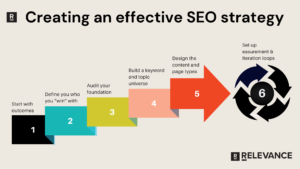
1. Start with outcomes, not keywords
SEO strategy starts when you answer “what business problem will organic search solve this year” in plain language. That might be lowering blended CAC, diversifying away from paid, capturing mid funnel education, or protecting brand queries from competitors. From there, define how SEO fits into your growth model: which products, which markets, which parts of the funnel. Before you open Ahrefs or SEMrush, lock in 3 to 5 measurable SEO outcomes and the constraints you are operating under: budget, content capacity, dev bandwidth, and time horizon for impact. Strategy is choice under constraint, not “everything search-related sounds nice.”
| Approach | What it looks like | Typical outcome |
|---|---|---|
| Task-first “SEO” | Random blogs, sporadic fixes | Noise, no clear impact |
| Goal-first SEO | Outcomes, constraints, then tactics | Measurable contribution |
| Channel-first SEO | “We just need more traffic” | Vanity traffic, weak ROI |
2. Define who you are winning with and how they search
You cannot build an effective SEO strategy around “our audience is busy decision makers.” You need specificity. Map your ideal customers by segment, job to be done, and triggers that make them search. Then, for each segment, write out the questions they type into Google at three moments: when they first feel the problem, when they are comparing options, and when they are trying to implement. Pair that with actual query data from Google Search Console and tools like AlsoAsked or AnswerThePublic. Your goal is a short list of real search journeys, not a 5,000 row export, so you can decide which journeys you will own and which you will ignore.
3. Audit your current reality and technical ceiling
Before you map opportunities, you need to know how much your site is holding you back. Run a focused technical review looking at crawlability, indexation, internal linking, mobile performance, and Core Web Vitals. Then overlay performance data from GA4 and Search Console: which page types already convert, which pages get impressions without clicks, where you have rankings on page 2 that could move with on page work and better links. Treat this as your “ceiling check.” If your site is slow, thin, and structurally confusing, no amount of new content will save you. Your strategy should include explicit technical bets, with dev effort sized and sequenced like any other growth project.
4. Build a keyword and topic universe that maps to the funnel
Now you can safely do keyword research. Start from your real search journeys, competitor analysis, and product roadmap. Group keywords into topics and map each topic to a funnel stage and a business outcome, not just search volume. A mid volume keyword with high buying intent that your sales team constantly hears will beat a vanity term every time. Decide which topics deserve deep clusters of content and which only merit a single strong page. This is where experienced teams differ from amateurs: they ruthlessly kill topics that are off thesis, too competitive for their domain authority, or misaligned with revenue, even if the search volume looks tempting.
You can sanity check priorities quickly with a short list like:
-
Relevance to product and revenue
-
Realistic ranking potential in 6 to 12 months
-
Clear intent and next action
-
Ability to create best-in-class content
5. Design the content, page type, and link acquisition plan
Strategy becomes real when you decide which page types will carry the load. That might be product and solution pages, use case hubs, deep educational guides, comparison pages, or programmatic templates. For each priority topic, define the primary page, supporting content, internal linking pattern, and required expertise for production. Then add a realistic plan for authority building. That can include digital PR, partnerships, product-led content that earns links, or targeted outreach.
In our work with companies like Nurx, long form educational content plus systematic authority building turned organic search from 4.8 percent to 28.7 percent of user acquisition, nearly a 6x increase, because it was tied directly to product and category strategy rather than generic blogging.
6. Set up measurement and an iteration loop you can actually maintain
An SEO strategy without a measurement loop becomes a quarterly slide that no one trusts. Decide on a small set of leading and lagging indicators: impressions and average position for target clusters, qualified organic sessions by page type, assisted and last click conversions, and contribution to pipeline or MRR. Build simple views in tools like Looker Studio, Mode, or your existing BI stack that align with how leadership already thinks about performance. Then commit to a review cadence, for example monthly at the squad level and quarterly for exec stakeholders. The goal is not to obsess over weekly ranking swings, but to learn which bets are working, which topics or page types outperform, and where to double down or cut losses. That learning loop is where SEO shifts from a black box to a reliable growth lever.
A durable SEO strategy is less about being a wizard with search tools and more about making honest choices: which customers you will win with, which problems you will solve in search, and which bets deserve your limited time. When you align SEO with business outcomes, build around real customer journeys, and give yourself a simple way to learn and adjust, organic stops being a side project and starts behaving like a channel that can stand next to paid, lifecycle, and partnerships. That is the kind of strategy that survives algorithm updates and budget reviews.