

When you’re writing for a brand, you’re not just trying to “sound good.” You’re trying to make someone feel something (confidence, curiosity, relief), understand something (what you do, why it matters), and then do something (subscribe, book a call, share, buy).
At Relevance, we’ve spent the last decade writing for brands that need content to pull real weight—PR pages that get quoted, SEO posts that actually earn clicks, and “AI-friendly” pages that still read like a human wrote them. The through-line: the best brand writing isn’t louder. It’s clearer.
We’ve also learned this the hard way. Plenty of smart teams ship “well-written” content that still doesn’t perform—because it’s written for the brand, not for the reader’s moment. The fix usually isn’t more creativity. It’s better technique.
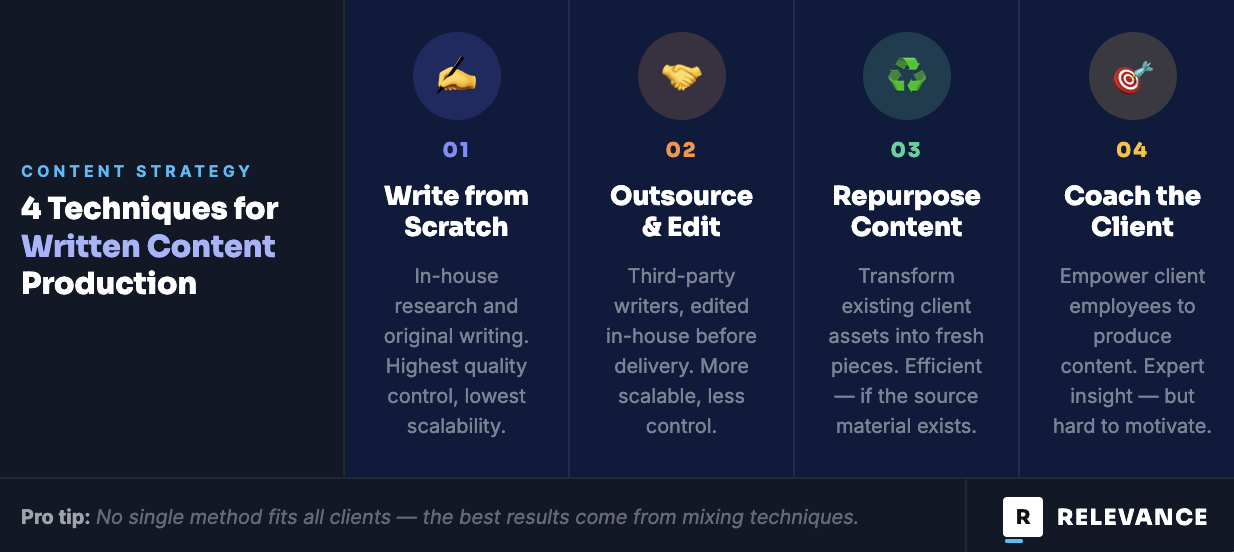
Below are four techniques we use to consistently create written content that sounds like the brand and moves the business.
1) Start with a “point of view,” not a voice
Most brand voice docs are a graveyard of adjectives: “bold, witty, approachable.” Cool. Still doesn’t tell your writer what to do when they’re staring at a blank Google Doc.
What works better is a point-of-view spine—a few sentences that explain how your brand sees the world, what you believe, and what you refuse to do. That POV becomes the invisible editor that keeps every page consistent.
Here’s what we mean in practice:
If your brand is in a crowded space (and you probably are), your writing can’t just be “helpful.” It needs a stance. Maybe you believe most category advice is outdated. Maybe you think the industry overcomplicates things. Maybe you’re the calm operator while everyone else is hype-driven.
Voice is style. POV is strategy. When you nail POV, voice becomes much easier (and way more consistent across writers).
2) Write to the reader’s “job,” then earn the next click
Great brand writing starts with a simple question: What is the reader trying to accomplish right now?
Not what keyword you’re targeting. Not what your company wants to say. What the reader is actually doing in that moment.
A few real scenarios we see constantly:
- Someone is comparing vendors and wants a “safe choice” they can defend internally.
- Someone is anxious and needs reassurance before they act.
- Someone is trying to look smart in front of their boss by finding a credible source.
- Someone is overwhelmed and needs a clean, confident next step.
When you write for that job, your structure changes automatically. Your intro stops being a generic definition. Your headings stop being fluffy. Your examples get more specific. And your CTA stops being “Contact us” and starts being the next logical step in the reader’s journey.
Match the reader’s moment, then guide them one step forward. Most content fails because it tries to do everything at once.
3) Use specificity as your unfair advantage (especially now)
Right now, “decent writing” is cheap. AI can produce it in seconds. That means the bar moved.
The content that stands out is packed with specificity—the little real-world details that can’t be faked without lived experience: the tradeoffs, the constraints, the “here’s what we saw,” the mistakes, the unexpected thing that worked.
This is also how you build trust fast. When a reader sees a specific insight that matches their reality, they relax. They stop scanning. They think, “Okay, these people know what they’re talking about.”
We lean on this constantly in SEO and PR-driven content. For example, in a campaign we ran for leadership author Michael Bungay Stanier, we didn’t position him as just another “leadership expert.” The writing and messaging centered on a sharper, more defensible niche—workplace relationship dynamics—then backed that positioning with credibility-first placements in premium business publications. That specificity is a big part of how you cut through a crowded market.
Specific beats clever. If you want content that performs, stop polishing sentences and start sharpening examples.
4) Edit like a conversion strategist, not a grammar cop
Most teams treat editing like cleanup. We treat it like performance tuning.
Because a piece can be “well-written” and still leak conversions through: unclear headlines, buried proof, meandering intros, generic CTAs, or paragraphs that never actually land the point.
When we edit brand content, we’re usually asking:
- Is the promise clear in the first 5 seconds?
- Did we earn trust before we ask for action?
- Does every section move the reader forward?
- Are we saying the true thing in the simplest way?
Here’s a simple edit pass we use when a draft feels “fine” but not effective:
- Cut the first paragraph if it’s just warming up
- Replace general claims with one concrete example
- Move the proof (results, quote, stat, named mechanism) higher
- Shorten any paragraph that tries to make two points
- Make the CTA the next step, not a generic ask
Editing is where brand writing becomes business writing. Clarity is the multiplier.
Consistency beats brilliance
Most brands don’t need a viral writer. They need a repeatable way to produce content that sounds like them, speaks to real reader intent, proves credibility quickly, and converts without feeling salesy.
If you apply just these four techniques—POV spine, reader job alignment, specificity, conversion-first editing—you’ll feel the difference immediately. Your content will read less like “marketing” and more like a helpful expert who actually does the work.
And in 2026, that’s the whole game.
